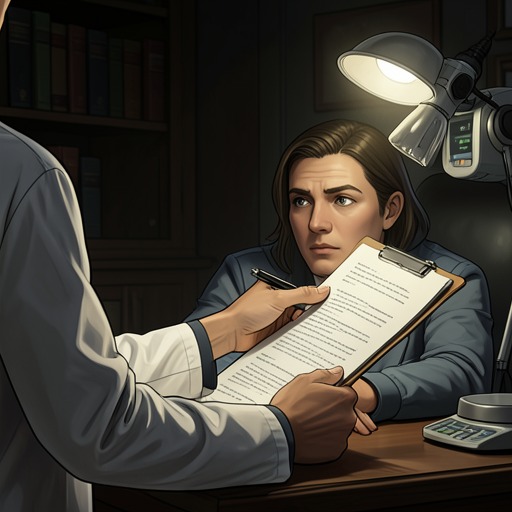
Paranoid psychosis
AsylumParanoid psychosis is the condition through which Edgar Stark’s jealousy becomes more than suspicion: ordinary events acquire the force of evidence, and a belief that survives the murder of Ruth Stark continues to govern his account of what happened. The novel presents a stark division between Edgar’s capacity to function and his inability to reconsider that belief. His apparent recovery does not resolve the danger, because the central delusion remains intact.
The Delusion and the Murder
About a year before his admission, Edgar became obsessed with the idea that Ruth was having an affair. She was described as quiet and sensible, modeled for him, and often supported him financially. His accusations were wild and violent; the marriage deteriorated until Ruth threatened to leave. One night, after they had been drinking, a terrible quarrel ended when Edgar bludgeoned her to death with a hammer. What he did to her afterward indicated the severity of his disturbance, though the account does not detail those acts at this point.
The novel makes clear that the delusion was not supported by substantial evidence. Edgar claimed to possess abundant proof of Ruth’s infidelity, but when questioned he offered commonplace occurrences and assigned them extravagant meanings. A flushing toilet, a stain on the floor, and a box of washing powder placed on a windowsill could all become significant to him. In a later interview, Peter Cleave describes the same pattern in other examples: Ruth opening a window as a motorbike passed, a crease in a pillow, or a stain on a skirt. Edgar’s reasoning has a ghostly resemblance to logic: if an affair existed, he reasoned, there must be signals and traces; he then converted banal incidents into those traces.
Recovery Without Insight
Edgar arrived at the hospital in profound shock. Peter initially expected grief and guilt to follow, but neither appeared in the way he anticipated. After a few weeks Edgar regained his equilibrium and became involved in hospital activities. He was intelligent and capable of functioning at a high level, and in most respects appeared to have recovered his sanity. Yet he showed no insight into why he had killed Ruth. The fixed point was his belief that her supposed betrayal had justified the murder.
His account contained a limited concession rather than a reconsideration. Edgar agreed that the killing should not have happened and regretted drinking so much, but maintained that Ruth’s taunts and insults had driven him to it. This distinction mattered to the clinicians: regret about the circumstances was not the same as recognizing that the accusation itself was delusional. Edgar remained unshakable on that central issue, despite the absurdity of the evidence he cited. Because he continued to regard the murder as justified, Peter and his colleagues did not consider him ready for release.
The persistence of the belief outlasted the more visible disturbance. Edgar had already been at the hospital for five years, and Peter expected he might remain for at least another five. During this period he could take part in activities and was given work restoring Max Raphael’s conservatory, but practical competence did not establish that the delusion had lifted. The contrast between orderly participation and an unrevised belief is central to the novel’s account of the illness: apparent stability and clinical safety are not treated as interchangeable.
Clinical Limits and Legal Consequences
Peter’s account also emphasizes the difficulty clinicians faced in understanding and treating paranoid patients. He explains to Stella Raphael that patients diagnosed as paranoids could be as dangerous as people with schizophrenia who had killed, even when they showed no obvious flicker of psychosis. The hospital did not medicate these patients; it tried to treat them, but with little success. Staff could manage and contain them without truly understanding what they were. Edgar therefore represents a problem that institutional routine cannot simply settle: he can work and appear composed, while the belief that preceded the killing remains beyond persuasion.
At Edgar’s trial, two psychiatrists testified that he suffered from a paranoid psychosis, and the court accepted the insanity defense. Peter admitted him to the hospital the following day. The legal finding addressed his responsibility for Ruth’s murder; it did not establish that he had subsequently abandoned the delusion or become safe to release. That distinction became publicly contentious when the press asked why a man who had killed his wife was allowed to leave the hospital daily and work in its gardens. The controversy exposed the gap between a court’s decision, a clinical judgment of continuing risk, and what the public could see of Edgar’s supervised routine.
The Delusion’s Reach
Edgar’s condition also shapes Stella’s involvement with him. During the summer, he worked with a parole group maintaining the estate grounds, and Stella often encountered him while picking vegetables or flowers. When the attendant, John Archer, was not present, she sometimes sat and talked with Edgar. She recognized her attraction but tried to dismiss the danger by telling herself that befriending a patient could do no harm. The ordinary setting of the garden thus brought her into contact with a man whose outward activity concealed an unresolved and violent delusion.
After Edgar’s case returned to the press, Stella was forced to confront the murder and the mutilation of Ruth’s corpse. The renewed attention brought scrutiny to the hospital and to the daily freedom allowed its patients. Years later, after Charlie Raphael drowned, Peter interpreted Stella’s intense attachment to Edgar as a particularly dramatic case of morbid obsessional sexual compulsion. He believed that, in the water, Stella had perceived Edgar rather than Charlie or Max. That is Peter’s clinical interpretation of Stella’s experience, not evidence that Edgar’s paranoid belief caused the drowning. The distinction preserves the novel’s wider contrast between a diagnosis applied to Edgar, the public’s response to his crime, and the competing clinical explanations offered for Stella’s behavior.