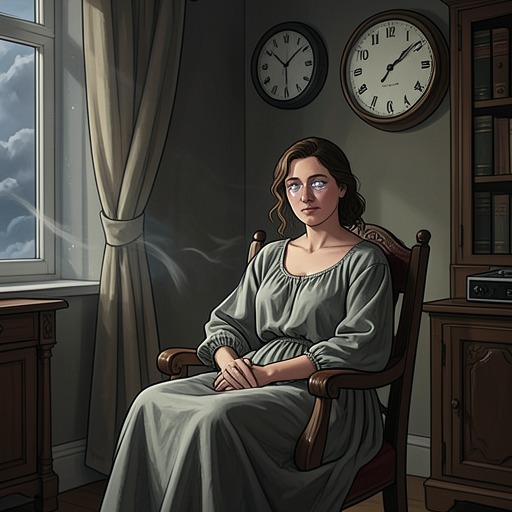
Stella’s dissociative state
AsylumStella Raphael’s dissociative state is a recurring alteration of perception and feeling through which danger and unbearable distress become strangely remote. It is most consequential at Cledwyn Heath, where she watches Charlie Raphael struggle in a pool without raising the alarm, but its significance cannot be reduced to that act: the narrative also shows her detached from a threatening encounter, from her own interrogation, and, later, from the feelings that Peter Cleave believes she must begin to face.
Perception and Detachment
During a frightening encounter with Edgar Stark, Stella examines her face in a compact and finds that both the object and her reflection seem far away. Her features appear too small to make out, as if the scene had been compressed and viewed from a distance. Edgar, too, seems tiny and remote, on the far side of an enormous room. This altered scale is not simply a description of what she sees: it accompanies her sense that she is detached from everything around her, even while she is thinking about escape and believes Edgar may murder her.
The scene turns on a sharp mismatch between the threat she perceives and the action that follows. Edgar has been sharpening a knife, but when he offers her a piece of orange, she eats it. The fruit makes the immediate purpose of his movement legible, yet it does not erase the preceding fear or restore ordinary closeness to the scene. Her voice sounds to her like it comes from an unknown source, toneless and metallic. Perception and response continue, but they seem to belong to a world seen at a distance rather than one in which she feels fully present.
Charlie’s Drowning
At Cledwyn Heath, this distance unfolds during a more devastating crisis. After walking away from the picnic group with Charlie, Stella sits back from the pool while he explores the shallows. She feels rain begin and describes black waves passing through her; the ground seems to undulate beneath her, and the air appears filled with fine black specks. The pool and Charlie are visible only through what seems like a heavy screen. These details establish the scene from within her altered perception before her conduct becomes the focus of others.
Charlie grabs at something in the water and loses his balance. As he moves into deeper water, struggles to stand, and shouts, Stella does not call out or move to help. She watches him, turns her head away, and brings a cigarette to her lips. When his head breaks the surface and an arm claws at the air before disappearing again, she turns aside once more. Her movements are described as tight, separate, and controlled; numbness creeps in as the waves of altered sensation begin to recede. Hugh Griffin arrives over the hill and rushes past her into the water. The narrative thus places the visible fact of her stillness beside the inward experience that makes the scene appear distant to her, without making that experience a rescue or undoing what happened.
Interrogation and Social Judgment
In the police station, Stella has no answer when asked why she did not shout after seeing Charlie in trouble. In the days that follow, Hugh’s account—that Charlie was screaming in the water while Stella stood smoking—shapes the response of those around her. The possibility that an alarm might have saved Charlie is disputed because of the distance from the hilltop to the pool; what horrifies people is that Stella neither made a noise nor moved. Their explanations collapse into a brutal alternative: she must be monstrous, or she must be mad.
Stella, meanwhile, experiences the questioning and confinement as if they were happening to someone else. She is numb and empty, detached from the woman moved between rooms and questioned repeatedly. She watches herself endure the hours both from within a barricaded inner refuge and from a point a few feet above and to one side. This divided vantage continues the earlier estrangement of perception, but now it attaches to her own body and to the consequences of Charlie’s death. When Peter visits unexpectedly and expresses his sympathy, Stella feels the first faint stirring of emotion she has known for days, and begins to cry. The response marks a break in the numbness, not an explanation of what she did at the pool.
Later Dreams and Peter’s Interpretation
Much later, Peter notices that Edgar no longer dominates Stella’s thoughts as he once did. Stella reports headaches at night after indistinct, terrifying dreams. She wakes in darkness with images still present and feels momentary panic at being unable to escape whatever threatens her. The dreams vanish within seconds, leaving only faint traces, a throbbing headache, and the sound of screaming in her mind. She minimizes the experience as a silly nightmare and asks only for aspirin.
Peter interprets the screams as the first stirrings of guilt that Stella has repressed, and believes she is hearing the cries of a drowning child. In his view, her recovery is beginning because she has let go of Edgar and is starting to deal with Charlie’s death; he expects the remaining work to be painful but relatively quick in its acute phase. These are Peter’s clinical judgments, not an account Stella herself can yet give: she cannot tell him more about the screaming. The contrast between her dismissal of the dreams and his interpretation leaves the return of feeling incomplete and uncertain.
Narrative Significance
Across these episodes, dissociation is rendered through particular disruptions: a face made too small to recognize, another person reduced to a distant figure, a dark pool screened from view, and a self observed from outside its immediate position. The same distance can accompany fear, numbness, and controlled action, but the scenes do not make those experiences interchangeable. At the pool, in particular, Stella’s altered perception and her failure to act remain in tension with the public judgment of her as monstrous or mad. The later dreams suggest that what could not be emotionally faced at the time may return in fragments, while Peter’s effort to interpret those fragments also shows the limits of what can be known from observation alone.