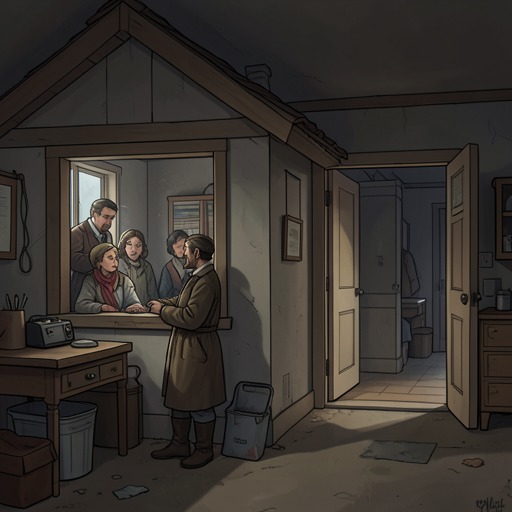
Cäcilia
AuerhausCäcilia is one of the young people who make the Auerhaus a shared home after Frieder leaves the psychiatric hospital. She joins the household partly to help care for him, but her story does not resolve into a simple celebration of communal loyalty: she gives up a privileged domestic comfort, later refuses to return when the group faces legal proceedings, and keeps her distance even in the narrator’s imagined account of their futures. Her changing place in the household makes visible both the force and the limits of chosen family.
Identity and Introduction
At school, Cäcilia is addressed as Frau Schreiner by Doktor Turnschuh. When he asks her to speak more loudly, the scene makes her habitual quietness conspicuous: her classmates do not tease or giggle as they normally might, and Doktor Turnschuh’s usual sharp head movement to set his hair strips back in place also fails to come. Cäcilia’s soft voice is not merely a personal detail; the unusual silence around her gives the moment a solemnity that departs from the school’s ordinary social rhythm.
The narrator first imagines moving in with Frieder as a way to escape the F2M2, his mother’s boyfriend. The prospect means no longer helping with the boyfriend’s paving, painting, and renovations, and no longer enduring his resentful silences and drinking. But the narrator worries that living alone with Frieder would mean carrying too much responsibility for someone who had tried to kill himself. Vera agrees to join, and Cäcilia becomes the third friend to move into the shared house.
Joining the Auerhaus
Cäcilia’s parents do not leave her choice unchallenged. They will not allow Vera to move in alone with two boys, so Cäcilia joins the group as well. The narrator cannot understand why she would leave: she has a large room, can watch television in the living room without being bothered, and, as Vera has heard from her mother, even has access to a swimming pool in the basement. This contrast gives her move real weight. Unlike the narrator, who is escaping a hostile home, Cäcilia does not appear to be driven away by a lack of space or material comfort.
She persuades her mother by arguing that Frieder has no chance of getting out of the hospital without her help. On moving day, Cäcilia stands beside the removal truck and quarrels with her mother while a mover carries out an ornate, glossy white bedroom dresser with curved legs and gold flourishes. Cäcilia insists that she does not need any of it. She wheels her bicycle out of the garage, lifts it onto the trailer, and climbs aboard the tractor with the others. Her mother runs after them with a long black case; Vera jokes that it is a machine gun, while Cäcilia says nothing in response to her mother’s questioning look. The scene makes the departure tangible through the contrast between the lavish furniture left behind and the bicycle she takes with her.
The first evening in the house is modest and provisional. The group sits around the kitchen table while the only cassette they can find plays too loudly for conversation. They twirl spaghetti onto their forks and bounce their knees; there is little to say because life together has only just begun. Cäcilia suggests that Frieder could learn an instrument, a small practical proposal in a household whose members are still discovering how to share ordinary time.
Care and the Meaning of Home
The house’s daily life develops around the knowledge that Frieder once tried to kill himself. The narrator describes a proper life full of talk at breakfast, lunch, and dinner, with all that talking serving, in effect, to keep watch over one of them. The group’s meals and conversations are therefore both domestic routine and a form of collective vigilance. Cäcilia is part of that arrangement, though the evidence does not assign her sole responsibility for Frieder or suggest that the others can reliably know what he intends.
That uncertainty is explicit when Frieder first gets permission to leave the hospital, in autumn, accompanied only as far as the park. The narrator is his escort, uneasy because Frieder is taking medication but the narrator still cannot know what he plans to do. At the park exit, Frieder says he wants to go into town, and the narrator’s panic becomes physically overwhelming. Cäcilia’s part in the household is framed by this larger fact: care is shared, but it does not confer certainty or control over another person’s choices.
Frieder later distinguishes wanting to die from no longer wanting to live. The narrator has difficulty understanding how someone could attempt suicide even while grasping the difference in principle. Cäcilia’s contribution to the group’s care belongs to this ongoing effort to live alongside an experience the friends cannot simply explain away. In this context, the Auerhaus is not just an alternative address; it becomes the place the narrator privately considers home. On December 24, the narrator is physically with family, but explains that home means family when speaking to outsiders and the Auerhaus when speaking to someone who belongs there. The narrator’s former room has gone to a sister, who has inherited the portable television. The shift in the meaning of home registers how the shared house has become a lived affiliation rather than a temporary shelter alone.
Separation and Legal Conflict
Cäcilia’s participation in the household eventually meets the demands of her own future. After police involvement, she returns to the kitchen doorway, prompting the narrator to think she may be moving back in. She says she has only come to collect her violin. She then clarifies that her parents are paying a lawyer to get her out of the case, and that the lawyer may put blame on the others to do so. Cäcilia stresses the word me, making the distinction between her defense and theirs audible.
She says that she will not come back to the Auerhaus because her defense depends on the judge seeing her as someone who got caught up in something. That, she emphasizes, is the lawyer’s account, not hers. She also has a place to study in America and needs a completely clean record. Her apology does not make the decision less consequential: to preserve her legal prospects, she separates herself from the people with whom she had built a home. Her parting observation that she can understand why they may not understand her leaves the conflict unresolved rather than presenting her choice as either betrayal or simple necessity.
The division has a concrete family dimension as well. Cäcilia’s father comes to collect her by car and says nothing; he does not look at the others. Frieder, Vera, Pauline, and the narrator walk back together. Vera remarks that if they ever really shot a politician or a factory owner, the police could now identify them immediately. Cäcilia’s departure thus occurs amid suspicion and the prospect of shared consequences, while the silent arrival of her father marks her return to a different family structure.
Later Life and Narrative Role
The investigations are ultimately discontinued after Cäcilia’s lawyer succeeds in getting all the proceedings dropped; Harry receives a warning for the cannabis found in his room. Cäcilia does not return to the shared house. The others remain at the Auerhaus until Harry finishes his apprenticeship, then move together to a run-down house in Cologne. The collective home continues beyond the immediate crisis, but Cäcilia’s absence remains part of its history.
In the narrator’s imagined end credits, an off-screen voice says that Cäcilia studied law and became a judge at a small district court in the Rhineland. She does not want to be filmed. That detail makes her later life both a continuation and a refusal: the legal future she protected by leaving the Auerhaus comes to pass, but she declines to appear in the narrator’s retrospective picture of what became of everyone. The narrator reflects that a simulated alternative ending produced only a healed world, without crashes, injuries, or deaths, and rejects that version as escapism; real landings are harder. Against that recognition, Cäcilia’s unfilmed future is not a neat reconciliation with the household but a boundary the story preserves. Her arc holds together acts of care and self-preservation, generosity and separation, without pretending that one cancels the other.