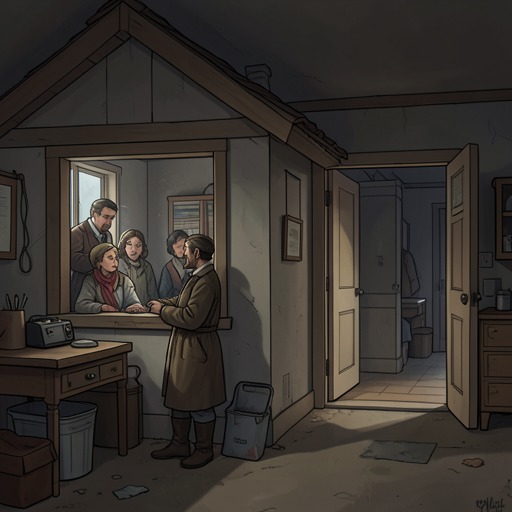
Frieder
AuerhausFrieder is the narrator’s longtime friend, a survivor of a suicide attempt whose presence makes Auerhaus both a home and a place of constant, uncertain care. He can explain difficult physics, think through questions of life and death, and take part in the group’s ordinary routines; none of those facts resolves the danger his friends are trying to understand. His story turns on the gap between wanting to die, not wanting to continue living, and choosing to remain alive for another day.
Identity and Background
Frieder and the narrator have known each other since fifth grade and become friends around ninth grade. They ride their bicycles to the quarry lake in summer, travel by bicycle to a cinema twenty kilometers away and back at night, and study together before exams. Frieder is particularly good at explaining difficult physics so that the narrator can understand it. Their friendship has a long, practical history, but before Frieder’s crisis they have never discussed sex, or even the absence of sex. When the narrator first tries to respond honestly, embarrassment leaves him with little he can say.
The narrator’s recollection of Frieder’s suicide attempt gives the crisis a specific, domestic setting. Frieder takes sleeping pills from his mother’s supply; because she changes her dose and does not keep track of how many remain, he can set pills aside. After collecting enough, he drinks a two-liter bottle of Imiglykos wine after school, goes down to the cellar, and swallows the pills with the last of the wine. He wakes with a tube in his throat. His father, unexpectedly home because he has received a load of wood to prepare for firewood, goes down to the cellar while searching for an axe and finds Frieder instead. The account connects the attempt not to a single explanatory statement, but to an ordinary household’s untracked medication and the chance circumstance that brings his father into the cellar.
The Shared House and Everyday Care
For the narrator, moving in with Frieder also offers a way to escape his mother’s unpleasant boyfriend. He would no longer have to help pave the driveway, paint the facade, or cover ceilings with ugly boards, nor endure the man’s continual complaints and anger. The decision to share responsibility for Frieder is equally important: the narrator wonders whether they can move in together with someone else, so that watching over Frieder will not fall entirely on him. Vera agrees to move in. The household begins, then, as both refuge from one family’s conflict and a chosen arrangement for caring for a friend.
On the first evening in the house, the group sits around the kitchen table while the only cassette immediately available plays loudly enough to prevent conversation. They turn spaghetti onto their forks and move their knees to the music. The scene’s near-silence is not evidence of distance so much as an ordinary beginning: there is not yet much to discuss. Against that small domestic image, the narrator later defines their life together as abundant talk at breakfast, lunch, and dinner. All that conversation carries a serious purpose: they are keeping watch over one of their own, someone who has tried to kill himself.
That care does not give the narrator understanding or control. Even after weeks, he cannot grasp how someone could actually attempt suicide, although he can partly understand the wish behind it. Frieder himself gives the distinction the narrator has struggled to articulate: he had not wanted to kill himself; he had only not wanted to live anymore. The sentence clarifies a difference without supplying a complete reason for his attempt. The narrator’s continuing confusion is part of the account, not a problem the house’s companionship can simply solve.
Living with Uncertainty
Frieder’s moods do not serve as dependable evidence of what he will do. At one point he grins tiredly as the others hurry to catch the bus to town while he insists on riding his bicycle. When the narrator reaches the classroom, the seat beside him is still empty, and he imagines Frieder hanging from a rope in the hayloft. He cannot stop the image. The narrator also understands that Frieder rejects the prospect of being struck by a train, describing the imagined outcome as raspberry mush. The details show how fear takes hold of the narrator’s attention: a routine absence becomes a possible death, while even the forms of death Frieder has rejected remain present in the conversation around him.
Later, when Frieder pauses beside the refrigerator with everyone watching, including Harry, the narrator cannot tell what he is about to announce. Perhaps Frieder will say he has decided never to try to kill himself again; perhaps he will say he intends to do it that day and ask the others to leave the house. The narrator cannot determine where he stands with Frieder: sadness might only mean tiredness, while apparent happiness might mean he has already made a decision. He recalls Frieder’s warning that, for someone who has thought constantly about suicide, an unexplained good mood can mean that a decision has been made. The warning makes cheerfulness no reassurance. The people closest to Frieder are left to interpret signs whose meanings may be opposite to what they appear.
The narrator asks directly whether he should rescue Frieder if he suddenly falls through ice or faces another immediate danger, or whether Frieder would resent being saved. After thinking for a long time, Frieder says the narrator may rescue him: he thinks he wants to be able to decide for himself. When the narrator observes that Frieder has imagined what life in the house would be like without him, Frieder answers that someone who asks such a question will not do it, because he believes he matters to other people. The exchange places a wish to retain choice beside an acknowledged attachment to the group. It gives the narrator a reason to hope, but not a guarantee that he can predict or prevent what Frieder may do.
Crisis, Guilt, and the Limits of Explanation
The narrator’s uncertainty culminates when Frieder admits what happened during the confrontation with the police: he deliberately tried to make the officer shoot him. In the moment of disclosure, the narrator strikes Frieder repeatedly, knocks him from his chair, sits on him, and berates him for putting the group in danger; Frieder turns aside and tries to throw him off, but does not fight back. The narrator’s response is neither calm comprehension nor a resolution of the crisis. It is anger at being drawn into a potentially fatal act that could also have endangered the others.
After Frieder dies by suicide, the narrator returns in memory to the first attempt and asks why Frieder wanted to die then. The more he had talked it over with Frieder, the fainter the question had become, until it nearly disappeared. He never found an answer. He also cannot establish whether the reasons behind the later, successful suicide were the same as those behind the attempt that failed. The narrative thus refuses to turn the first attempt into a key that explains the death: the two events are connected, but their motives remain inaccessible to the narrator.
Significance in the Narrative
Frieder’s story is shaped by the difference between an event and the explanation others seek from it. The pills, wine, cellar, and father’s unexpected search establish what happened during the attempt, but not a single definitive cause. In Auerhaus, meals, conversation, shared responsibility, and the prospect of rescue give Frieder companionship without making his intentions transparent. His own words distinguish not wanting to die from not wanting to live, while his later admission of provoking the police exposes how little even close friends can infer from visible moods or ordinary routines.
The narrator’s final reflection turns toward possibility rather than certainty. If he chose not to kill himself today, he could still do so tomorrow; if he killed himself today, he could not choose not to do it tomorrow. He prefers the choice that leaves more possibilities open. That reasoning does not explain Frieder’s decisions or undo his death. It shows what the narrator carries forward from knowing him: the recognition that the wish to die, the wish to be rescued, and the choice to postpone an irreversible act do not collapse into one simple answer.