F2M2
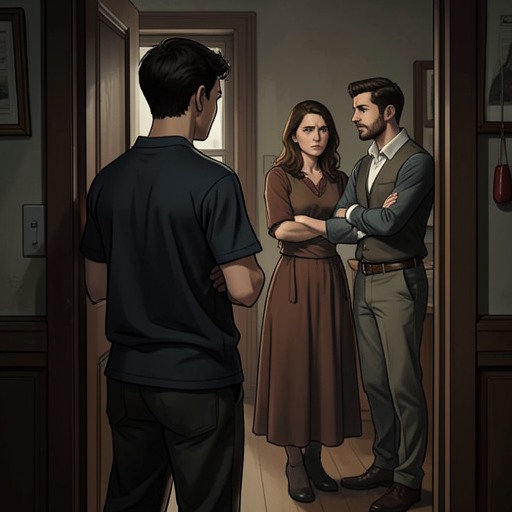
AuerhausF2M2, the narrator’s name for his mother’s boyfriend, is the domestic antagonist from whom the narrator seeks escape. A house-painter who continually alters the family home, he demands the narrator’s labor while telling him he is weak and clumsy; the resulting resentment helps turn moving in with Frieder into more than an act of friendship. It is a way out of a household where criticism, silence, and explosive anger govern everyday life.
Identity and the Name
The narrator first refers to the man as the unpleasant boyfriend of his mother, then gives him the deliberately insulting shorthand F2M2. Frieder initially tries out F2DM and then F2D2, but neither version works; he eventually adopts the narrator’s F2M2. The shared nickname is odd because the man is not Frieder’s mother’s boyfriend, yet the narrator accepts it as a small sign of kinship: Frieder’s use of the name feels a little like having another brother. The label thus does more than mock the man. It marks the alliance between the boys, while the narrator’s brief qualification that the arrangement is strange acknowledges the gap between their families.
F2M2 is a painter by trade, specifically a worker who paints walls rather than landscapes or people. He has learned to spread paint reasonably evenly and has also learned to hang wallpaper. The narrator’s dry distinction between making art and applying color keeps the description in his own sardonic register; it offers a picture of the man’s practical occupation without claiming a broader artistic identity for him.
The House and Its Work
F2M2 moved into the narrator’s home several years before the account and began remodeling it. Because he considered the rooms too high, he installed wooden false ceilings, one room after another. The narrator had to help with this work, although F2M2 repeatedly suggested that he lacked the strength and skill to do anything properly. During one task he asked for the carpenter’s hammer and challenged whether the narrator even knew what it was. The labor therefore carries a double pressure: the narrator is made responsible for helping improve a home in which he is simultaneously treated as incompetent.
The remodeling extends beyond the ceilings. The narrator expects that living with Frieder will free him from helping F2M2 pave the driveway, paint the façade, and nail unattractive boards over the ceilings. These tasks make F2M2’s influence tangible: his presence is not limited to arguments but is built into the narrator’s rooms and the work demanded of him. The house is continually being remade according to F2M2’s preferences, while the narrator experiences that work as an obligation imposed by someone who disparages him.
The narrator also responds to the household by withdrawing into his room. He buys a small portable television with a telescoping aerial using wages from work at a chicken farm. When home, he watches series, old films, and even black-and-white idealized family programs on Sunday afternoons. He stays with the television except when F2M2 again requires his help. The contrast is pointed: the narrator turns toward images of family life on a private screen while avoiding the demands of the family home around him.
Conflict and Domestic Atmosphere
The narrator’s resentment appears in a specific act of retaliation during a wallpapering job. He had canceled an appointment with Vera to help F2M2 paper the living room. When F2M2 discovered that he had miscalculated and there was not enough wallpaper, he drove off to buy more, leaving the narrator waiting in the room without either Vera or the materials. The narrator scraped away the old wallpaper, fetched brown paint from the cellar, and wrote an insult across the bare plaster: “ARSCHLOCH DUMM WIE 1m FELDWEG.”
He then began hanging the wallpaper over the writing. He did not want F2M2 to take the message personally when he returned, because that would lead to another major shouting match; the narrator describes F2M2 as particularly sensitive to criticism. The sequence makes the wall a temporary outlet for an anger the narrator expects he cannot safely voice. He conceals the insult beneath the very wallpapering he had been ordered to do, an act of defiance folded back into compliance.
The conflict is also shaped by F2M2’s response to the narrator’s relationship with his mother. If she spoke with her son for more than five minutes, F2M2 would take offense and punish her by refusing to speak to her for three days. He would then drink six or eight beers and explode. The account links household silence to later volatility: a prolonged, punitive refusal to communicate gives way to an outburst. The narrator presents this pattern as part of the reason he cannot bear living there, rather than as an isolated quarrel.
The narrator’s view of F2M2 is markedly different from that of his two younger sisters, who still like him. He imagines the older girl will come to hate him once she notices him staring at her as she enters puberty; he expects the younger girl’s gifts of dolls and sweets to preserve her affection for a few more years, until she too reaches the age when the staring begins. These are the narrator’s predictions, not reported confrontations, and his account gives no later confirmation of what either sister comes to think. Still, the contrast shows how he understands F2M2’s apparent generosity toward the younger child alongside his suspicion of the man’s attention to the older one.
Leaving Home and the Meaning of Home
When the narrator is fed up with F2M2, he sometimes runs away for a few days. On the occasion associated with an incident elsewhere in the story, he says he was absent and knew nothing about what had happened because he had left after becoming unable to stand his mother’s boyfriend. His departure is both literal escape and a recurring response to domestic pressure.
The prospect of moving in with Frieder offers a more durable way out. The narrator expects that he will no longer have to work on the driveway, façade, and ceilings, or endure F2M2’s complaints that he thinks himself superior because he attends secondary school and does not answer the man’s constant talk. When the narrator worries about the responsibility of moving in to watch over Frieder, he considers having someone else share it; Vera agrees to join them. F2M2’s role in this decision is indirect but decisive: escape from his household is one of the reasons the narrator accepts the move.
The novel later makes the meaning of home depend on who is speaking. On December 24, the narrator is “at home” with his family, but he explains that the Auerhaus is actually home to him; when talking to people who live there, home means the Auerhaus, while in conversations with outsiders it means his family’s house. His old bedroom has become one sister’s room, and she is watching the portable television he had bought with his own wages. The changed room and inherited television give material form to the life he has left behind, even as his language locates belonging elsewhere.
F2M2 is therefore significant less as a fully developed portrait than as the force that makes leaving home necessary for the narrator. His remodeling projects, demands for labor, belittling remarks, retaliatory silences, and drinking-fueled explosions define the household the narrator wants to escape. Against that home, the shared nickname with Frieder and the move to the Auerhaus suggest an alternative family built through chosen companionship rather than enforced domestic proximity.