Fried's sleeping pills
AuerhausFrieder’s sleeping pills are the means of his first suicide attempt and a recurring object through which the novel keeps the wish to die distinct from the wish to go on living. Taken with wine in a cellar, they lead to his discovery and survival; later, an empty packet in his room renews the danger without explaining it. The pills make a private crisis physically visible, but they never turn it into a problem his friends can read with certainty.
The First Attempt
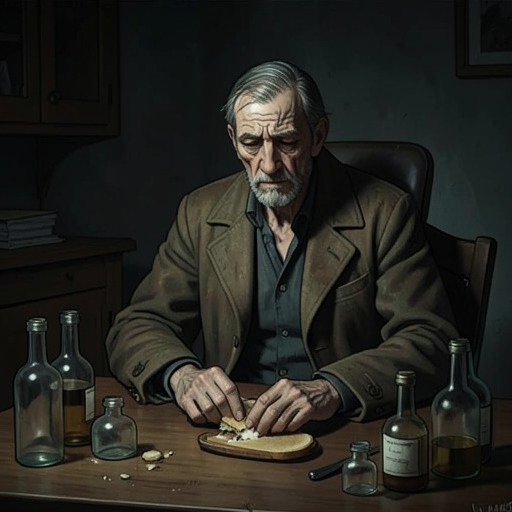
Frieder had taken the pills from his mother’s supply little by little. She took one every evening, sometimes two, and kept changing the dose, so she had no clear count of what remained. The theft could accumulate unnoticed in the disorder of an ordinary household routine. Once he had enough, Frieder drank a two-liter bottle of Imiglykos wine shortly after school, went down to the cellar, and swallowed the pills with the last of the wine.
He woke with a tube in his throat. His father, unusually at home rather than in the stable or at work for the post office, had received a load of wood and gone looking for the axe so he could make firewood. He could not find it and searched the cellar. The axe was not there; Frieder was. The attempt was thus discovered through an everyday errand, and survival depended on a search whose intended object was something else.
The narrator later told Frieder that the axe had saved his life. Frieder answered that the axe had not even been there and called it a useless axe. Their exchange turns the rescue into a bitterly comic coincidence, without making the pills or the attempt less grave. The object that had been missing becomes part of the story of how Frieder was found, while the pills remain the deliberate means of the crisis.
What Frieder Says About Wanting to Die
After the attempt, the narrator and Frieder talk about what had happened. Frieder eventually says, “Ich wollte mich nicht umbringen. Ich wollte bloß nicht mehr leben. Ich glaube, das ist ein Unterschied.” The distinction does not erase the fact that he swallowed the pills; it gives the narrator a way to understand that an act directed toward death need not arise from a simple, settled desire to die.
Frieder describes the moment of swallowing the tablets as one in which he felt fully present, self-assured, and as though everything were all right. He also says that if he could have felt that way all the time, he would not have taken them; to reach that feeling, he had to swallow them. The passage holds relief and danger together: a moment experienced as calm arrives through an irreversible act, not through evidence that the underlying crisis has passed.
He explains that after swallowing the pills, he had already made peace with the things he believed he would lose: finishing his Abitur, moving away, and finding out what it was like to sleep with a woman. In that state, these futures no longer mattered to him. The pills are therefore linked not only to an attempt but to a narrowing of imagined possibility. What disappears in the moment is the future in which school, departure, and intimacy might still happen.
The Empty Packet and Unreadable Risk
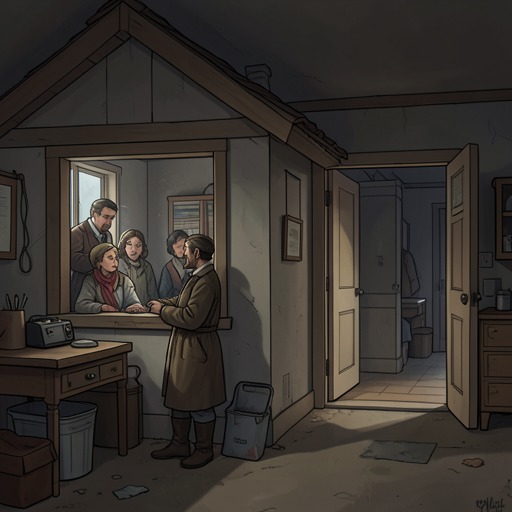
The pills return as an immediate warning when the friends hurry upstairs into Frieder’s room. An orange tree with small white blossoms stands on the windowsill; on the table are an empty glass and an empty packet of tablets. The bed is empty too. Outside, an ambulance is still flashing blue, while Seidel sits across the way on his tractor and looks up. Two men in bright red jackets emerge from the kitchen, one carrying a metal emergency case. Frieder is absent from the room, and the evidence left behind offers no easy account of what has happened.
That uncertainty shapes the narrator’s attention to Frieder’s ordinary behavior. On a morning when Frieder says he will ride his bicycle anyway, the narrator and Cäcilia and Vera hurry to catch the bus to town. In the third lesson, the seat beside the narrator is still empty. He sees Frieder hanging from a rope in the hayloft and cannot stop the image. The narrator says pistols are not available to them and that Frieder would not throw himself in front of a train; Frieder finds the imagined end disgusting and calls it “Himbeermatsch.” The pills are one known means, but knowing about them does not allow the narrator to predict what Frieder will do—or when.
At home, even Frieder’s mood is difficult to interpret. The narrator cannot tell whether a sad appearance means that Frieder is merely tired, or whether a cheerful one means he has already decided to die. Frieder once says that when someone who has thought about suicide continually becomes cheerful for no reason, that person has made a decision. The statement gives the friends a possible warning sign, but not a dependable way to distinguish recovery from danger. The pills have made one crisis visible; they cannot make later risk transparent.
Rescue, Responsibility, and What Remains Unknown
The narrator asks Frieder whether he should rescue him if he suddenly falls through ice or is otherwise in danger of dying. After a long pause, Frieder says the narrator may rescue him: he wants to choose for himself. When the narrator points out that Frieder has imagined what life in the house would be like without him, Frieder replies that someone who asks such a question will not do it, because he believes his presence matters. These exchanges refuse a clean division between wanting rescue and wanting death. Frieder’s words allow for intervention while insisting that his choice cannot be taken from him.
In another conversation, with a cigarette moving from mouth to ashtray and back, Frieder tells the narrator that if he tries again, the narrator will not be to blame. The reassurance is direct, but it cannot settle the question of responsibility for the people who are afraid of losing him. Later, Frieder admits that at the traffic lights he had deliberately provoked the policeman to shoot him. The narrator responds by striking and beating him, furious that Frieder had put them all in danger. The confrontation gives the earlier pills a wider context: Frieder’s danger is not contained in a single method, and his friends’ fear can turn into anger when he draws them into it.
After Frieder’s eventual successful suicide, Vera says that if an attempt fails, people may think it was done only to be rescued; the narrator observes that if it succeeds, it is called an accident. He reflects that the question of why Frieder wanted to die the first time had grown paler through their conversations until it had almost vanished. He still cannot answer whether Frieder had the same reasons in the successful suicide as in the earlier attempt. The pills preserve the fact of that first crisis, but not a final explanation of it. In the novel’s recollection, their meaning lies in that gap: an unmistakable act, a real rescue, and a motive that friendship and hindsight cannot fully recover.