Psychiatric isolated ward hospitalization status
AuerhausPsychiatric hospitalization in the novel is not a single episode of treatment but a contested condition: the locked ward can protect Frieder from immediate danger and provide structure, yet its restrictions and routines also risk eroding the person his friends recognize. Through the narrator’s visits, the ward’s material details, and Frieder’s movements between hospital and home, care and confinement remain closely intertwined rather than settling into a simple story of recovery.
The Hospital and the Locked Ward
The psychiatric hospital stands at the edge of town in an old, ornamented building that resembles a small castle. The forest that once surrounded it has disappeared, leaving the institution between a slaughterhouse, a crematorium, and a busy railway line. The narrator recalls that children used to bike out to the tracks searching for traces of people who had jumped in front of trains. The location makes the hospital’s protective role feel uneasy: a place for people in crisis sits beside a recurrent, lethal danger.
The ward’s boundary is made concrete by a glass door that remains shut and a large button the narrator must press to summon entry. Once inside, he finds patients in a common room: a television plays a silent black-and-white film, men play cards, and a woman collects cigarette tobacco from an ashtray into a tin. The scene gives hospitalization the texture of ordinary, repetitive time, but the locked door distinguishes the patients’ situation from the visitor’s. When the narrator worries that the small nurse could not restrain a patient, she reassures him that nobody there will hurt him and that the patients are no crazier than the staff. Then she points to the decisive difference: the staff have the key.
Frieder as a Patient
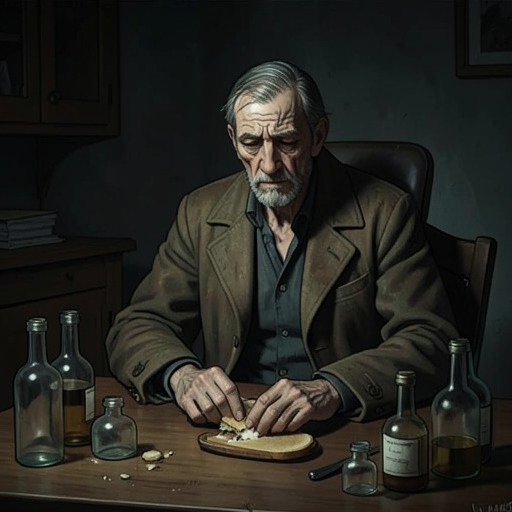
When Frieder first appears to the narrator inside the ward, he is wearing pajamas and slippers. He walks stiffly, his arms hanging heavily at his sides, and sits with such awkwardness that the narrator imagines “he” and “himself” as separate people. This changed bearing contrasts with the bear Frieder had been: a familiar, calming presence whose appearance could discourage trouble. The ward does not merely shelter him from danger; it also makes visible how illness and institutional life have altered the way he moves and appears to his friend.
Frieder is not free to leave the locked ward, and the narrator visits him every two days. They do homework together, and the narrator reports what has happened at school, carrying news from the outside into Frieder’s restricted daily life. Frieder’s days are also organized around conversations, medication distribution, and occupational therapy. In one activity, a colored plastic window decoration has melted into a wholly black disc. When the narrator asks whether it was left in the oven too long, Frieder explains that it is meant to keep the place from becoming too cheerful. The object turns a routine therapeutic craft into a dry comment on the emotional atmosphere of the ward.
A First Outing and the Visitor’s Boundary
In autumn, Frieder is allowed to leave the ward for the first time, but only under supervision and only to walk in the hospital park. The narrator is assigned to accompany him. Though he assumes permission means Frieder must be considered well enough, he does not know what Frieder intends to do and wonders whether he would be expected to catch him if he ran. Before they leave, Frieder takes an unusually long and elaborate leave of Pauline; she tells the narrator to bring him back safely, while the porter’s instruction is simply to return.
The outing changes the narrator’s experience of the institution. Until then, he had treated the park as a passage between the entrance and the ward, moving through it quickly because he was a visitor, not a patient or inmate, and could come and go as he wished. Walking there with Frieder, he feels that there is no difference between the patients and himself. He imagines that the locked ward and foggy park might now be his world, and pictures himself on a tree with a rope, caught by a forester and brought to the hospital. The thought does not establish that he has been admitted; rather, it exposes how thin the boundary feels when he shares the space under another person’s supervision.
Treatment, Routine, and Leaving
A doctor recommends that Frieder no longer live with his parents. Frieder tells the narrator that his grandfather’s house is empty, that his parents would allow him to move in, but that they do not want him living alone. The possibility of a home outside the hospital therefore emerges alongside the question of what kind of support he needs. The narrator eventually sees Frieder’s proposal that they live together as impossible to refuse, even while recognizing that caring for him would constrain his own life.
The narrator can also see reasons Frieder might remain in the hospital. Frieder could cycle to school in the morning, study in the school library, and return in the afternoon to doctors and nurses who might stop him from taking his life. The ward’s regular timetable, occupational therapy, and three punctual meals seem to offer stability; Pauline is there too. Yet the narrator fears that medication, soothing voices, the feel of the leatherette couch against bare skin, and the smells of cigarette smoke, cleaning products, and panic sweat will gradually reduce Frieder to a “stalking broccoli” or some other placid vegetable, safe because he has been made compliant. That grotesque image is the narrator’s fear, not a neutral account of treatment: the same schedule that might provide a foothold could also, in his eyes, diminish Frieder’s selfhood.
Unresolved Risk and the Meaning of Care
Frieder’s words resist any easy interpretation of his condition. He distinguishes wanting to die from not wanting to continue living: he says he did not want to kill himself, only not to live anymore, and believes there is a difference. Later, when the narrator asks whether he should rescue Frieder if he were suddenly in danger, Frieder says that the narrator may save him, because he wants to choose for himself. The exchange leaves room for both the desire to escape life and the wish to retain agency in a crisis; neither statement turns into a reliable promise of safety.
That uncertainty persists after Frieder is no longer confined to the ward. The narrator cannot tell whether a sad mood means Frieder is merely tired or whether apparent good humor signals that he has decided to die. Frieder has warned that someone who has thought about suicide for a long time may suddenly become cheerful after making a decision. Much later, after the successful suicide, the narrator wonders whether Frieder’s reasons were the same as they had been during his first attempt. By then the question has faded without an answer. The hospital’s routines and safeguards mattered, but the novel does not present hospitalization as a final explanation or cure: it shows the limits of what friends can infer, and the unresolved tension between protection, autonomy, and a wish not to go on.