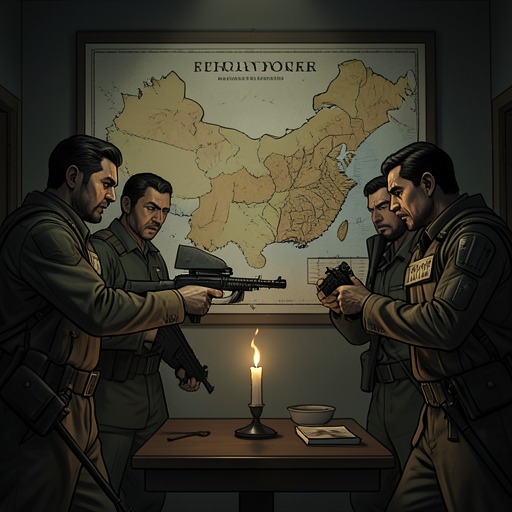
Ameristde Delegation
BabelThe Amherst Embassy was the second major British effort to negotiate expanded commercial access to China, and its failure became part of the historical chain that led from diplomatic frustration to the threat of war. In the novel, it is significant not merely as a failed mission but as evidence that British demands for free trade repeatedly collided with Qing restrictions, incompatible diplomatic expectations, and the British refusal to approach the Qing court on its own terms.
Causes and Diplomatic Context
The embassy arose from the British desire for broader trading rights. British merchants wanted free trade, additional ports and market access beyond the established arrangements at Canton and Macau, and the removal of restrictions on imports including opium. The Qing government, wary of foreign influence, preferred to confine British and other foreign traders to designated commercial spaces. This disagreement was not presented as a temporary misunderstanding: it reflected opposed ideas about sovereignty, commerce, legal authority, and the acceptable place of foreigners within the Qing order.
The Amherst Embassy followed the failure of the 1793 Macartney embassy. Lord George Macartney refused to kowtow to the Qianlong Emperor and returned without securing the concessions Britain sought. In 1816, Lord William Amherst likewise refused to kowtow to the Jiaqing Emperor and was refused admission to Peking altogether. The novel places the two embassies in deliberate sequence, showing that the Amherst mission repeated the central diplomatic impasse rather than resolving it.
Failure and Historical Consequences
The mission’s failure was remembered alongside the later Napier affair of 1834, which ended in an exchange of cannon fire and Lord William Napier’s death from fever in Macau. Together, these episodes formed a record of repeated British diplomatic defeat: three attempts to obtain broader trading rights had ended without the concessions British merchants wanted. By the time of the fourth delegation, British officials and trading companies treated these failures as proof that ordinary negotiation had reached its limits.
The Amherst Embassy also became part of the rhetoric used to justify a more forceful policy. In preparations for the 1839 negotiations, British representatives argued that the new delegation would succeed because translators from Babel would lead the talks and prevent further cultural miscommunication. That claim revealed both a genuine recognition of translation’s importance and an evasion of the deeper conflict: the British objective remained the opening of Chinese markets and the protection of commercial interests, while the Qing government continued to defend its laws and restrictions.
From Diplomatic Humiliation to Coercion
The embassy’s failure acquired renewed meaning during the dispute over opium. British trading interests, represented especially by Jardine, Matheson & Company, demanded legal permission to sell opium along the Canton coast, an apology for the treatment of their agents, and compensation for more than twenty thousand chests confiscated by Commissioner Lin. British advocates portrayed the confiscation as an unjust seizure of property and argued that it supplied grounds for war.
Commissioner Lin exposed the contradiction underlying that argument by asking whether Britain itself prohibited opium with the utmost strictness and severity. He insisted that foreigners trading with the Qing Empire must obey the Emperor’s laws, including the new law that foreigners bringing opium into China for sale would be decapitated and have the property aboard their ships confiscated. The contrast between the Amherst Embassy’s diplomatic failure and Lin’s legal position shows why translation alone could not settle the crisis: the dispute concerned which sovereign’s law governed foreign commerce and whether commercial property could override that law.
Place in the Road to War
By 1839, the failures of the Macartney and Amherst embassies and the Napier affair were being converted into an argument for military action. Commissioner Lin’s prohibition of English trade from Canton and the destruction of the opium stock allowed Jardine, Matheson & Company and their allies to claim that Britain had to defend its honour. The House of Lords began debating a military expedition, while the decisive material issue was silver: victory over China could open access to one of the world’s greatest reserves and strengthen British ships, weapons, and imperial expansion.
The novel therefore treats the Amherst Embassy as an early station on a progression from failed representation to informal imperial coercion. Diplomatic missions sought commercial concessions; trading companies turned losses into claims of national injury; translation institutions promised to repair communication; and military planners prepared to force open the market when negotiation did not deliver the desired result. The embassy did not itself produce the Opium Crisis, but its remembered failure helped furnish the precedent and grievance through which later demands were made to appear reasonable, urgent, and eventually enforceable by war.