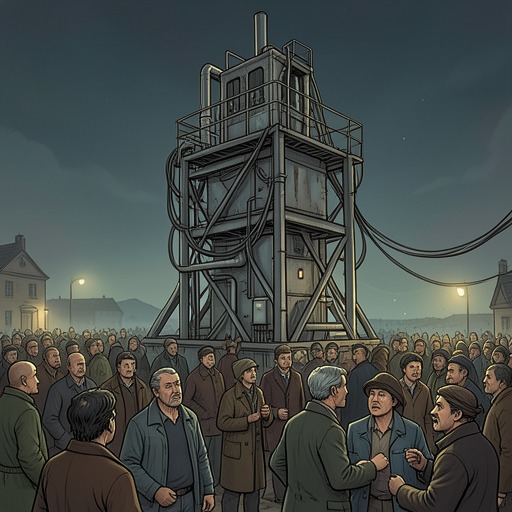
Babel Tower destroyed
BabelThe Destruction of Babel is the climactic act of revolutionary self-destruction in which Robin Swift chooses to destroy Babel, the Royal Institute of Translation, rather than leave its silver-working power available to the institution and the empire it serves. The event converts Babel’s central technological principle into a weapon against the tower itself: a chain reaction races through hundreds of silver bars, destroys the material foundations of translation, and brings the building down around Robin as he remains inside to complete the operation.
Decision and Stakes
Robin reveals the decision to Victoire Desgraves after concealing it from her because he does not want to make her share the burden and fears her response. His answer is stark: he intends to destroy the tower and himself. Victoire immediately understands that this is not merely an attack on a building. Robin’s imagined destruction extends from the vibrating silver bar once demonstrated by Professor Jerome Playfair to the tower and, beyond it, the country whose power depends on Babel’s work. The proposed act therefore joins personal sacrifice to institutional and political rupture.
Robin explains that the destruction can be achieved through a chain reaction. If one silver bar touches another, the effect transmits across the metal and continues until all the silver becomes unusable. The plan targets more than Babel’s architecture: the silver lining its walls, the library, the Grammaticas, the resonance rods, and the facilities that sustain the translators would all be lost. Even if the translators continued cooperating, the material system that gives their labor power would no longer exist.
Preparation and Departure
Before dawn, the conspirators arrange hundreds of silver bars into pyramids at vulnerable points throughout the tower. They place them around the base supports, beneath the windows, along the walls and bookshelves, and in substantial pyramids around the Grammaticas. Because they cannot predict the exact scope of the devastation, they prepare for the widest possible destruction and make it nearly impossible to salvage useful material from the ruins. The arrangement transforms Babel’s stored wealth and working equipment into a continuous circuit of ruin.
The preparation is also marked by separation. Victoire Desgraves and Yusuf leave an hour after midnight, and their farewells remain brief because the group fears that either too little or too much speech will make parting unbearable. Robin embraces Victoire and whispers safe travels, while Abel Goodfellow gives him a warmer, more direct farewell, squeezes his hand, wishes him good luck, and invokes God’s protection. These gestures place the coming destruction beside an intimate recognition of its human cost: the plan requires Robin to remain where the others have departed.
Triggering the Chain Reaction
Robin begins by placing his hand on the nearest pyramid, closing his eyes, and speaking the command “Fānyì. Translate.” The sharp ring that follows echoes through the room and up and down the tower. It is described as a siren’s screech and a death rattle, a sound that confirms that everyone has carried out the required duty and that no one has withdrawn at the final moment.
He repeats the command at each successive pile. The action is deliberate and nearly ritualistic, but its result is violently material. The floor shifts beneath him, the walls tremble, books tumble from their shelves, and something groans above him. The translation command no longer produces a usable act of linguistic or silver-working exchange; it initiates the conversion of Babel’s own network into an irreversible collapse.
Collapse and Immediate Consequences
The destruction expands from vibration to structural failure. The ceiling begins by releasing streams of pebbles and then whole pieces of marble, exposing planks and breaking beams. Shelves collapse, and sunlight enters rooms that previously had no windows. Robin looks upward and sees Babel falling inward upon him, with the sky visible beyond the ruined structure before dawn. The tower’s interior, once sealed and ordered around books, bars, and institutional knowledge, becomes open to the weather and to the approaching day.
Robin expects to fear the death awaiting him beneath roughly eight thousand tons of rubble. He considers whether death will be immediate or arrive in small increments as his hands and limbs are crushed and his lungs lose the space required to expand. Yet the anticipated physical terror is interrupted by an older memory. He has waited for death before, in a stale, hot room marked by paralysis and dreams of the end, and remembers the stillness and peace of that waiting. As the windows shatter, he closes his eyes and imagines his mother’s face smiling and saying his name.
Significance and Ending
The event produces a decisive value reversal. Babel’s silver, which has represented knowledge, translation, institutional prestige, and imperial capacity, becomes the mechanism of its destruction. The tower is not defeated by abandoning its technology but by forcing that technology to reveal its destructive potential and to erase the infrastructure that made Babel powerful. The same network that promises connection through translation becomes a chain of transmission that cannot be stopped once activated.
Robin’s sacrifice gives the collapse its final human measure. He does not merely order the destruction or observe it from safety; he remains inside, repeats the command, and accepts the possibility of being buried beneath the tower. His remembered mother provides the last image before the epilogue, placing private memory against the scale of institutional ruin. Babel falls as a building and as a system, while Robin’s final consciousness turns away from its marble, silver, and books toward a face and a name from before the tower.