Babel Tower Siege
BabelThe Siege of Babel is the decisive escalation of the Oxford resistance against the British invasion of Canton. It turns a strike and blockade into open warfare: workers and veterans barricade the streets around Babel, the British Army enters Oxford and withdraws only after granting forty-eight hours, and subsequent rifle fire converts the tower into a besieged stronghold. The event makes the connection between imperial policy and domestic class violence impossible to ignore, while showing that Babel’s privileges, defenses, translators, and students are all entangled in the material systems the revolt opposes.
Causes and Political Background
The siege grows out of the campaign to stop the invasion of Canton. Griffin Lovell explains that the central issue is silver: a British victory would give the British Empire access to an almost inexhaustible reserve, strengthening its warships, guns, and future imperial projects, while defeat would sharply restrict Britain’s imperial capacity. The House of Commons has not yet voted, and an antiwar faction led by Sir James Graham, Viscount Mahon, and William Gladstone still offers a political opening. The uncertainty matters because the resistance is trying to use division within Parliament, rather than treating military action as inevitable.
The imperial crisis has been prepared by commercial pressure. Babel translators are sent to help negotiate on behalf of private trading companies, foremost Jardine, Matheson & Company, after earlier British delegations failed through cultural misunderstanding and diplomatic arrogance. Mr Baylis frames the opium bond as an intolerable burden on foreign ships and calls the confiscation of more than twenty thousand chests of opium, worth nearly two and a half million pounds, an unjust seizure of British property. At the meeting with Commissioner Lin, he demands legal permission to sell opium, an apology, and compensation, while presenting free trade as the secret of national prosperity. The negotiation therefore reveals the structure that the siege resists: commercial demands are translated into national honor, then placed before Parliament as a reason for war.
Anthony Ribben supplies the resistance with a broader political strategy. Resources taken from Babel will not be enough to dislodge Jardine, Matheson & Company and other entrenched powers; the movement needs a coalition containing unlikely sympathizers. Its argument must appeal to the self-interest of men who might ignore justice or human dignity but understand profit. Anthony therefore recasts the conflict as a war of class rather than race, linking a poor family in Canton to an unemployed weaver in Yorkshire. The silver industrial revolution produces inequality, pollution, unemployment, and poverty across different regions while concentrating its gains in the hands of imperial power.
Barricades and the Army’s Arrival
The immediate beginning of the siege is both improvised and theatrical. One morning, barricades have appeared overnight around Babel, blocking High Street, Broad Street, and Cornmarket. They are not military fortifications in the conventional sense but accumulations of ordinary urban debris: upturned carts, sand-filled barrels, fallen streetlamps, iron grillwork torn from the fences around Oxford’s parks, and stone rubble gathered as evidence of the city’s deterioration. Their materials make the political point physically. The streets used to sustain orderly civic life have become the raw material of resistance.
Abel Goodfellow confirms his responsibility for the barricades with an almost playful smile, even as the structures obstruct nearly the entire width of High Street. His cheerfulness makes the blockade resemble a momentary inversion of authority: a worker who ordinarily occupies the margins now determines who may pass through the city. Yet the gesture is not merely symbolic. The barricades cut off the main entrance to Babel and establish a defensible perimeter around the tower.
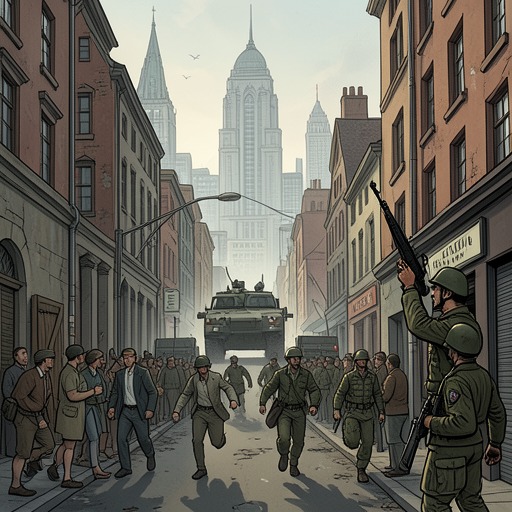
The British Army marches into Oxford that evening. Red-coated troops advance in a single column along High Street, but their arrival initially looks more like a parade than a punitive expedition. They move slowly among townhouses, shops, and cheering civilians, making way for people who cross the street. The polite surface of the procession contrasts with the force it represents: the state has brought armed troops into the university city, but the scene has not yet settled into the expected language of military occupation.
The confrontation changes when the commander reaches the first upturned wagon. Abel walks out alone to meet him. Their conversation begins civilly, then becomes heated, with both men gesticulating and the commander apparently close to arresting him. Abel finally retreats behind the barricade, walking backward as though expecting to be shot, while the commander returns to his battalion. To the observers’ amazement, the Army withdraws instead of attacking. The bargain is temporary rather than conciliatory: Abel reports that the commander has granted forty-eight hours to clear the barricades, after which the Army will remove them by force.
From Blockade to Siege
The forty-eight-hour ultimatum fails to end the resistance. As pressure from London grows, the conflict becomes increasingly militarized. Parliament does not reject the China invasion, so the public intensifies its pressure on the Army; at the same time, shortages and accidents spread, and London’s patience becomes strained. Westminster Bridge has not yet fallen, but the city’s failing systems and political deadlock make the streets around Babel feel like a front in a wider war.
The barricaders initially fight defensively. They reinforce their structures, maintain supply lines, and avoid provoking the guardsmen. That restraint disappears as soldiers begin firing regularly at them. The civilians answer with incendiary devices made from cloth, oil, and bottles, hurled at Army camps. They climb onto the rooftops of the Radcliffe Library and the Bodleian Library to throw paving stones and pour boiling water onto troops below. The struggle is strikingly uneven in appearance but unexpectedly durable in practice. Many of Abel’s men are veterans, discharged from an Army deteriorating after the defeat of Napoleon; they know where firearms can be found and how to use them.
Babel’s translators contribute materially to the defense rather than merely interpreting events. Victoire Desgraves, reading French dissident literature with urgency, composes the language match-pair élan-energy. Its associations with revolutionary zeal, the Latin lancea, throwing, and momentum help the barricaders’ projectiles fly farther and strike more accurately than ordinary bricks and cobblestones should. Language thus becomes part of the siege’s weaponry. The same institution whose linguistic expertise was recruited to smooth imperial commerce now supplies the rebels with a technical advantage against the state.
The tower’s magical defenses prove equally uncertain. When a window shatters beside Victoire’s head and a bullet is later found lodged in the shelf behind her, Babel’s supposed invulnerability is exposed as a fiction. Professors Letitia Price and Anand Chakravarti have replaced Professor Jerome Playfair’s wards, but they admit that their work is inferior and may not hold. Once soldiers with Professor Playfair’s inventions might reach the front door, the strike’s survival would be in doubt. The blockade has therefore become a siege because the defenders can no longer assume that the building itself will protect them.
Labor, Privilege, and Coalition
The siege gains force from a labor coalition that had seemed politically impossible. A hundred miles away, white British factory workers crowd Westminster Hall to protest a war in a country they have never visited. Their action confirms Anthony Ribben’s claim that imperial expansion can be opposed through the interests of those whom the empire impoverishes at home. The revolt is not an isolated Oxford disturbance but the most dramatic expression of a decade of anti-silver resistance, following the Rebecca Riots in Wales, the Bull Ring Riots in Birmingham, and Chartist uprisings in Sheffield and Bradford.
The coalition’s common ground is not identical experience but a shared structure of exploitation. Lancashire spinners work in silver-gilded British factories with cotton picked by enslaved people in America; Indian weavers have already endured conditions later imposed on British textile workers; a poor family in Canton and an unemployed weaver in Yorkshire are separated by geography but joined by the profits of empire. The imperial system distributes suffering across places so that no single community initially becomes powerful enough to overturn it. The siege marks the moment when that fragmentation begins to fail.
Robin Swift’s position within this structure is especially revealing. At Babel, students enjoy privileges unavailable to ordinary servitors: living expenses, room, board, and tuition are paid directly; they receive a stipend of twenty shillings a month and access to a discretionary fund that can even cover a gold-capped fountain pen if it can be presented as useful to study. Their libraries, lodging, food, and education are supplied so completely that they scarcely see the bills. The siege forces that sheltered arrangement into visibility by placing the protected university inside the same political violence that its wealth helps sustain.
The contrast reaches into daily survival. When the group later searches the Hampstead house, it finds no provisions because Mrs Piper has not stocked it. The house has a persistent rat problem, and the absence of perishables reflects the practical limits of care within an abandoned property. Ramy Mirza discovers only ground coffee and salt; the group drinks the unsweetened coffee because it has nothing else, accepting sharpened hunger in exchange for alertness. Elsewhere, years of reliable stipends have left the students unable to imagine how people find work once lodgings and meals disappear. The siege therefore strips privilege down to its material foundations: food, shelter, income, and the labor required to maintain them.
Open Warfare and Significance
The siege reaches its decisive threshold when the defenses no longer merely contain the Army but become the center of a sustained battle. Guardsmen are permitted to fire at individual scholars even when the tower itself is left alone. Robin Swift stops going outside after rifle fire interrupts a meeting with Abel, and Victoire Desgraves is forced to crawl with the others into the basement after a bullet breaks a window beside her. The building remains standing, but its inhabitants can no longer move through Oxford as students or scholars. Their bodies have become military targets.
The distinction between strike and siege is made explicit when the defenders recognize that Babel is not impenetrable. The barricades still hold, but the surrounding skirmishes turn bloody, and the Army’s superior force is checked by veterans’ knowledge, improvised weapons, the translators’ silver-working, and the city’s transformed architecture. Libraries become firing positions; streets become trenches; everyday objects become defenses or weapons. Oxford’s academic infrastructure is not outside the conflict but is repurposed by it.
The wider crisis finally breaks into open warfare when Westminster Bridge falls. The event is immediately linked to Oxford: the bridge’s collapse is followed by the declaration that Oxford has entered open warfare. At the tower, the scholars wait around the telegraph machine for news when a gunman announces that a girl has been killed. The siege thus ends its first phase not with a negotiated settlement but with the collapse of public infrastructure and the confirmation that civilian death has entered the center of the conflict.
The Siege of Babel is significant because it converts an argument about opium, Canton, and imperial policy into a visible struggle over who bears the costs of national power. The British Army’s retreat after Abel’s negotiation suggests that authority can be forced to bargain, but the subsequent gunfire demonstrates how quickly that limited concession gives way to coercion. The barricades expose the city’s accumulated decay; the tower’s failing wards expose the limits of institutional protection; and the labor coalition exposes the common economic logic joining colonial subjects, factory workers, and privileged students. By the time Oxford becomes a battlefield, the language of free trade and national honor has been revealed as inseparable from hunger, unemployment, militarization, and the struggle over silver.