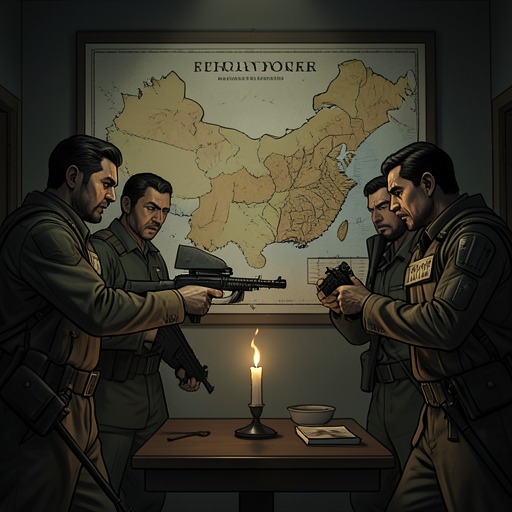
Macartney Embassy
BabelThe Macartney Embassy was the first of three failed British attempts to negotiate broader trading rights with the Qing court, and its remembered failure becomes a foundation for the later Opium Crisis. In the novel, the embassy is not merely an episode of diplomatic embarrassment: it is repeatedly recast by British merchants and officials as evidence that ordinary negotiation has failed, helping turn demands for market access into arguments for military force.
Causes and Diplomatic Purpose
The embassy took place in 1793, when British interests sought a wider commercial relationship with China. British merchants wanted free trade, open ports, access to markets beyond the islands, and the removal of restrictions on imports such as opium. The Qing court, wary of foreign influence, preferred to contain British and other foreign traders in Canton and Macau. The embassy therefore stood at the intersection of incompatible political and economic assumptions: British commercial expansion pressed toward access and deregulation, while the Qing state sought to regulate foreign presence and protect its own legal and social order.
The embassy’s importance lies partly in the way later characters remember it. While preparing the fourth British delegation to China, Professor Lovell explains that trade relations have been marked by mutual misunderstanding and suspicion since the end of the previous century. He presents the Macartney Embassy alongside the Amherst embassy of 1816 and the disastrous Napier affair of 1834 as a cumulative record of failure. The history supplies the background against which the new delegation claims to offer a different method: Babel translators will lead the talks, supposedly preventing further cultural miscommunication.
Course and Failure
The immediate cause of the embassy’s failure was Lord George Macartney’s refusal to kowtow to the Qianlong Emperor. The refusal became, in the British account, the decisive gesture that prevented the mission from obtaining anything. The embassy returned without broader trading rights, and its outcome was later remembered as a global punchline rather than a diplomatic breakthrough.
The episode also establishes a recurring pattern in the novel. British representatives interpret the failure as proof that the Qing court will not accommodate British demands, while the possibility that British demands themselves are incompatible with Qing law and sovereignty receives less attention. The embassy’s collapse is thus remembered through a one-sided political grammar: refusal by the Qing court is treated as obstruction, whereas the British envoy’s refusal to perform the required ritual is treated as principled resistance.
From Humiliation to Coercion
The Macartney Embassy becomes the first link in a chain that British negotiators use to justify increasingly forceful measures. The Amherst embassy of 1816 is described as having ended in much the same way after Lord William Amherst refused to kowtow to the Jiaqing Emperor and was refused admission to Peking. The Napier affair then culminated in an exchange of cannon fire and Lord William Napier’s death from fever in Macau. By the time of the fourth delegation, these incidents have been assembled into a narrative in which diplomacy appears doomed unless backed by power.
That narrative supports the interests of private trading companies, foremost Jardine, Matheson & Company. Their representatives want the Qing government to legalize the coastal opium trade, apologize for the treatment of their agents, and return or compensate them for the more than twenty thousand chests of opium confiscated under Commissioner Lin. British commercial demands therefore exceed a request for equal diplomatic contact: they seek legal protection for a trade that Qing authorities regard as criminal and destructive.
The comparison with the Macartney Embassy also exposes the changing scale of the conflict. The earlier mission failed through ritual and diplomatic confrontation; the later dispute is connected to opium, confiscation, naval planning, and the prospect of invasion. Letters found by Robin contain detailed war plans, including sketches of Canton’s docks, lists of Chinese naval vessels, accounts of coastal defenses, the positions of forts, and the number of troops stationed at naval bases. Professor Lovell is revealed not as a scholar accidentally caught in commercial hostilities but as one of the hawkish figures helping design the conflict.
Historical Memory and Imperial Logic
The embassy’s remembered failure helps British characters present war as a response to repeated insult rather than as an instrument for expanding trade. Anthony Ribben explains that the immediate task is to convince Parliament and the British public that war against China would harm Britain’s interests. Griffin Harley Lovell counters that the opium-burning crisis has brought matters to a head and that Jardine, Matheson & Company are using the hostility to demand action in defense of British honor. The House of Lords is already debating a military expedition, although Parliament remains hesitant about committing resources to a distant and unprecedented war.
Beneath the language of honor lies the material attraction of Chinese silver. Defeating China would give the British Empire access to the world’s greatest reserve of silver, which could make warships sail faster and guns fire farther and more accurately. London is portrayed as a city whose mechanical heartbeat depends on silver, while its colonial trade moves tea, cotton, tobacco, and manufactured goods across the world. The Macartney Embassy’s failure therefore acquires retrospective significance: a diplomatic setback is absorbed into an imperial system already hungry for markets, resources, and technological advantage.
Significance in the Novel
The Macartney Embassy functions as both historical precedent and ideological evidence. It demonstrates the limits of diplomacy when one side treats commercial access as a right and the other treats foreign trade as a regulated privilege. Later British actors invoke the embassy to claim that misunderstanding, rather than imperial ambition, caused the breakdown; yet the subsequent demands for legalized opium, compensation, and unrestricted trade reveal that the conflict is also about forcing Qing law to yield to British commercial power.
Its place in the novel’s larger design is especially pointed because Babel’s translators are recruited to prevent another failure of communication. Translation is presented as a possible remedy for diplomatic misunderstanding, but the embassy’s legacy shows that accurate language cannot by itself reconcile incompatible interests. Even when the words are conveyed precisely, British merchants still demand that China accept opium, surrender regulatory authority, and submit to the consequences of confiscating British cargo. The Macartney Embassy thus foreshadows the central contradiction of the later mission: translation may clarify what each side says, but it cannot make coercive demands mutually acceptable.