Unemployment
BabelUnemployment is a central human cost of the silver industrial revolution. In the world of the novel, silver-working makes factories, agriculture, transport, and imperial power more efficient, but that efficiency is achieved by displacing the people whose labour those systems once required. The resulting loss of work produces poverty, anger, protest, and political instability, while exposing the contradiction between claims of progress and the suffering needed to sustain it.
Mechanization and the Loss of Work
The immediate explanation offered for unemployment is technological replacement. During a lesson in Etymology, Professor Richard Linton Lovell dismisses protesting workers as riffraff, drunkards, malcontents, and people incapable of expressing themselves except by shouting in the street. His contempt rests on the belief that the labour they performed had become redundant and should have been mechanized long before. Weaving, spinning, carding, and roving, in his account, belong to an obsolete economy; workers displaced from those trades should simply learn skills that the new order considers useful.
That argument is reinforced by the extraordinary industrial achievements attributed to silver-working. Kay’s flying shuttle, Arkwright’s water frame, Crompton’s spinning mule, and Cartwright’s loom have enabled factories to operate with only a quarter of their former workers. Silver-working therefore appears as a machine for converting technical ingenuity into unemployment: it increases agricultural and industrial productivity while removing the labour that made older forms of production possible. The people excluded from the new economy are told that their exclusion is evidence of progress rather than a political choice about who should bear its costs.
Poverty Behind the Promise of Progress
The wider consequences make unemployment inseparable from the social crisis of industrial Britain. Silver-powered machines rapidly replace artisanal labour, yet prosperity does not spread through the population. Instead, the country enters an economic recession, the gap between rich and poor widens, rural agriculture declines, and men, women, and children move into cities in search of factory work. Those who find employment often endure exhausting hours and fatal or disabling accidents; those who cannot find it face poverty without any reliable route into the promised future.
The New Poor Law of 1834 intensifies this vulnerability. Designed chiefly to reduce the cost of poverty relief, it withholds assistance unless applicants enter workhouses whose deliberately miserable conditions are intended to deter dependence. The system treats unemployment as a burden to be disciplined rather than as evidence that the economy has failed its workers. Professor Lovell’s language of human progress is consequently set against an environment in which the new jobs he recommends do not materialize and the main beneficiaries are people already rich, or the few who are sufficiently cunning or fortunate to become so.
The novel also shows that unemployment is embedded in the material infrastructure of daily life. Silver rods at Babel form a central network whose resonance sustains linked bars throughout England; the centre supplies power to a dependent periphery. That same system supports factories, railways, sewage, lighting, agriculture, and the ordinary conveniences of modern cities. When silver-working is interrupted, the danger is not merely that individual trades will lose employment. The entire network begins to fail, revealing how industrial livelihoods and urban survival have been organized around a technology controlled by a narrow institution.
From Industrial Injury to Collective Resistance
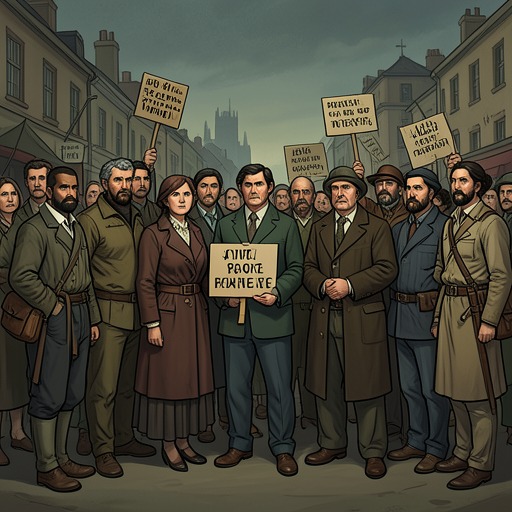
The workers’ protests are initially misunderstood by Robin Swift and the other students, who have absorbed Professor Richard Linton Lovell’s description of strikers as lazy and undeserving. Their understanding changes when the workers explain that the dispute was not simply about silver. It concerned wage cuts, shoddy work, women and children confined all day in hot, airless rooms, and untested machines whose speed made injury inevitable. Unemployment is therefore part of a larger continuum of labour insecurity: even those still employed can be impoverished, endangered, and treated as disposable by the same industrial system.
The political significance of that connection emerges as opposition to the war in China gathers strength. A hundred miles away, white British factory workers crowd Westminster Hall to protest a war in a country they have never visited. Their action links domestic unemployment to imperial policy. Earlier disturbances, including the Rebecca Riots in Wales, the Bull Ring Riots in Birmingham, and Chartist uprisings in Sheffield and Bradford, had been presented as isolated outbreaks. The new alliance reveals them as related responses to a common structure of coercion and exploitation.
Anthony Ribben argues that this connection could become the basis of a coalition. The fate of a poor family in Canton is tied to that of an unemployed weaver from Yorkshire because neither benefits from imperial expansion, while companies and the powerful accumulate the gains. He insists that an effective coalition must appeal to the self-interest of men who may reject justice or human dignity but can still be persuaded that an empire founded on pyramids of silver threatens their profits. Unemployment thus becomes a potential bridge across racial and geographical divisions, even though forming that bridge requires turning a debate apparently about opium and China into a conflict over class.
Public Evidence and Political Consequences
The argument about industrial unemployment proves more persuasive in public debate than arguments focused only on China because its effects are immediate and legible to ordinary Britons. Newspapers publish accounts of factories in which children inhale coal dust, workers lose fingers and toes to silver-powered machinery, and girls are strangled when their hair catches in spinning machinery and looms. Peter Gaskell’s 1833 study, The Manufacturing Population of England, supplies researched evidence of the moral, social, and physical damage caused by silver-working, while the Spectator depicts emaciated children crushed beneath the wheels of the silver revolution.
These reports make unemployment visible as part of a system rather than a private misfortune. The industrial economy produces both the absence of work and the degrading conditions offered as its substitute. A country may claim that mechanization creates efficiency, yet the evidence circulating through the press shows that its wealth depends on underpaid labour, dangerous machines, child exploitation, and the abandonment of those whom technology has displaced.
The issue also changes the strategic balance around the proposed invasion of Canton. Griffin Harley Lovell states that preventing the invasion is urgent because victory would give the British Empire access to an almost limitless supply of silver, whereas defeat would cause Britain’s supply to dry up and its imperial capacities to contract. He identifies an antiwar faction in the House of Commons, including Sir James Graham, Viscount Mahon, and William Gladstone, and recognizes that opposition to industrial exploitation may create political pressure against imperial war. Unemployment therefore becomes part of the argument that domestic workers and overseas conquest are joined by the same economic logic.
Collapse, Exposure, and Meaning
The fragility created by unemployment and industrial dependence becomes physically visible when Magdalen Tower falls. Its supports had relied on silver-facilitated engineering since the eighteenth century, and Babel scholars were supposed to maintain them every January and June. After Professor Playfair is removed from the institution and his maintenance notes become inaccessible, the upcoming appointment is forgotten. The collapse shows that systems which appear permanent depend on specialized labour, institutional memory, and regular maintenance; when those responsibilities are disrupted, a local failure can become a civic disaster.
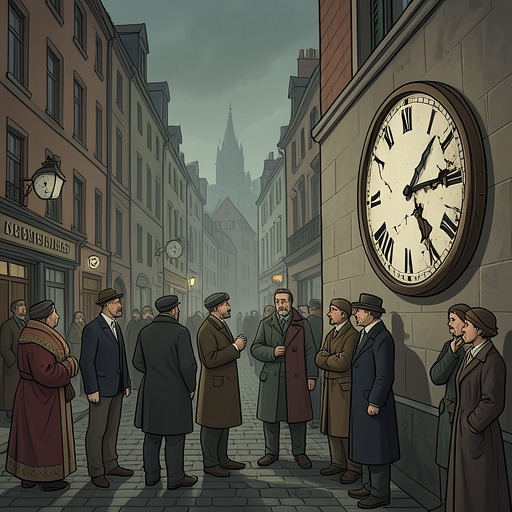
The consequences spread rapidly. Bell-tower clocks stop at 6.37 in the morning, sewage becomes an unmoving mass of sludge, and Oxford’s lamp-posts fail until High Street lies in darkness. The same network that promised modern convenience also creates cascading vulnerability. In London, the stakes are even larger: silver powers ice-making machines, breweries, flour mills, locomotives, railways, water systems, and the machinery of spinning, weaving, carding, and roving. If those systems stop, Britain’s textile industry collapses and the countryside faces possible starvation. Regional centres in London, Liverpool, Edinburgh, and Birmingham can provide only a temporary substitute, especially because they lack Babel’s maintenance ledgers.
The response is militarized as well as political. The British Army marches into Oxford, while the strike and the threat to silver infrastructure force the state to confront workers not as an irrelevant mob but as participants in a crisis affecting the whole country. Yet the novel’s final emphasis is not that unemployment is solved. It is that the industrial order has made exploitation widely distributed and responsibility narrowly concentrated. The silver industrial revolution takes a little from many places, separating the injuries of English workers, colonial labourers, enslaved people, and poor families so that no single community initially bears enough of the burden to overturn the system. Unemployment becomes decisive when those separated injuries are recognized as one structure and begin to act together.