Poverty
BabelPoverty is a structural condition that determines who receives security, education, food, and a future, rather than a private failure of effort. In the novel it appears first as the fate awaiting Robin Swift in Canton and later as the hidden cost of London’s and Oxford’s silver-powered prosperity. Its most decisive function is to connect individual vulnerability to imperial economics: Robin is rescued from destitution by an institution that fully supports him, while families, factory workers, displaced labourers, and students without stipends must bear the material costs that make such protection possible.
Poverty as Inherited Vulnerability
Professor Richard Linton Lovell presents poverty to Robin as an almost inevitable future. With Robin’s mother and grandparents dead, his father unknown, and no extended family available to help him, the boy has no money and no dependable social protection. Professor Richard Linton Lovell predicts that he may spend several years begging or stealing before seeking work on the docks, and that even survival into adulthood would offer little beyond backbreaking labour on ships. The prediction is delivered without visible emotion, making poverty sound less like a personal tragedy than a socioeconomic calculation: without intervention, disease, starvation, precarious labour, and early death form the expected sequence.
Professor Richard Linton Lovell’s offer therefore functions as both rescue and incorporation. Robin is promised room and board at the professor’s estate, an education in Latin, Greek, and Mandarin, and an easy life until he can support himself. In exchange, he must apply himself diligently to a curriculum designed by his benefactor. The arrangement protects Robin from immediate destitution, but its language resembles a business proposal more than an act of familial affection. Education becomes the mechanism through which poverty is escaped, while dependence on an elite institution becomes the price of escape.
Urban Wealth and Unequal Survival
London makes poverty visible as the underside of industrial power. Robin encounters a city whose silver economy produces financial dominance, technological expansion, theatres, balls, luxurious buildings, and mechanized transport, while the profits remain radically unequal. The same London that serves as the world’s leading financial centre contains teeming slums around St Giles. Reformers, abolitionists, feminists, socialists, and political radicals contest the city’s future, yet conservative landed interests resist change. Beneath these arguments, silver recurs as the material basis of finance, manufacturing, transportation, roads, housing, agriculture, and imperial ambition.
The city’s wealth is also sustained by global extraction. At the Port of London, ships carrying tea, cotton, tobacco, and British goods wait amid the colonial trade, with silver embedded in their masts and crossbeams to make them faster and safer. Silver moves through London like an industrial bloodstream, but the prosperity it supports does not circulate evenly. The city is therefore both rich and starved: its abundance depends on systems that produce deprivation elsewhere and leave large parts of its own population without security.
Robin gradually learns to read this contradiction through ordinary life. English food introduces him to another hierarchy of resources and status. He misses the porridge, steamed buns, dumplings, and vegetables of Canton, while the English diet he encounters relies mostly on salty and unseasoned dishes despite the country’s profits from the spice trade. Potatoes are considered unsuitable for important company even though Robin enjoys them, and silver-gilded dishes conceal the means by which food is kept warm. These details show poverty operating not only through hunger but through distinctions about what may be eaten, displayed, or served to people of different rank.
Institutional Protection and Its Cost
Babel’s students inhabit a protected economic enclave. Because Robin and his fellow Babblers are affiliated with the Institute, their room, board, and tuition are paid directly by Babel. They do not serve food in hall or clean tutors’ rooms like other servitors, receive twenty shillings a month, and can draw on a discretionary fund for course materials. Even an implausible claim that a gold-capped fountain pen would aid their studies might be enough to secure institutional payment. Their privilege is material before it is symbolic: libraries, lodging, meals, education, and spending money are arranged so completely that the students scarcely see the bills.
The arrangement also makes their later vulnerability easy to overlook. When graduation approaches and the students imagine leaving Oxford, they realize that their stipends will disappear. Outside the university, they would have to pay for lodgings and meals, yet they possessed enough money to survive for only several months. Their years of reliable support had taught them to forget the costs of ordinary life and had left them without a practical understanding of employment. The question of how other people find work becomes unexpectedly difficult, since apprenticeships require both training and money. Babel has enabled their education while insulating them from the social reproduction of poverty that governs everyone outside it.
That insulation is reinforced by food and domestic labour. At the Hampstead house, the group finds nothing substantial to eat because Mrs Piper has not stocked provisions. A persistent rat problem makes storing perishables difficult, while Professor Richard Linton Lovell refuses cats and Mrs Piper dislikes leaving food vulnerable. The students find only ground coffee and salt, drink the bitter mixture without sugar, and remain hungry but alert. Even in a house associated with comfort, survival depends on the often invisible planning and labour of a domestic caretaker; once that support is absent, educated and privileged young people quickly discover how little they can provide for themselves.
Industrial Progress and the Poor
The silver industrial revolution intensifies rather than resolves poverty. Silver-powered machinery replaces artisanal labour, but the result is recession, a widening gap between rich and poor, declining rural agriculture, and mass movement into cities. Men, women, and children work unimaginably long hours in factories, suffering mutilation and death in mechanical accidents. The New Poor Law of 1834 offers relief only through workhouses designed to be so miserable that applicants will avoid them. Progress, in this context, promises enlightenment while producing punitive institutions and insecure employment; the displaced workers whom Professor Richard Linton Lovell imagines finding new jobs often have nowhere to go.
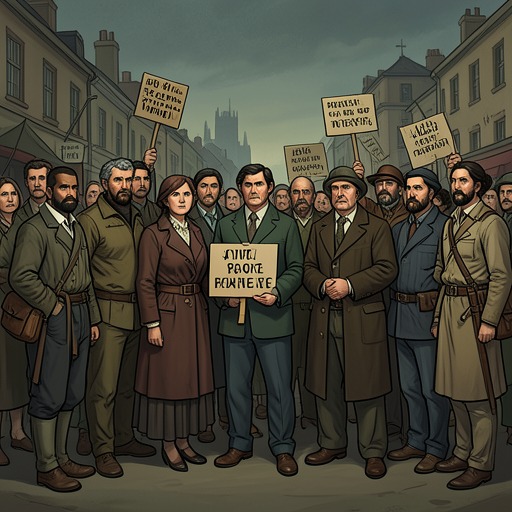
Robin’s encounter with a family begging on Woodstock Road gives this process a face. On a stormy night, he sees a father, two small children, and the family’s tin mugs held out for alms. The children wave to him, and their pale, rain-streaked faces persuade him to give them several pennies. Robin then recognizes the father as one of the men who had screamed obscenities at him when he entered the tower weeks earlier. Rather than confront the recognition, Robin walks faster, leaving the man’s possible words to disappear into wind and rain. The scene captures poverty as both moral exposure and social distance: the beggar who once appeared as an angry protester has become a dependent father, while Robin can offer a small payment but cannot face the system connecting their positions.
Abel Goodfellow describes factory poverty as worse than the spectacular accidents reported in newspapers. The public hears about coal dust inhaled by children, fingers and toes lost to silver-powered machines, and girls strangled by their own hair in spinning machinery, but these are only the most visible incidents. The ordinary condition is a cramped factory floor, rising before dawn, working until nine, and receiving few breaks. The bitter irony is that such employment represents the kind of work displaced people may wish to recover. Robin admits that university does not demand comparable labour, exposing the distance between Babel’s intellectual discipline and the bodily exhaustion imposed on industrial workers.
Infrastructure, Dependence, and Cascading Deprivation
Poverty is also produced when the infrastructure of modern life fails. Babel’s resonance system links a central tower to bars across England, allowing lower-quality silver bars on land to draw power from the Institute instead of requiring constant reactivation. Robin compares this structure to British outposts calling on the imperial centre for soldiers and supplies. The metaphor reveals that infrastructure reproduces political dependence: distant communities receive convenience from a central institution, but their capacity to function is tied to that institution’s knowledge, maintenance, and authority.
When silver-working is interrupted, the consequences move quickly from technical failure to material deprivation. Transportation begins to collapse because carriages rely on speed-based match-pairs that make horses and vehicles travel rapidly and safely. Drivers accustomed to the bars fail to compensate when they stop working, causing overturned wagons and cabs to block Oxford’s roads; in the Cotswolds, a family of eight falls into a ravine after a driver relies on a system that no longer functions. Postal carriages also fail when parcels, formerly made to seem lighter by a French-English match-pair, suddenly weigh three times as much and collapse under the load.
The dependency extends to the necessities of mass survival. Silver powers London’s ice-making machines, breweries, flour mills, locomotives, textile machinery, plough-frames, seed drills, threshing machines, and drainage pipes. A prolonged strike therefore threatens transport, clean water, breathable air, manufacturing, agriculture, and food supplies. Regional silver-working centres in London, Liverpool, Edinburgh, and Birmingham provide only a temporary buffer, because they lack Babel’s maintenance ledgers. The network’s apparent efficiency conceals a concentration of knowledge that makes ordinary society vulnerable when the centre withdraws its labour.
The collapse of Magdalen Tower makes that vulnerability brutally concrete. The tower, Oxford’s second-tallest building, has depended since the eighteenth century on silver-facilitated engineering to compensate for soil erosion at its foundations. Babel scholars were supposed to reinforce its supports every January and June, but the exiled faculty cannot reach Professor Playfair’s locked notes and do not remember the upcoming appointment. Professor Playfair, who has overseen the work for fifteen years, lies unconscious in hospital after being given laudanum, while a city councillor bangs on Babel’s door without being heard because the wards keep out the people classified as disruptive. Poverty here is not only lack of income: it is exposure to the failures of systems whose expertise and maintenance are privately controlled.
Narrative and Political Significance
The novel uses poverty to test the promises made by education, technology, and empire. Robin’s life demonstrates that institutional provision can transform a child’s prospects, but it also shows that such provision is selective, conditional, and capable of making its beneficiaries forget the cost of survival. Babel pays for its students’ rooms, meals, tuition, books, and stipends while workers outside its walls face hunger, dangerous employment, and punitive relief. The contrast makes privilege appear not as an abstract social position but as a daily absence of worry about food, lodging, clothing, and medical or educational access.
At the same time, silver modernity does not simply divide the secure from the poor; it binds them together through dependence. The same infrastructure that makes London richer and faster creates dangerous labour, concentrates knowledge, and transfers the consequences of interruption onto families, travellers, farmers, postal workers, and consumers. A protest directed at Babel can therefore become a crisis for the entire country, while the institution’s internal protections allow its students to experience unrest as something that can be ignored until its effects become impossible to contain.
Poverty finally exposes the moral limits of looking away. Robin can pass beggars, accept Babel’s comforts, and imagine a future of professional repayment without fully confronting the labour and deprivation beneath that future. Yet the family on Woodstock Road, the hungry students in the empty kitchen, the factory workers described by Abel Goodfellow, and the casualties of failed transport keep returning as connected evidence. Poverty is the condition that the novel places behind every polished promise of progress: the unpaid cost, the displaced body, and the denied future on which the Silver City depends.