Opium trade
BabelThe Opium trade is the central economic instrument of the imperial crisis connecting India, China, and Britain. It does not function merely as an exchange of a commodity for money. Opium redirects silver toward British interests, finances the expansion of the British Empire, and gives private trading companies a reason to demand legal privileges backed by naval force. The trade therefore reveals how commerce, translation, diplomacy, and violence operate as parts of one system.
Origins and Commercial Structure
The trade grows out of a severe imbalance in Anglo-Chinese commerce. Britain imports Chinese porcelain, lacquered cabinets, silks, and tea, but China has little appetite for British manufactured goods. Tea alone is worth at least thirty million pounds in annual exports to England, and the British pay for it in silver. Because the Qing court can produce what it needs domestically, silver flows eastward, creating the deficit that British merchants seek to reverse. Opium becomes the commodity capable of converting Chinese demand into silver revenue.
The drug is cultivated in Bengal, Bihar, and Patna, then packed and transported to Calcutta, where private merchants take it onward to China. The two most popular brands in Canton are Patna and Malwa, names taken from regions in India. Ramiz Rafi Mirza, whose guardian Sir Horace Wilson invested in an opium plantation in West Bengal, sees the production system at its source: scarlet flowers cover the fields, and colonial cultivation turns Indian land and labor into a pipeline feeding Chinese consumption. His description makes the trade an imperial connection between his homeland and Robin Swift’s adopted one, rather than an isolated commercial transaction.
Free Trade and Imperial Power
British merchants defend the Opium trade through the language of liberal exchange. Mr Baylis argues that restrictions violate free trade and that trade is a matter of justice between those who possess goods and those who wish to purchase them. Reverend Karl Gützlaff minimizes the drug by comparing it with laudanum, tobacco, and brandy, while Baylis insists that the real issue is not vice but the absence of a reciprocal Chinese demand for British goods. His bluntest position is that every person in China might as well smoke opium until they can no longer think clearly, because such consumption would solve Britain’s commercial deficit.
The argument collapses under its own contradiction. Commissioner Lin points out that Britain prohibits opium for its own civilians, a prohibition that demonstrates British knowledge of the drug’s harm. Britain therefore claims the right to export to China what it restricts at home. Its account of free trade also depends on force: the merchants are protected by naval power, and trading companies possess capacities resembling government, including the ability to wage war, assess taxes, and administer justice. In this system, “free” trade means access secured by an unequal combination of private capital, imperial institutions, and military threat.
The trade also depends on linguistic and institutional power. Babel gathers foreign languages and talent, turning them into translation magic that benefits England, while the most powerful silver bars rely on Chinese, Sanskrit, and Arabic even though very few such bars circulate in the countries where those languages are widely spoken. Translation allows British merchants to enter negotiations and commercial systems without surrendering control over the terms. Robin Swift and Professor Richard Linton Lovell are valuable in Canton because skilled translators are scarce, while foreign teaching of Chinese remains officially punishable by death. Linguistic expertise thus becomes another resource extracted and concentrated at the imperial center.
Conflict with Qing Law
The Qing government initially confines British and other foreign traders to Canton and Macau, while British merchants seek open ports, wider market access, and the removal of restrictions on imports including opium. Earlier delegations failed through cultural misunderstanding and diplomatic arrogance: the Macartney embassy of 1793 ended after Lord George Macartney refused to kowtow to the Qianlong Emperor; the Amherst embassy of 1816 likewise failed; and the Napier affair of 1834 ended in cannon fire and Lord William Napier’s death from fever in Macau. The fourth delegation is presented as different because Babel translators are placed at the center of negotiations.
By the time Robin arrives, Commissioner Lin has transformed the enforcement of the ban. Under the opium bond, foreign ships would assume responsibility before Chinese law for opium smuggled into China. Baylis describes the earlier system, in which ships anchored at places such as Lintin and Camsingmoon and distributed their cargo through local partners. Lin’s arrival ends that practical impunity. He confiscates more than twenty thousand chests of opium, worth nearly two and a half million pounds by Baylis’s estimate, and the merchants portray the seizure of contraband as the seizure of British property.
At the meeting with Commissioner Lin, Baylis demands that Jardine, Matheson & Company and other merchants be allowed to sell opium legally along the Canton coast, receive an apology for their treatment, and be compensated for the confiscated shipment. Lin rejects the premise that foreign commercial interests outrank Chinese law. He states that foreigners who bring opium into China for sale will be decapitated and that the property aboard their ships will be confiscated. When Baylis claims that British citizens and property fall outside Chinese jurisdiction, Lin answers that criminal conduct does not create immunity and insists that the meeting is taking place inside Chinese territory.
From Contraband to War
The confiscation turns the Opium trade into a direct cause of war. Jardine & Matheson treat Lin’s proclamation banning English trade from Canton as grounds for military intervention, while British merchants appeal to national honor and fear of humiliation in the East. The House of Lords begins debating a military expedition. The proposed invasion is not only about defending merchants: defeating China would give the British Empire access to one of the world’s greatest silver reserves, allowing its warships to sail faster and its guns to shoot farther and more accurately. A victory would expand Britain’s capacity to pursue imperial projects across Africa, Asia, and South America.
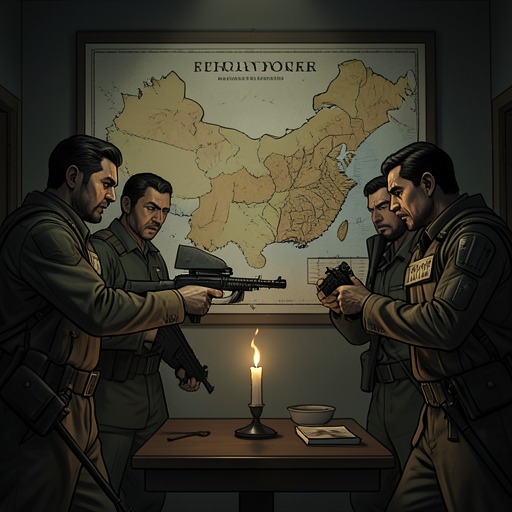
The war plans expose how closely commercial and military intelligence are connected. Documents found by Robin Swift include a detailed sketch of Canton’s main docks, a list of Chinese naval ships, reports on coastal defenses, the number of junks protecting naval stations, the positions of forts, and the troop strength on surrounding islands. These are not abstract policy proposals but operational plans. Professor Richard Linton Lovell is among the most hawkish advocates, describing a Chinese army as weak and undisciplined and arguing that war would provide access to immense linguistic resources. He has not merely been a scholar caught in commercial hostilities; he has helped design them, including a letter to Lord Palmerston assessing the Chinese fleet and proposing that the British warship Nemesis make short work of the Chinese vessel Cambridge.
The response of the Hermes Society is to oppose the invasion before Parliament commits to it. Anthony Ribben defines the immediate task as convincing Parliament and the British public that war against China would harm Britain’s own interests. The argument must reach beyond moral condemnation, because the people who control the system respond most readily to profit. Anthony proposes a coalition joining unlikely sympathizers, including British people who might otherwise support expansion, by showing that a global empire founded on silver would intensify inequality, pollution, and unemployment. The fate of a poor family in Canton is linked to that of an unemployed weaver in Yorkshire, even though the two groups are separated by race, distance, and political power.
Global Consequences and Significance
Robin Swift gradually recognizes the Opium trade as a web rather than a sequence of separate transactions: cotton moves from India to Britain, opium from India to China, silver becomes payment for Chinese tea and porcelain, and the resulting wealth returns to Britain. At Oxford, these movements had appeared as abstract categories of use, exchange, and value. In the world beyond Babel, they become colonial labor and colonial pain. The trade’s violence is concealed by commercial vocabulary, but the concealment cannot survive contact with the plantations, the confiscated chests, the threatened executions, and the war plans.
The system also explains why the British Empire appears powerful while remaining materially dependent on extraction. Britain’s silver reserves are being drained by Chinese imports, yet the proposed solution is not to alter consumption or accept Chinese sovereignty. Instead, Britain forces a market for an addictive commodity, demands compensation when China enforces its laws, and prepares to seize more silver through war. The Opium trade thus converts a commercial deficit into an imperial program: the drug restores British financial power only by deepening the political and social destruction imposed on India and China.
Its decisive significance lies in the exposure of “free trade” as a form of coercion. The trade is defended as equality while its participants possess radically unequal access to capital, law, translation, and military force. It joins private companies, missionaries, translators, Parliament, and the navy in a common project, and turns resistance into an excuse for further expansion. By the time Robin learns that Richard Linton Lovell is one of the architects of the war, the Opium trade has become inseparable from the book’s larger question of how language and commerce serve empire: translation may make negotiation possible, but the institutions controlling the negotiation determine whose interests the exchange will serve.