Silver industrial revolution
BabelThe Silver industrial revolution is the book’s name for the mechanized transformation of nineteenth-century England through silver-working. It made cities faster, brighter, and more productive while binding transport, manufacture, sanitation, communications, and imperial power to a system whose benefits flowed chiefly to the already wealthy. Its decisive contradiction is that the technology presented as progress also produced poverty, dependence, pollution, and a vulnerability that could be turned against the institutions that controlled it.
Definition and Material System
The Silver industrial revolution emerged as silver-powered machines replaced artisanal labour across England. The process was not confined to factories: silver entered the wheels of cabs and carriages, the hooves of horses, buildings, shopfronts, streets, and the mechanisms of clock towers. In London, silver gave the capital a metallic, artificial heartbeat, making it larger, heavier, faster, and brighter than nature seemed able to permit. The city’s wealth was inseparable from its capacity to consume the world’s silver ore and languages, yet its abundance coexisted with extreme poverty and an underlying hunger for still more labour, capital, and resources.
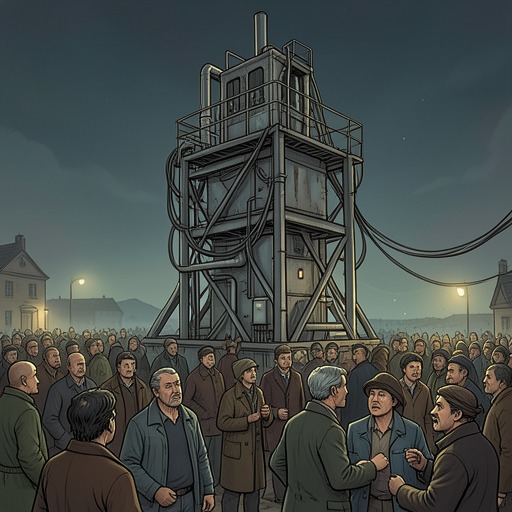
The system depended on a central infrastructure at Babel. In the resonance chamber, upright silver rods of different lengths and heights were engraved with commonly used match-pairs. They supplied power to linked bars throughout England: Babel functioned as the centre, while the resonance-dependent bars formed a national periphery. The arrangement resembled imperial administration itself, since distant installations drew upon a metropolitan source for power and renewal. Lower-carat silver could be used for land-based bars because the rods kept them fuelled through resonance, while higher-carat silver was reserved for bars requiring endurance, including those used by the British Navy and on merchant ships.
This network also converted language into infrastructure. Match-pairs did not merely describe or symbolize mechanical operations; they enabled them. A speed-based bar, drawing on the older association between speed, hope, and successful arrival, allowed carriages to travel quickly without the usual danger of collision. A French-English bar using parcelle-parcel made heavy postal parcels seem only a fraction of their true weight. By July 1839, Babel had also hosted England’s first working telegraph line, connecting Oxford with the British Foreign Office in London. The telegraph initially used Samuel Morse’s numerical code, but Professors De Vreese and Playfair developed an alphanumeric system that made commercial, personal, and governmental messages possible without match-pairs.
Social and Imperial Consequences
The revolution promised progress and enlightenment, but silver-powered machines produced recession rather than shared prosperity. Rural agriculture declined as men, women, and children moved into urban factories, where they endured extraordinarily long hours and suffered disabling or fatal accidents. The widening gap between rich and poor became a defining social fact. The New Poor Law of 1834 intensified the damage by withholding relief unless impoverished applicants entered workhouses deliberately made miserable and punitive. The new employment that Professor Lovell had imagined would absorb displaced workers did not appear; the main beneficiaries were factory owners, financiers, and the few people cunning or fortunate enough to join them.
The human cost was also environmental and bodily. Silver-working machinery polluted industrial life, injured children, and reorganized production around speeds that human bodies could not safely match. Reports later described coal dust inhaled by children forced into tunnels too narrow for adults, fingers and toes lost in rapidly moving machines, and girls strangled when their hair caught in spindles and looms. Peter Gaskell’s 1833 study, The Manufacturing Population of England, documented the moral, social, and physical consequences of silver-working, while newspapers brought its evidence into public debate. The Spectator’s image of children crushed beneath the wheels of the revolution, captioned “WHITE SLAVES OF THE SILVER REVOLUTION,” made the violence legible to readers who otherwise enjoyed the conveniences the system supplied.
The same machinery connected British industry to colonial exploitation. Silver moved through ships, factories, and imperial trade routes carrying tea, cotton, and tobacco between the Port of London, India, the West Indies, Africa, and the Far East. Its expansion enriched the British Empire while distributing suffering across different populations: Indian weavers, enslaved labourers producing American cotton, factory workers in Britain, and poor families in Canton became participants in one chain of extraction. The argument advanced by Anthony Ribben was that a poor family in Canton and an unemployed weaver in Yorkshire were tied to one another precisely because neither benefited from imperial expansion, while companies and elites accumulated the profits.
Silver therefore became a strategic motive for war as well as an industrial resource. In the debate over invading Canton, the prospect of access to China’s immense silver reserves promised faster warships, more accurate guns, and a dramatic enlargement of British imperial capacity. Griffin Harley Lovell insisted that preventing the invasion mattered because a British victory would provide an effectively inexhaustible supply of silver, whereas defeat would cause the country’s supply and imperial power to contract. The silver system thus linked domestic machinery to foreign coercion: the prosperity of English infrastructure depended upon the continued acquisition of resources beyond England.
Dependency and Cascading Failure
The revolution’s apparent strength concealed deliberate fragility. Babel’s scholars had designed Oxford to depend on the Institute as completely as possible. Bars were made to last only weeks rather than months, so that maintenance appointments would generate continuing income; the arrangement inflated prices and manufactured demand. The network worked elegantly while Babel maintained it, but its dependence meant that a relatively small interruption could become a civic catastrophe.
That vulnerability became visible when Babel’s scholars went on strike. Magdalen Tower fell after its scheduled reinforcement was missed. The tower had relied since the eighteenth century on silver-facilitated engineering to compensate for centuries of soil erosion at its foundations, and Babel had maintained its supports every January and June. Professor Playfair had supervised the work for fifteen years, but his notes were locked in his office after the faculty’s exile, while Playfair himself lay unconscious in hospital after being given laudanum. The collapse exposed not only a technical omission but the institutional consequences of concentrating essential knowledge in inaccessible records.
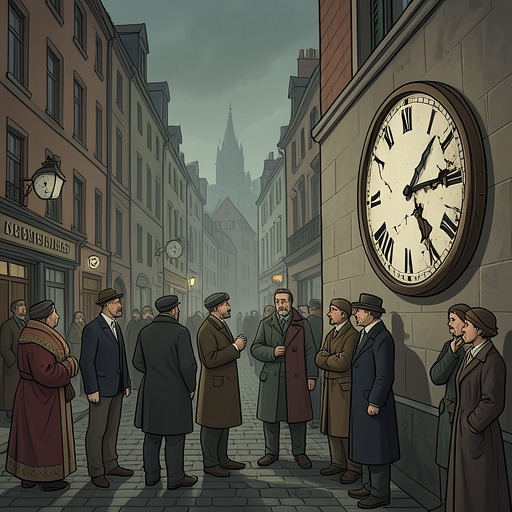
The failure spread rapidly through Oxford. On the following day, every bell-tower clock stopped at precisely 6:37 in the morning. Sewage, whose flow had been facilitated by silver, became an immobile mass of sludge and filled the city with a great stink. That evening the lamp-posts failed one after another until High Street was completely dark, the first such night in two decades of gas lighting. By the third day, transport began to break down. Drivers had grown so accustomed to silver-assisted speed that they failed to compensate when the bars stopped working; overturned wagons and cabs blocked Oxford’s roads, and a family of eight fell into a ravine in the Cotswolds after a driver misjudged a turn.
The postal system failed through the same chain of dependence. Carriages equipped with parcelle-parcel bars had treated heavy loads as though they were lighter than their actual weight. Once the bars ceased functioning, horses struggled under three times the expected burden and postal carriages collapsed on their routes. What looked like a collection of separate conveniences—clocks, sewers, streetlights, transport, and mail—was revealed as one interconnected system whose local failures could cascade through urban life.
The consequences extended beyond Oxford. Silver powered ice-making machines in the kitchens of London’s wealthy, brewery engines, flour mills, locomotives, railways, water systems, and the machinery of spinning, weaving, carding, and roving. Without it, Britain’s textile industry could collapse, rail construction would stop, water would become foul, and the air would thicken with grime. Silver was also embedded in plough-frames, seed drills, threshing machines, and drainage pipes, creating the possibility of agricultural failure and widespread starvation. Regional centres in London, Liverpool, Edinburgh, and Birmingham could temporarily compensate, but they lacked Babel’s maintenance ledgers and could not replace the Institute’s full capacity.
Resistance and Political Meaning
The workers’ movements of the 1830s were direct responses to the revolution’s unequal effects. The Luddites were killed or exiled to Australia; Lancashire spinners were forced back to work within a year by the threat of starvation; and the Swing Rioters won temporary improvements that were later withdrawn, followed by executions and transportation to penal colonies. These defeats encouraged public indifference: people wanted modern conveniences without confronting the labour and suffering that produced them.
Yet the worsening of the system created a new basis for hope. Silver-powered looms and spinning machines became cheaper and more widespread, enriching factory owners and financiers while putting more workers out of employment, impoverishing families, and maiming or killing children. The anti-silver movement could draw upon a condition that had become harder to contain. The Rebecca Riots in Wales, the Bull Ring Riots in Birmingham, and Chartist uprisings in Sheffield and Bradford had appeared to be isolated disturbances, but the narrative reveals their common structure: British factory workers, Indian weavers, enslaved labourers, and communities damaged by imperial extraction were caught in the same web of coercion.
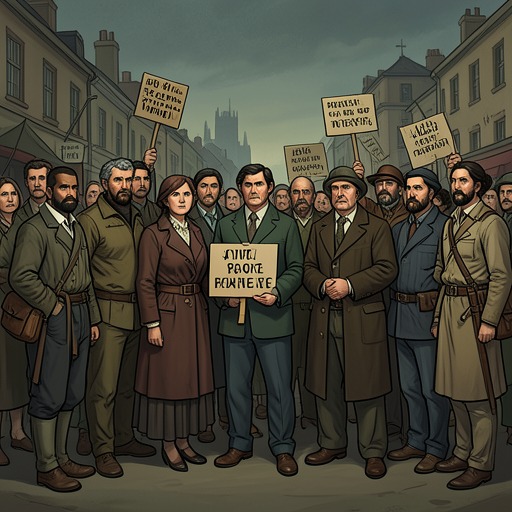
Babel’s translators believed their strike possessed unusual leverage because no substitute institution could perform their work. If the scholars withdrew, Britain could not simply hire replacement labourers or deploy ordinary scabs. The strike therefore attacked the technical and linguistic centre of the national system. A hundred miles away, white British factory workers crowded Westminster Hall to protest a war in a country they had never visited, suggesting that the conflict over Canton had become inseparable from domestic class politics. Radical newspapers, including The Red Republican, presented the translators as heroes of the working class, while antiwar publications redirected attention from distant foreign policy to the immediate dangers of silver-working.
The revolution’s political significance lies in this unexpected coalition. Anthony Ribben argued that reformers had to persuade even wealthy men who accepted racial exploitation that imperial expansion based on silver threatened their own interests. Justice and human dignity would not be enough to move entrenched power; profit was the logic such men understood. The resulting class analysis connected the fate of a poor family in Canton with that of an unemployed Yorkshire weaver and made the antiwar struggle part of a broader revolt against inequality, pollution, unemployment, and colonial wealth.
Historical and Narrative Significance
The Silver industrial revolution is both a technological transformation and a political structure. It makes language, silver, machinery, and empire operate as parts of one system, so that the same match-pairs that accelerate a carriage or lighten a postal load also embody the institutional dependence of the British world on Babel. The system’s grand scale creates the illusion of mastery, but its failures reveal how little autonomy remains once everyday life has been reorganized around centralized maintenance.
Its collapse also turns infrastructure into evidence. The stopped clocks, blocked sewers, dark streets, overturned vehicles, and broken mail carriages make visible the labour and knowledge normally hidden behind convenience. The revolution’s violence is slow when absorbed by workers, children, rural communities, and colonized populations, but sudden when the network fails. That contrast explains why the strike can transform a technical dispute into a national crisis: the system has already distributed its harms widely, and its apparent invisibility has depended on keeping those harms fragmented.
By the time soldiers of the British Army enter Oxford, the state is responding not merely to rebellious scholars but to the possibility that the machinery of imperial modernity can be interrupted. The soldiers’ arrival at the barricades looks more like a polite parade than a punitive force, an ironic image of authority confronting a city whose material order has already begun to unravel. The Silver industrial revolution thus becomes the central contradiction of the book’s modernity: it promises connection and abundance, yet produces dependence and exclusion; it expands imperial power, yet gives the oppressed a shared infrastructure on which to organize resistance.