University of Oxford
BabelThe University of Oxford is both a physical institution and a political system in Robin Swift’s story. Presented to him as a place where the nation’s great minds gather for research, study, and instruction, it becomes the setting in which he is remade as a British subject, admitted to Babel, and trained for work that serves imperial commerce. Its libraries, colleges, rituals, and privileges offer genuine intellectual wonder, but the institution’s grandeur is inseparable from the wealth, hierarchy, and imperial power that sustain it.
Definition and Setting
The University of Oxford is described as a university made up of twenty-two colleges, each possessing its own residences, coat of arms, dining hall, customs, and traditions. Christ Church, Trinity, St John’s, and All Souls have the largest endowments and the finest grounds, while Worcester and Hertford are dismissed as poor, unattractive, and badly fed. Robin is assigned to University College, commonly called “Univ,” whose students in the Royal Institute of Translation live behind a Gothic-looking facade of turrets, regular windows, and smooth white stone.
Oxford in 1836 is an institution in an “era of becoming.” Its colleges continually renovate their grounds, purchase land from the city, replace medieval buildings with newer halls, and construct libraries for expanding collections. The city’s buildings often bear the names of wealthy patrons rather than names derived from their functions. The Ashmolean Museum houses curiosities including a dodo’s head, a hippopotamus skull, and a supposed three-inch sheep’s horn from an old woman in Cheshire. The Radcliffe Library dominates the university’s architectural imagination, while the Bodleian is treated as a national treasure whose collection grows under Reverend Doctor Bulkeley Bandinel, supported by a book-buying budget of nearly two thousand pounds a year.
The university’s most imposing institution is Babel, the Royal Institute of Translation. Its tower is an eight-storey neoclassical building of gleaming white stone, ornamental pillars, and tall stained-glass windows. It dominates High Street so thoroughly that the nearby Radcliffe Library and University Church of St Mary the Virgin appear insignificant beside it. The tower is not merely a landmark: it is the specialized faculty in which Robin and his cohort will spend the next four years, and its architecture gives visible form to Oxford’s claim to intellectual and national importance.
Admission, Assimilation, and Institutional Protection
Before Robin can enter Oxford, Professor Richard Linton Lovell arranges the practical and legal transformation that will make him legible to British society. Robin is examined by a physician, vaccinated against smallpox, taken to a barber, fitted by a hatter and bootmaker, and measured by a tailor. At the courthouse, a solicitor drafts papers intended to make him a legal citizen of the United Kingdom and a ward under Professor Richard Linton Lovell’s guardianship. The process turns belonging into paperwork: Robin stands on a bench because the solicitor’s desk is too high, signing documents whose language resembles the guardianship contract he had already received in Canton.
Oxford therefore receives Robin only after his body, clothing, legal status, and future have been reorganized. The university is presented as an open place of learning, yet admission depends on prior acts of assimilation and supervision. Its promise of intellectual mobility rests on bureaucratic definitions of who may belong and under whose protection.
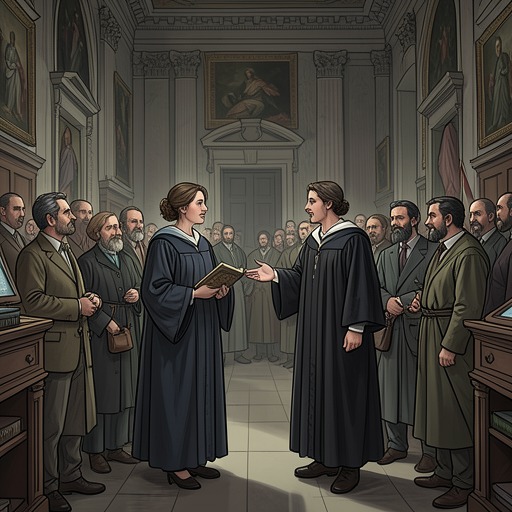
The same administrative logic operates inside Babel. At the beginning of their course, Robin, Ramiz Rafi Mirza, Victoire Desgraves, and Letitia Price are required to give blood. In a small windowless room behind the shelves, Professor Jerome Playfair reveals drawers filled with glass vials, each labeled with the name of the scholar whose blood it contains. The samples allow Babel’s wards to distinguish scholars from intruders because the faculty experiences more attempted robberies than the banks of London. Hair and fingernails had proved too easy to steal, so the institution makes identity a registered bodily substance. Security is thus not abstract: it is written into the architecture and stored in a hidden archive of bodies.
Privilege and Social Reproduction
Babel makes its students unusually privileged within the University of Oxford. Its scholars are allowed into every college library, including the ornate Codrington, even when its collections are not useful to their studies. Their room, board, and tuition are paid directly by Babel; they do not serve food in hall or clean tutors’ rooms like other servitors. Each receives a stipend of twenty shillings a month and access to a discretionary fund for course materials, even when the educational justification is as flimsy as claiming that a gold-capped fountain pen might aid study.
This arrangement initially appears to Robin as ordinary life rather than institutional wealth. He understands its significance only when he encounters Bill Jameson struggling over numbers and discovers that other students cannot reliably afford their meals. Robin has recently collected his own stipend and counts out coins to help cover Jameson’s food. The contrast exposes the university’s hierarchy: the same Oxford that celebrates learning distributes the material conditions of study unevenly, while Babel’s students are protected from costs that shape the lives of everyone around them.
The protection extends beyond money into status. Babel is Oxford’s most prestigious faculty. Its students win the Chancellor’s Prize for Latin verse and the Kennicott Hebrew Scholarship, receive invitations to receptions attended by politicians, aristocrats, and wealthy lobby clients, and enjoy access to the Senior Common Room. A rumor that Princess Victoria would attend the faculty’s garden party proves false, but she sends a marble fountain instead; Professor Jerome Playfair enchants it to send glittering arcs of water into the air at all hours. By the middle of the Hilary term, Robin, Ramiz Rafi Mirza, Victoire Desgraves, and Letitia Price have absorbed the superiority of students who can move freely across campus. Visiting scholars who once ignored or patronized them become deferential when they learn that the four study translation.
The institution also reveals the limits of Oxford’s social taboos. Victoire Desgraves and Letitia Price gradually grow out their hair after realizing that women’s presence is treated less as an official prohibition than as an open secret. Letitia eventually appears at dinner in a skirt rather than trousers. University College boys whisper and point, but the staff serve her three courses and wine without incident. The episode shows Oxford managing transgression through silence: exclusion is not always announced as a rule, and tolerance may consist only in declining to enforce an unofficial boundary on a particular evening.
Oxford and Imperial Power
The University of Oxford is remote from the immediate centers of government, yet its influence flows directly into the machinery of empire. Oxford is characterized as a refuge, decades behind the rest of England in most areas except academic life. Its antiquarian design lets scholars imagine themselves living in any of the previous five centuries, and local disturbances are so rare that a robin singing near the end of a sermon at Christ Church can become news in the University College newsletter. Yet the university produces the people who occupy power: its alumni run the Empire.
That contradiction becomes decisive when Babel students participate in the mission to Canton. Professor Richard Linton Lovell explains that they are to help negotiate on behalf of private trading companies, foremost Jardine, Matheson & Company. British merchants seek free trade, open ports, access to markets beyond the islands, and the removal of restrictions on imports such as opium. The Qing court, wary of foreign influence, confines foreign traders to Canton and Macau. The mission is presented as an attempt to overcome earlier failures of cultural misunderstanding, including the Macartney embassy of 1793, the Amherst embassy of 1816, and the Napier affair of 1834. Babel translators are expected to make the fourth delegation different.
The university’s claim to solve political conflict through translation is tested against the unequal legal positions of Britain and the Qing state. Commissioner Lin points out that Britain prohibits opium within its own territory and asks whether that prohibition does not prove British knowledge of the drug’s harm. He then states that foreigners who bring opium into China for sale will be decapitated and that the ships’ property will be confiscated. When British representatives argue that British citizens and property do not fall under Chinese authority, Commissioner Lin insists that they are standing inside Chinese territory and that Chinese laws will be enforced there. The exchange reveals the limits of Babel’s ideal of neutral mediation: translation can clarify the opposing claims, but it cannot erase the struggle over jurisdiction, commerce, and imperial authority.
A later confrontation makes the institution’s political investment explicit. Professor Jerome Playfair demands to know what has happened to Professor Richard Linton Lovell, while Robin accuses Lovell of helping architect the war, obtaining military intelligence from British spies in Canton, and maintaining direct contact with Lord Palmerston. The scene places Babel’s academic authority inside a crisis that its public representatives cannot easily acknowledge. The university’s language of scholarship and service is shadowed by the possibility that its personnel are assisting military and commercial aggression.
Crisis, Class, and Narrative Significance
When revolution and occupation reach Oxford, the university’s apparent isolation becomes an illusion. Oxford is not the center of activity, but it is a refuge whose institutions train the people who govern Britain. News of the occupation could travel from Oxford Station to London and reach the Cabinet and the House of Lords; the university’s distance from power therefore makes it a strategic relay rather than an irrelevant provincial enclave. Its old walls and quiet rituals do not protect it from national consequences. They conceal how closely its educational life is connected to the state.
The institution’s wealth also depends on social conditions that its privileged students can fail to see. Robin learns that English food, domestic care, and university provision are structured by class: potatoes are considered unfit for important company, silver-gilded dishes discreetly keep food warm, and the distinctions among lunch, luncheon, and noon dinner encode social custom. In contrast, the students’ Babel stipends and supplied rooms allow them to forget how quickly their resources would disappear outside Oxford. Without stipends, lodgings, and meals, they would have only enough money to survive for several months and no clear route into employment.
The contrast becomes harsher when industrial workers describe the conditions behind the silver-powered economy. Factory labor begins before dawn and continues until nine with few breaks, including cramped floors, coal dust, mutilating machinery, and accidents involving children’s bodies and trapped hair. Robin asks whether the factories are truly as bad as reported and is told that the reports show only the most spectacular injuries; the ordinary day-to-day conditions are worse. The jobs that workers endure are also the jobs they may wish to recover. Against this background, Oxford’s quiet libraries, full meals, stipends, and protected academic schedules appear not as universal benefits of education but as a form of institutional shelter financed by a wider system of extraction.
The University of Oxford consequently functions as a central paradox. It is a place of genuine scholarship, architectural beauty, and intellectual companionship, and it gives Robin a home in which he can study translation with other outsiders. At the same time, it naturalizes hierarchy, converts bodies and identities into administrative records, supplies expertise to imperial trade, and reproduces the distance between those who govern and those who labor. Its most important narrative role is to show that empire is not produced only in battlefields or government offices: it is also cultivated in libraries, colleges, scholarships, dining halls, and the confident assumption that knowledge can be separated from the power that pays for it.