Luddite movement
BabelThe Luddite movement is the book’s central historical example of organized resistance to industrial progress built on silver-working. Although Professor Lovell dismisses the Luddites as foolish workers who smashed machinery rather than adapt, the later account corrects that characterization: they were highly coordinated insurgents whose struggle arose from the displacement, impoverishment, and bodily danger produced by silver-powered mechanization. Their defeat does not invalidate their analysis of industrial society; instead, it demonstrates how thoroughly the British state could mobilize violence to protect the interests of machinery, capital, and empire.
Origins in Silver Industrialization
The movement emerges from the transformation that silver-working brought to Britain during the preceding decade. Silver-powered machinery greatly increased agricultural and industrial productivity, allowing factories to operate with a quarter of their former workers. In textiles, Kay’s flying shuttle, Arkwright’s water frame, Crompton’s spinning mule, and Cartwright’s loom all became possible through silver-working. The gains were celebrated as progress, but they displaced thousands of labourers and left the promised replacement occupations unrealized. The Luddite movement therefore represented resistance to a concrete social reordering: machines made production faster and more profitable while removing the employment on which working families depended.
Professor Lovell interprets this resistance as irrational refusal. He describes the Luddites as workers who preferred destroying machinery to learning skills that might be useful, and places their actions within a broader wave of attacks directed at Babel and industrial institutions. Across England, protesters committed arson, stoned building owners, threw acid at factory managers, and smashed looms in Lancashire. His account reveals the ruling logic the movement opposed: technological efficiency was treated as self-evidently beneficial, while unemployment, insecurity, injury, and class inequality were treated as the workers’ failure to adapt.
Organization and Methods
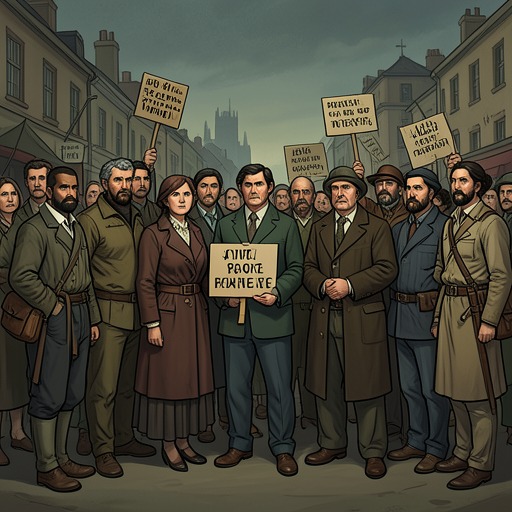
The later narrative sharply revises the stereotype of the Luddite as an uneducated machine breaker. The movement consisted of small, disciplined groups that used disguises and watchwords, raised funds, gathered arms, terrorized opponents, and carried out carefully planned and targeted attacks. Its members possessed organizational competence and strategic purpose; the movement’s apparent disorder was partly a perspective imposed by institutions that preferred to describe resistance as ignorant violence rather than recognize its political intelligence.
That sophistication also explains the scale of the response required to defeat it. The Luddite movement ultimately failed only after Parliament mobilized twelve thousand troops to suppress it—more soldiers than had fought in the Peninsular War. The comparison makes the state’s priorities unmistakable. Industrial property and the social order built around it warranted a military campaign of exceptional size, showing that the machinery of progress depended not only on silver and factories but also on coercion, surveillance, and armed force.
Defeat and Historical Memory
The movement’s defeat becomes part of the cautionary history remembered by later strikers. The Luddites ended either dead or exiled to Australia. Lancashire spinners were forced back to work within a year because starvation left them little choice. The Swing Rioters achieved temporary improvements in wages and working conditions by smashing threshing machines and burning barns, but those gains were promptly withdrawn; more than a dozen participants were hanged and hundreds were transported to penal colonies in Australia. These outcomes establish a recurring pattern in the book: workers could disrupt industrial production, but without broader solidarity and durable political leverage, the state and employers could wait them out, punish them, or reverse their concessions.
Public opinion further weakened such movements. Strikers rarely won broad support because the public wanted the conveniences of modern life without confronting the violence and deprivation through which those conveniences were produced. The Luddite movement was consequently remembered as an obstacle to progress, while the beneficiaries of silver industrialization escaped equivalent moral scrutiny. Its historical marginalization is itself political: the society that profited from mechanization also controlled the language used to explain resistance to it.
Influence on Later Resistance
The forces that produced the Luddite movement did not disappear after its suppression. Silver-powered looms and spinning machines became cheaper and more ubiquitous, enriching factory owners and financiers while putting more men out of work, leaving families destitute, and maiming or killing children in machines faster than the human eye could follow. Later movements—including the Rebecca Riots, the Bull Ring Riots, the Chartist uprisings, and renewed strikes by textile workers, dock workers, factory employees, and gasworks stokers—are presented as connected expressions of the same widening inequality rather than isolated disturbances.
This continuity gives the Luddite movement renewed importance during the Babel strike. Abel’s organizers bring to that action the same training and professionalism associated with earlier insurrectionary movements. The barricades and coordinated resistance are not spontaneous riots by discontented lowlifes; they are the inheritance of organized working-class struggle. The earlier Luddite example also clarifies the danger facing the translators: white workers had already failed to secure lasting victories, and the public had often refused to support them. The translators therefore require an alliance broader than institutional protest alone.
Class, Empire, and Political Significance
The movement’s grievances become inseparable from the imperial system that finances and distributes industrial wealth. Silver gives British factories their extraordinary power, helps sustain the mechanical infrastructure of London, and supports the expansion of the British Empire. In the political crisis over military action against Canton, the proposed invasion is valued not merely as punishment or national vindication but as a means of obtaining China’s immense silver reserves. The same resource that destroys employment at home strengthens the military and commercial reach of Britain abroad.
Anthony Ribben’s proposed coalition depends on making that connection legible. He argues that the fate of a poor family in Canton is tied to that of an unemployed weaver from Yorkshire: neither benefits from imperial expansion, while companies and the already powerful grow richer. His strategy is to frame opposition to the war as a matter of British class interest rather than solely as an anticolonial appeal, because profit is the language that powerful potential allies are most likely to understand. When white British factory workers crowd Westminster Hall to protest a war in a country they have never visited, the old Luddite struggle appears not as a failed local quarrel with machinery but as one strand in a larger antisilver revolt.
The Luddite movement thus supplies both a history of suffering and a practical political lesson. Its members understood that machinery was embedded in ownership, labour discipline, and state power; their failure resulted not from the insignificance of their cause but from the ability of the ruling order to isolate and crush them. Later resistance gains its chance when those isolated struggles are recognized as parts of one system of coercion and exploitation. The movement remains defeated in the immediate historical record, but its methods, grievances, and suppressed analysis survive as the groundwork for collective action against the silver industrial revolution and the imperial expansion it enables.