British Army
BabelThe British Army functions in the novel as both the distant instrument of imperial expansion and the immediate force brought against domestic resistance. Its appearance in Oxford turns political pressure into a visible military crisis: red-coated troops occupy the streets, negotiate with the barricaded scholars, and ultimately threaten to destroy the resistance at Babel by force. Yet the Army is not presented as a simple, autonomous villain. Its commanders hesitate, its soldiers appear uncomfortable in the university city, and its orders are shaped by Parliament, public anger, and the government’s desire to resolve a crisis produced by trading interests.
Imperial Instrument and Political Context
The Army’s domestic deployment is inseparable from the proposed British campaign against China. In preparation for the Canton mission, Professor Richard Linton Lovell explains that Robin Swift and his companions are to negotiate for private trading companies, foremost Jardine, Matheson & Company. British merchants seek free trade, wider access to Chinese ports, and the removal of restrictions on imports such as opium. Earlier diplomatic efforts, including the Macartney embassy, the Amherst embassy, and the Napier affair, have failed, and Babel translators are now expected to prevent further cultural miscommunication.
The immediate dispute concerns the opium bond and the destruction of more than twenty thousand chests of opium seized under Commissioner Lin. Mr Baylis presents the seizure as an attack on British property and treats war as the proper answer. In the negotiations with Commissioner Lin, he demands legal permission for agents of Jardine, Matheson & Company to sell opium along the Canton coast, an apology for the treatment of foreign traders, and the return of the seized opium or compensation for its market value. The Army therefore stands behind an economic program presented as national honour: military force is used to secure commercial access and protect the interests of private companies.
The war plans discovered by Robin make that relationship explicit. Reverend Karl Gützlaff’s letters include a detailed sketch of Canton’s main docks, a list of Chinese naval vessels, reports on junks and forts, and precise figures for troops stationed along the coast. Professor Richard Linton Lovell is among the most hawkish participants in these discussions, arguing that Chinese forces can be easily defeated and describing the linguistic resources that a victorious war would place at his disposal. The British Army is thus part of a larger system in which translators, merchants, intelligence-gatherers, Parliament, and military planners convert language and commercial ambition into imperial power.
Entry into Oxford
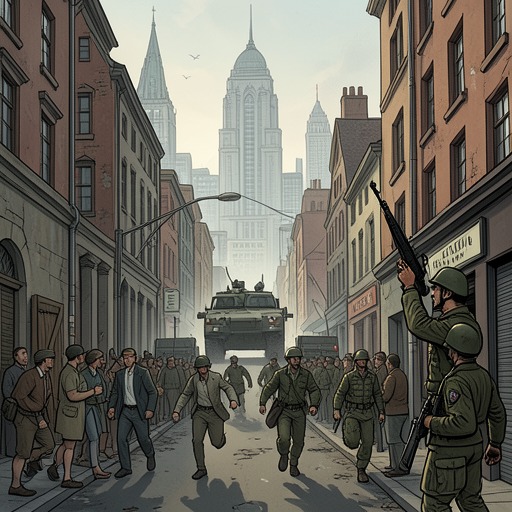
On the evening when the conflict reaches Oxford, the British Army marches into the city in a single column along High Street. The scene deliberately resists the grandeur associated with military occupation. The red-coated troops move slowly among townhouses and shops, make way for civilians crossing the street, and appear more like participants in a parade than a punitive force. The townspeople who gather to cheer them further blur the boundary between public ceremony and coercion.
The Army halts at the barricades erected around Babel. Its commander, a heavily mustachioed officer covered in medals, dismounts and approaches the first overturned wagon in visible confusion, as though the barricade itself is an unexpected problem requiring explanation. Abel Goodfellow then walks out alone to meet him. Their exchange begins civilly but becomes heated, with both men gesticulating wildly and Robin fearing that the commander may arrest Abel. Instead, the two men reach an agreement, and the Army retreats.
The retreat is not a withdrawal from the confrontation. Abel reports that the commander has granted the occupiers forty-eight hours to clear the barricades, after which the Army will remove them by force. The deadline converts the occupation into a political and logistical emergency. The scholars have only two days to decide whether to abandon Babel, intensify their resistance, or find a way to influence the unresolved debate in London.
From Containment to Coercion
The Army’s initial strategy is shaped by restraint as much as by force. Later, Letitia Price explains that the guardsmen have been ordered to leave the tower itself alone and have been permitted to aim at individual scholars when opportunities arise. The policy suggests an attempt to contain the occupation without destroying the translators, whose knowledge remains valuable to the state. The Army does not want the scholars dead, but it is willing to make the surrounding space dangerous enough to isolate them.
That restraint nevertheless produces direct violence. Robin stops going outside after a meeting with Abel is interrupted by rifle fire. A window shatters beside Victoire Desgraves’s head while she searches the stacks, forcing the scholars to crawl across the floor and retreat to the basement. They later find a bullet lodged in the shelf behind the place where she had been standing. The apparent invulnerability of Babel’s windows and walls cannot prevent every form of danger, and the attack exposes the gap between the institution’s magical security and the state’s willingness to target individual bodies.
The pressure intensifies as accidents and shortages spread through the country. Westminster Bridge has not yet fallen, but London’s infrastructure is failing and public patience is exhausted. Since Parliament refuses to reject the proposed invasion of China, public demands for retribution push the Army toward increasingly aggressive action. The military presence around Babel is therefore connected to a broader crisis in which imperial policy, economic disruption, and urban disorder reinforce one another.
The Final Approach to Babel
The Army’s next major move is carefully staged. More than a dozen troops stop on High Street, but only five proceed toward the tower. The soldiers part, allowing Letitia Price to walk forward alone carrying a white flag. Her arrival shows that military action remains entangled with personal and political negotiations: she is not simply an enemy messenger, but someone who has written to her father and used every available connection to reach the besieged scholars.
Letitia warns that the Army will storm the tower at dawn and destroy the resistance with guns. She explains that the troops have delayed because they hoped to starve the occupants into surrender and because they do not want to shoot scholars. At the same time, she makes clear that public anger has reached its limit. The state’s patience is not infinite, and the usefulness of the translators no longer outweighs the pressure to end the occupation.
This planned assault marks the transformation of the Army from a force of intimidation into an instrument of destruction. Its earlier deadline, negotiation, and containment tactics have failed to produce surrender. The next step is an armed storming of Babel, even though the political question that generated the crisis remains unsettled.
Narrative and Political Significance
The British Army embodies the contradiction at the centre of Britain’s imperial project. It is deployed to defend commercial claims arising from the opium trade, yet its first substantial action in Oxford is against students and scholars rather than a foreign army. Its presence makes visible the continuity between overseas coercion and domestic repression: the same national rhetoric that describes invasion as a defence of British pride also labels Babel’s foreign-born students traitors and treats barricades and strikes as threats to public order.
The Army’s officers and troops are consequently shown within a contested political field rather than as a perfectly unified machine. The commander negotiates with Abel instead of immediately attacking, the soldiers’ arrival looks awkwardly ceremonial, and the force initially avoids the tower. But these limits do not cancel its function. When parliamentary hesitation, hostile newspapers, shortages, and popular demands converge, the Army becomes the means through which an unresolved imperial policy can be enforced at home.
Its significance lies in that progression from distant war planning to local siege. The military threat against Babel demonstrates how the proposed attack on China is not merely a foreign-policy decision. It reorganizes streets, institutions, and bodies in Britain itself, placing translators under fire while Parliament debates the interests of trading companies and the imperial value of Chinese silver. The Army’s approach to the tower makes that political logic impossible to keep abstract: empire arrives in Oxford wearing a red coat, carrying rifles, and offering forty-eight hours before violence begins.