British Empire
BabelThe British Empire is the dominant imperial power of the novel's nineteenth-century world, presented as both the richest and most technologically advanced political system of its age and a voracious structure sustained by colonial extraction. Its decisive significance lies in the connection between silver, language, infrastructure, and violence: Babel converts foreign languages into silver-working, while the Empire converts that power into trade advantages, military force, and an ever-expanding claim on global wealth.
Scale, Wealth, and Contradiction
The Empire first appears through London, described as the heart of the British Empire and, in that era, the largest and richest city in the world. Yet imperial grandeur does not erase contradiction. London is simultaneously rich and poor, expanding and starved, virtuous and hypocritical. Its prosperity has accumulated the world's silver ore and languages in one metropolitan centre, making the city bigger, heavier, faster, and brighter than nature would permit while bringing it close to a reckoning: it may devour itself or reach outward for new supplies of labour, capital, and culture.
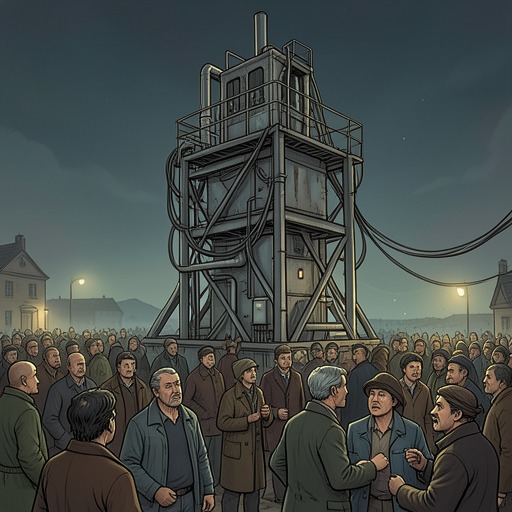
The silver that gives London its splendour is also the material basis of its ordinary life. It glimmers in carriages, horses' hooves, buildings, shopfronts, streets, gutters, and clock towers; it freshens canal water, disguises the smell of sewage, and carries sound across the city. The effect is not merely decorative. Silver makes the capital's mechanical heartbeat possible, turning imperial wealth into an infrastructure that reaches into transport, sanitation, manufacturing, communication, and domestic comfort.
Babel and Imperial Power
The Empire's most important institutional ally is Babel, the Royal Institute of Translation. Babel collects foreign languages and foreign talent and uses them to produce translation magic that benefits England above all other countries. The newest and most powerful silver bars depend on Chinese, Sanskrit, and Arabic, yet fewer than a thousand such bars exist in countries where those languages are widely spoken, and even there they are largely restricted to wealthy and powerful households. The resulting imbalance makes language a resource extracted from the world and concentrated in Britain.
The process is described as deliberate rather than accidental. Babel's professors present the tower as a refuge for pure knowledge, but its translation work serves commerce, missionaries, diplomacy, and colonial expansion. The Literature Department translates works into English rather than distributing English knowledge equally in the opposite direction, while interpreters are sent abroad to advance imperial interests. The Empire therefore does not rely on military occupation alone: it governs through an institutional system that makes foreign culture economically useful to Britain while limiting the places from which that value originates.
The relationship between Babel and the Empire also operates through a centre-and-periphery structure. Babel is the centre, while resonance-dependent bars throughout England form the periphery. The external bars draw power from the tower, just as British outposts in the colonies call upon the home country for soldiers and supplies. The metaphor makes infrastructure reveal political dependence: what appears to be a network of independent conveniences is sustained by a central institution whose power radiates outward.
Silver, Trade, and the Road to China
The Empire's expansion follows the historical movement of silver. Silver helped the Romans expand their empire, and the Spanish Habsburgs later extracted immense deposits from the Andes through the labour of Indigenous miners, minting the metal into pieces of eight. That wealth purchased Indian cotton, which was used to buy enslaved Africans for plantation labour in colonial territories. In this history, silver does not circulate innocently; it accumulates through conquest, unequal labour, slavery, and the impoverishment of the regions from which imperial wealth is taken.
By the nineteenth century, Britain has displaced Spain as the leading imperial power. The Napoleonic Wars have weakened France, Britain possesses Europe's largest silver reserves, Babel is the world's leading translation institute, and the Royal Navy has secured supremacy at sea after Trafalgar. Silver, translation, and naval power reinforce one another, placing the British Empire on a path toward global rule.
That supremacy is threatened by the direction of trade with China. Britain spends enormous sums on Chinese porcelain, lacquered cabinets, silks, and tea, with tea exports alone worth at least thirty million pounds annually. Because China has little appetite for British manufactured goods, silver flows from Britain to China rather than returning through reciprocal trade. The Empire's response is not to accept the imbalance but to seek a new means of forcing silver back into British hands. The planned solution is the expansion of trade on British terms, including open ports, broader market access, and the lifting of restrictions on opium.
Diplomacy, Coercion, and War
British commercial interests repeatedly fail to secure broader rights from the Qing court. The Macartney embassy of 1793 ends without results after Lord George Macartney refuses to kowtow to the Qianlong Emperor. The Amherst embassy of 1816 likewise fails when Lord William Amherst refuses the required submission and is denied admission to Peking. The Napier affair of 1834 ends in cannon fire and Lord William Napier's death from fever in Macau. The fourth delegation is presented as different because Babel translators will lead the talks, but the promise of linguistic accuracy conceals a more coercive purpose.
The central commercial demand is the opium bond, which would make foreign ships legally responsible under Chinese law for opium smuggled into China. Merchants had previously evaded the prohibition by distributing cargo at outer anchorages such as Lintin and Camsingmoon. Under Commissioner Lin's stricter enforcement, more than twenty thousand chests of opium are confiscated. Jardine, Matheson & Company demands legal permission to sell opium, an official apology, and either the return of the seized cargo or compensation worth nearly two and a half million pounds. These demands turn a public-health and sovereignty dispute into a claim that Chinese enforcement constitutes an attack on British property.
The negotiations are therefore never conducted in good faith. Documents found among Professor Lovell's papers include a detailed sketch of Canton's principal docks, a list of Chinese naval vessels, accounts of coastal defences, the number and placement of forts, and precise troop numbers. They are war plans, not contingency exercises. Correspondence dating back to 1837 shows that Jardine, Matheson & Company, and Professor Lovell had considered hostilities long before the delegation sailed. Their objective is silver: if the Qing Emperor will not alter the balance of trade, British guns must open the route to China's reserves. The negotiations serve as a pretext for a short, brutal, efficient war.
When the opium shipment is destroyed and Commissioner Lin bans English trade from Canton, the imperial crisis reaches Parliament. Jardine & Matheson portray the conflict as a defence of British honour, while the House of Lords debates a military expedition. The question is not simply diplomatic prestige. Victory would give the British Empire access to what is described as the world's greatest silver reserve, allowing its ships to sail faster, its guns to fire farther and more accurately, and its wider programmes in Africa, Asia, and South America to become possible. War against China would thus transform a commercial dispute into an imperial escalation.
Infrastructure and Dependence
The Empire's modernity depends on silver-working systems that are both powerful and deliberately fragile. Telegraphy briefly suggests a different technological future: after Samuel Morse demonstrates his electrical device in January 1838, Babel scholars bring him to Oxford, where the Institute develops the first working telegraph line in England by July 1839, connecting Babel with the British Foreign Office in London. Professors De Vreese and Playfair improve Morse's numerical code into an alphanumeric system capable of transmitting messages of any kind, and the new service immediately attracts businessmen, government officials, and clergymen.
Yet the same infrastructure that makes imperial coordination possible exposes the Empire's dependence on Babel. When silver-working fails, speed bars cease to assist carriages, and drivers who have grown accustomed to their aid cannot compensate. Accidents block Oxford's roads, while a family of eight is carried into a ravine in the Cotswolds after a driver relies on a failed system during a difficult turn. Postal transport collapses as well: carriages using the French-English match-pair parcelle-parcel can no longer reduce the apparent weight of parcels, leaving horses to pull loads three times heavier than normal.
The consequences spread beyond transport and communication. Silver powers ice-making machines, brewery engines, flour mills, locomotives, rail construction, water systems, textile machinery, plough-frames, seed drills, threshing machines, and drainage pipes. A prolonged stoppage threatens not only urban convenience but Britain's food supply and industrial economy. Regional centres in London, Liverpool, Edinburgh, and Birmingham can provide only a temporary substitute, particularly because they lack Babel's maintenance ledgers. The Empire's apparent self-sufficiency is therefore revealed as dependence on a concentrated store of linguistic expertise and technical knowledge.
Imperial Crisis and Historical Significance
The British Empire is not merely a background state but the novel's governing system of value. It measures knowledge by the wealth and force that knowledge can produce, treats languages as resources to be gathered, and presents commercial domination as free trade. Its machinery of expansion joins private companies, Parliament, diplomatic missions, military planning, Babel's scholars, and silver-powered infrastructure into a single cycle: wealth finances force, force protects trade, trade gathers more silver, and silver strengthens the institutions that make further expansion possible.
That cycle is also its vulnerability. The Empire's power depends on the continued movement and maintenance of silver, yet its commercial appetite causes silver to flow toward China. Its global infrastructure promises speed and abundance, yet failure leaves roads, mails, factories, railways, water supplies, and agriculture exposed. Its translators claim to prevent cultural misunderstanding, yet the war plans show that understanding has been subordinated to conquest. The British Empire therefore embodies the novel's central irony: the more completely it turns language, technology, and trade into instruments of domination, the more visibly its prosperity rests on resources and systems it cannot ultimately control.