Qing dynasty
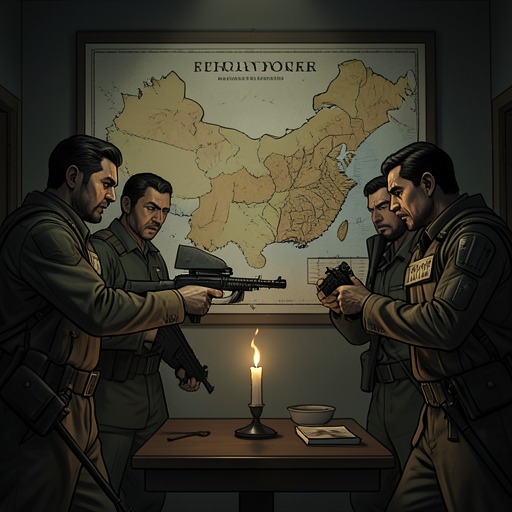
BabelThe Qing dynasty is the governing power that defines the legal and political stakes of the Canton crisis. Its attempt to control foreign merchants, prohibit opium, and preserve authority over trade collides with British demands for open markets and compensation, turning a dispute over commerce into a struggle over jurisdiction, sovereignty, and the imperial use of translation.
Government, Territory, and Trade
The Qing dynasty maintains a restrictive framework for foreign commerce. British traders are contained in Canton and Macau, while the Qing court resists demands for broader market access, open ports, and the removal of restrictions on imports such as opium. This policy reflects both suspicion of foreign influence and a claim to regulate trade within Chinese territory rather than accept the commercial rules proposed by British merchants.
The imbalance between the two economies intensifies the conflict. Britain consumes enormous quantities of Chinese porcelain, lacquered cabinets, silk, and tea, with at least thirty million pounds’ worth of tea exported to England each year. Britain pays for these imports in silver, while China shows little reciprocal demand for British manufactured goods. The resulting silver flow toward China is treated by British interests as an economic emergency, even though the underlying cause is British dependence on Chinese goods and the Qing dynasty’s ability to supply what its own market requires.
Law and the Opium Crisis
Under Commissioner Lin, the Qing government’s opium prohibition becomes an actively enforced legal regime rather than a rule that foreign traders can evade. British ships had previously used outer anchorages such as Lintin and Camsingmoon to distribute opium through local partners, but Lin’s arrival disrupts that arrangement. More than twenty thousand chests of opium are confiscated, an action British merchants describe as the seizure of property and use as grounds for war.
In negotiations, the British demand that opium be legalized along the Canton coast, that an apology be issued for the treatment of foreign trading agents, and that the confiscated cargo be returned or compensated at market value. The demands are advanced on behalf of Jardine, Matheson & Company and other private trading interests, but they are framed as though British commercial privilege should override Qing law.
Lin answers by exposing the contradiction in that position. Britain itself prohibits opium use by its civilians, and that domestic prohibition demonstrates that British authorities recognize the drug’s harm. The Qing government therefore treats the British attempt to sell opium in China as knowingly exporting a substance that Britain refuses to tolerate at home. Lin declares that foreigners trading within the Chinese empire must obey the Emperor’s laws: those who bring opium into China for sale are to be decapitated, and the property aboard their ships is to be confiscated.
The dispute is consequently not merely about a commodity. It concerns who may define a crime, whose law governs foreign merchants, and whether British nationality can exempt traders from Chinese jurisdiction. When the British side insists that its citizens and property do not fall under the Commissioner’s authority, Lin replies that the meeting takes place on Chinese territory and that the Qing government will enforce its laws as it sees fit. His position makes sovereignty explicit, while the British response converts refusal into a pretext for defending national honour.
Translation and Sovereignty
The Qing dynasty’s encounter with Babel reveals translation as part of the conflict’s administrative machinery. Robin Swift and his companions are sent to Canton to negotiate on behalf of private trading companies, and their role is presented by Professor Lovell as a solution to earlier diplomatic failures caused by cultural misunderstanding. The Macartney embassy of 1793 and the Amherst embassy of 1816 both failed after their representatives refused to kowtow to the Qing emperors; the Napier affair of 1834 ended in cannon fire and Lord William Napier’s death from fever in Macau. Babel therefore claims that trained translators can make a fourth delegation succeed where conventional diplomacy failed.
The meeting with Lin complicates that promise. His own interpreter, William Botelho, translates his words into English, while Robin translates the British demands for Mr Baylis, producing a conversation in which four people stand between speaker and listener. Robin attempts to deliver Baylis’s patronizing demands in a flat manner, but the arrangement does not erase the unequal purposes behind the exchange. Translation transmits the language of negotiation while exposing the coercive structure beneath it.
Lin also recognizes translation as an instrument of political knowledge. When he learns that Robin belongs to the Translation Institute, he describes the profession as honourable but notes that many Chinese regard the study of foreign languages with disdain. He explains that he has commissioned translation projects since assuming power and invokes the principle that one must know barbarians in order to control barbarians. Within the Qing administration, linguistic knowledge is therefore not simply cultural accommodation: it is a means of governing foreign power and defending Chinese authority.
From Diplomatic Conflict to War Plans
British commercial interests and imperial strategists interpret Qing resistance as an opportunity for expansion. The opium confiscation and Lin’s proclamation banning English trade from Canton are used by Jardine, Matheson & Company to argue that Britain must act militarily or suffer humiliation in the East. Parliament debates a military expedition, while the prospect of defeating China promises access to what British planners regard as the world’s greatest reserve of silver. That silver would strengthen warships and artillery and could support further imperial ventures across Africa, Asia, and South America.
The conflict is backed by detailed intelligence. Robin discovers letters containing a sketch of Canton’s main docks, a list of Chinese naval ships, reports on Qing coastal defences, the number of junks protecting naval stations, the placement of forts on surrounding islands, and the number of troops stationed at each position. These documents are not abstract policy proposals but war plans. Professor Lovell appears among their most hawkish advocates, arguing that a supposedly weak and undisciplined Chinese force could be defeated easily and identifying the conflict as a source of linguistic resources for Babel.
The Qing dynasty is thus made the target of a coordinated system linking private merchants, British political authorities, military planning, and Babel’s translation institutions. The immediate dispute concerns the legal status of opium and foreign traders, but the larger objective is control over Chinese commerce and silver. In this structure, Qing law becomes an impediment to imperial extraction precisely because it refuses to recognize British commercial interests as universally superior.
Historical and Narrative Significance
The Qing dynasty functions as the story’s clearest counterpoint to the British Empire’s claim that free trade and translation naturally produce prosperity. Its trade restrictions, opium prohibition, and insistence on territorial jurisdiction are portrayed through the British characters’ own demands, which expose the violence hidden inside their language of property, access, and honour. The dynasty’s resistance makes visible the difference between lawful commerce and commerce protected by force.
Its political position also clarifies the novel’s broader account of imperial infrastructure. Babel gathers foreign languages and talent, converts them into silver-working power, and concentrates the resulting wealth in England. British silver-powered systems depend on knowledge and resources drawn from elsewhere, just as the empire’s military ambitions depend on information about Qing defences. The Qing dynasty stands at the point where that system meets a state capable of refusing its terms.
The resulting confrontation has consequences beyond Canton. Britain’s hunger for Chinese goods, the movement of silver, the opium trade, and the strategic value of translation all converge on the question of whether the Qing government can preserve its legal authority. By presenting Qing resistance as the condition that British expansion seeks to break, the narrative makes the dynasty central to the transition from commercial pressure to imperial war.