Jardine, Matheson & Company
BabelJardine, Matheson & Company is the foremost private commercial interest behind the British delegation to Canton and one of the principal forces driving the crisis toward war with China. Its significance lies in the way it turns commercial grievances into a national cause: the company’s demands for open trade, the legalization of opium, compensation for confiscated cargo, and protection by British arms become the basis on which merchants, diplomats, Parliament, and the military can act together without initially presenting conquest as the objective.
Commercial Aims and Diplomatic Strategy
Jardine, Matheson & Company is presented as a leading private trading company whose representatives want British access to Chinese markets expanded beyond the existing restrictions at Canton and Macau. Its preferred settlement includes free trade, open ports, wider market access, and the removal of limits on imports, particularly opium. Professor Richard Linton Lovell explains that the company is the foremost client of the delegation in Canton, where the translators are expected to negotiate with the Qing court on behalf of several private trading companies. The mission is difficult because Chinese authorities distrust foreign influence and confine foreign merchants, while British commercial interests regard those restrictions as obstacles to profit.
The company’s demands are not limited to future trading privileges. It also seeks an official apology for the treatment of its agents and the return of more than twenty thousand chests of opium confiscated under Commissioner Lin, or monetary compensation equivalent to their market value. During the audience with Commissioner Lin, Mr Baylis presents these demands as if they were mutually beneficial, arguing that legal opium sales would benefit both Chinese and British subjects. The claim exposes the company’s central strategy: a private commodity is described as a public good, while resistance to its circulation is reframed as an insult to British rights.
Opium, Property, and Conflicting Jurisdictions
The company’s commercial practices had previously depended on the weakness of enforcement. Mr Baylis describes how foreign ships anchored outside the principal port, at places such as Lintin and Camsingmoon, where opium cargoes could be distributed for resale through local partners. Commissioner Lin’s arrival changes that arrangement. The confiscation of the opium stock, followed by the proposed opium bond, threatens to make foreign ships legally responsible before Chinese law for contraband carried aboard them. For Jardine, Matheson & Company, the issue is therefore both commercial and juridical: Chinese law is asserting authority over a trade that the company expects British power to protect.
Mr Baylis values the fact that Commissioner Lin underestimates the merchants, but the meeting makes clear that the supposed diplomatic dispute is a confrontation between incompatible claims to jurisdiction. Commissioner Lin points out that Britain itself prohibits opium with great severity and therefore understands its harmfulness. He then states that foreigners trading in China must obey the Emperor’s laws, including the new provision that anyone bringing opium into China for sale will be decapitated and that the ship’s property will be confiscated. Mr Baylis rejects the application of Chinese authority to British citizens and British property; Commissioner Lin answers that the meeting is taking place on Chinese territory and that Chinese laws will be enforced there. Jardine, Matheson & Company’s demands thus rely on a distinction between commercial entitlement and local law, while Commissioner Lin refuses to recognize that distinction.
From Commercial Pressure to War Plans
The company’s response to the confiscation is explicitly political and military. Mr Baylis calls the loss of more than twenty thousand chests, valued at nearly two and a half million pounds, an unjust seizure of British property and treats it as grounds for war. Captain Elliot’s decision to allow the confiscation in order to prevent starvation and violence is condemned as cowardice, because it has shown the Chinese that Britain can be resisted. Jardine, Matheson & Company instead presents armed retaliation as the defence of national honour, using a private loss to solicit public power.
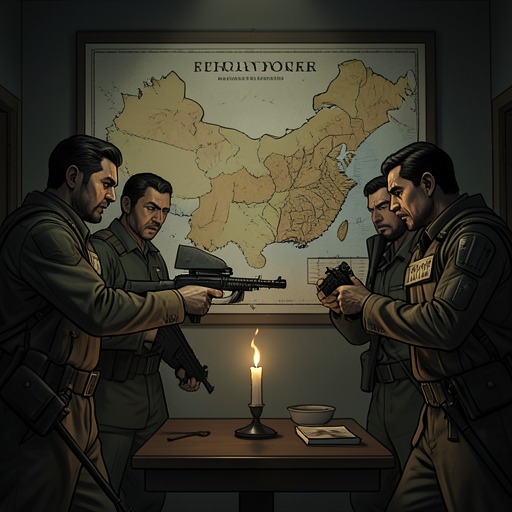
The company’s hostility is connected to organized preparation for invasion. Robin Swift discovers letters containing sketches of Canton’s docks, inventories of Chinese naval vessels, accounts of coastal defences, the locations of forts, and precise troop numbers. These documents are identified as war plans rather than speculative policy papers. The crisis therefore reveals a continuum between commerce and military intelligence: information gathered in the service of trade can become operational knowledge for an imperial campaign. Professor Richard Linton Lovell is found to be among the most hawkish participants, advocating the benefits of war and the linguistic resources that victory would place at his disposal, while describing Chinese forces as easy to defeat. Jardine, Matheson & Company is not the only architect of the conflict, but its commercial objectives help supply the motive and immediate justification for the plans.
Parliamentary Lobbying and Imperial Stakes
The opium-burning disaster brings the company’s campaign into the British political sphere. Commissioner Lin’s proclamation banning English trade from Canton gives Jardine, Matheson & Company an opportunity to argue that Britain must act immediately to defend its honour. The House of Lords begins debating a military expedition, although neither the Whigs nor the Radicals initially feel secure enough to call a vote. The company’s private quarrel is consequently transformed into a question of whether the British state will spend public resources to enforce the claims of private merchants.
The stakes extend beyond the company’s balance sheet. The conflict is tied to silver, which would strengthen British warships and artillery and expand the imperial capacity of the British Empire. A British victory would open access to China’s enormous silver reserves, enabling projects across Africa, Asia, and South America that otherwise seem impossible. Jardine, Matheson & Company’s demand for compensation and free trade therefore participates in a larger system of imperial extraction: private commercial pressure supplies the immediate occasion, while the state anticipates strategic and financial gains on a global scale.
Opposition, Propaganda, and Narrative Significance
The organization becomes a central target of the antiwar campaign conducted by Robin Swift and his allies. Their task is to persuade Parliament and the British public that military action against Canton serves the greed of trading companies rather than a legitimate national interest. Robin extracts the most damaging evidence of collusion from Professor Richard Linton Lovell’s letters and helps turn it into inflammatory pamphlets. The campaign deliberately translates the issue into terms that a London audience will recognize, emphasizing scandal, corruption, collusion, and lack of transparency rather than relying solely on anticolonial or racial arguments.
This strategy reflects the difficulty of opposing Jardine, Matheson & Company. Anthony Ribben argues that the coalition must include unlikely sympathizers and must appeal to the material interests of men who will not respond to justice or human dignity. The company’s profits are linked to the silver industrial revolution, which Anthony identifies as a driver of inequality, pollution, and unemployment in Britain. In that framework, a poor family in Canton and an unemployed weaver in Yorkshire are placed within the same economic chain: neither benefits from imperial expansion, while commercial companies grow richer. The company thus serves as the narrative’s clearest example of how distant suffering and domestic impoverishment can be produced by one imperial economy.
The public debate nevertheless remains dominated by competing national frames. Prowar newspapers describe the invasion as punishment for injuries to the British flag and insist that China will be defeated almost immediately. They depict the occupation of Babel by foreign-born students, the Oxford barricades, and strikes in London as related acts of treason or disorder. Parliament’s refusal to negotiate with Babel and its assertion that Britain will not bow to foreigners show how Jardine, Matheson & Company’s commercial dispute is absorbed into a broader language of racial pride and national sovereignty. The company’s decisive narrative role is therefore not simply that of a merchant organization seeking profit: it is the mechanism through which private economic interests acquire the vocabulary, intelligence, and political protection of empire.