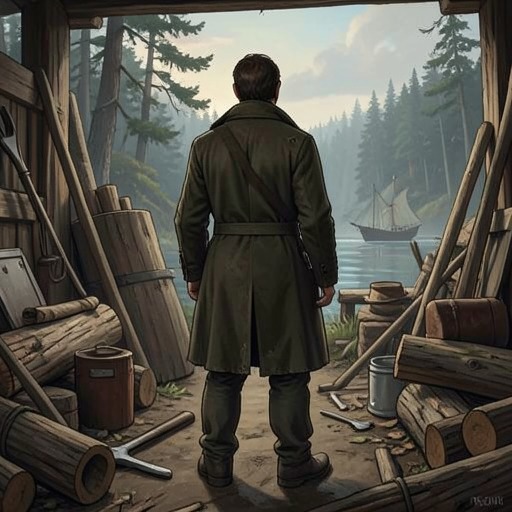
Duquet’s escape from Trépagny
BarkskinsDuquet’s escape from Trépagny is both a disappearance into the forest and the first decisive break in his movement from bound laborer to independent trader. Claude Trépagny’s threat and postponed promise of land make clear the limits of the men’s service; years later, René Sel learns that Duquet survived, while Duquet’s own plans reveal how the flight helped open a path toward a fortune built on forests rather than furs.
Identity and Circumstances
Duquet is an engagé working for Claude Trépagny alongside René Sel. Their master’s authority governs both their labor and their prospects: when René asks whether the seigneur will give them land to work, Claude says it will come only after three years, the completion of the domus, the arrival of his brothers, and the clearing of a new maize plot. Land, in other words, is held out as the end of service, not an immediate right. The exchange gives the escape its material context: Duquet is not simply wandering away from work, but leaving a system in which the master controls when the workers might acquire a foothold of their own.
Claude’s hostility is already personal. As Duquet suffers another tooth abscess, Claude extracts the tooth with blacksmith’s pliers and announces that he will pull them all. Duquet dodges him, refuses to submit, and does not answer when Claude threatens his life. The confrontation supplies the immediate atmosphere of danger around Duquet’s eventual departure, though the account does not state that this particular threat alone causes him to flee.
Disappearance into the Forest
Some days after René’s question about land, Duquet makes an excuse to relieve himself and walks into the forest, still carrying his ax. He remains away for hours. Claude treats the absence with vindictive amusement, describing the dangers of getting lost, drowning, or being attacked by animals and invoking Mi’kmaq forest spirits. René is unsettled by the stories, which make Claude seem immersed in a world he presents as savage and threatening.
The next day, a voice sounds from the distant trees. Claude interprets it as the loup-garou, a forest-haunting figure from French tradition, and warns René not to call back. The voice seems to René to be Duquet’s, calling for his mother, but Claude dismisses that possibility and orders him to keep silent. The men return to the house rather than continue working. The episode therefore withholds Duquet’s fate through a collision of competing interpretations: René hears a lost person, while Claude turns the sound into a supernatural danger. At this point, Duquet’s disappearance is left unresolved, and Claude believes he may have been caught and eaten by the loup-garou.
Survival and Recognition
The truth emerges much later through René’s encounter with Toussaint Trépagny. René has been thinking about a companion who stayed in Wobik with the fur packs and recognizes him as the man he once saw disappear into the spruce shadow. He tests his suspicion by asking whether this companion has bad teeth. Toussaint says the man has no teeth at all and must prepare soft food for himself. René then asks whether the man is Duquet.
Toussaint confirms the identification. René explains that he and Duquet had served together, traveled on the same ship, and been hired by Claude Trépagny; he also reports Claude’s belief that Duquet had been lost to the loup-garou. Toussaint answers that Duquet survived, though he jokes that he may have been eaten only around the edges. The revelation overturns the earlier account of the disappearance: the forest did not end Duquet’s life, and the voice the men feared did not establish that he had become a supernatural creature.
Duquet is no longer merely a presumed victim. Toussaint describes him as a man of affairs who knows important figures in the fur trade, including the English, and says that he expects to become rich. René, for his part, understands why Duquet would not want to see Claude again. Survival has become separation: Duquet has made a life beyond his former master’s household and its authority.
From Escape to Enterprise
Duquet’s later ambitions put the escape in a wider economic arc. During the fur trade’s cycles of surplus and scarcity, he sees that beaver and other living resources may disappear and that markets can falter. He wants wealth durable enough to pass to his sons and imagines establishing a family name. In searching for a resource that seems less vulnerable to those fluctuations, he repeatedly arrives at the forest. He regards timber as a commodity Europe needs for ships, houses, and fuel, and believes New France’s forests can sustain an expanding trade.
This plan does not mean that he immediately abandons furs. He intends to use the fur trade to accumulate money and prepare for a later move into timber. He briefly proposes the future shift to the Trépagny brothers as a possible partnership, but their response is cautious rather than enthusiastic. Duquet’s business plan thus extends the independence suggested by his escape: he seeks not only to leave one employer, but to build a lasting enterprise of his own. The confidence that forests can provide enduring wealth also carries an irony visible across the book, where commercial expansion repeatedly treats timber supplies as inexhaustible even as logging strips forests and leaves waste behind.
Narrative Significance
The escape is first presented through absence, rumor, and fear, then clarified through René’s recognition of Duquet among the fur traders. That delayed confirmation makes the forest both a literal refuge and a space onto which the settlers project danger. Claude’s confident stories cannot explain Duquet’s survival; the man returns not as a ghostly lost figure but as a trader with connections, plans, and a future.
The episode also establishes a contrast that recurs in Duquet’s career. Under Claude, land is a reward postponed until service is complete; Duquet’s later thinking instead treats resources and markets as means to personal and familial independence. His movement from the forest escape to a projected timber business links a private act of departure to the novel’s larger history of extraction. The escape frees him from one form of control, while the commercial vision that follows embraces another kind of dominion over the forest.