John Frost–William Leighton mast-tree trespass case
BarkskinsThe John Frost–William Leighton mast-tree trespass case turns a dispute over pine trees into a contest over land title, royal power, and colonial jurisdiction. A Crown license authorized mast cutting on public land, but the parcel had since become John Frost’s property. Frost sued the logger who cut the trees and won; the later refusal of a Massachusetts court to enforce a royal order transformed the case into a celebrated assertion of provincial authority.
Background and the mast license
The case is recounted during a family discussion about whether to side with England or France. Judge Bluzzard traces the dispute’s origins to London and to the Crown’s history of large land grants, then identifies a 1730 license as the immediate cause. The Crown granted Ralph Gulston, a merchant who traded with the Levant, a five-year license to enter Maine lands belonging to the Crown in 1691 and cut mast pines for the Royal Navy. The license thus depended on an earlier claim of Crown ownership: the relevant lands were treated as public because they had belonged to the Crown at that date.
Gulston later hired colonial logger William Leighton to fell the pines. The case arose because the land’s ownership had changed in the intervening decades. What the Crown’s grant treated as available public land was, by the time Leighton began work, privately titled property. The clash was therefore not simply over permission to cut naval timber, but over whether an old royal claim could override a later land title.
Cutting and the trespass suit
During the winter of 1733–34, Leighton cut and hauled out the mast pines. No one objected while the work was under way. By then, however, the title had passed to John Frost, an American landowner from Berwick, Maine. When spring arrived in 1734, Frost asserted his legal ownership and sued Leighton for trespass.
The court found for Frost. Leighton paid the judgment, apparently settling the immediate dispute between the landowner and the logger. But that payment did not end the larger conflict: Gulston, whose license and interests were affected by the outcome, sought royal intervention across the Atlantic.
The royal order and provincial jurisdiction
After hearing of the judgment, Gulston used his access to the King to obtain a royal order, which eventually arrived in Boston. The effort to bring the Crown’s authority to bear on the case shifted the dispute from the cutting of particular trees to the power of a colonial court to act within its own province.
The motion concerning the order was not heard until June 1738. The court then declared that it had no authority to execute it. Its stated position was that its jurisdiction extended to making law and holding courts for events occurring within the province, and that the royal order was a foreign judgment beyond its power to enforce. The decision did not merely revisit Frost’s title or Leighton’s liability; it denied that the Crown’s order could direct the court’s action in this matter.
Retelling and political significance
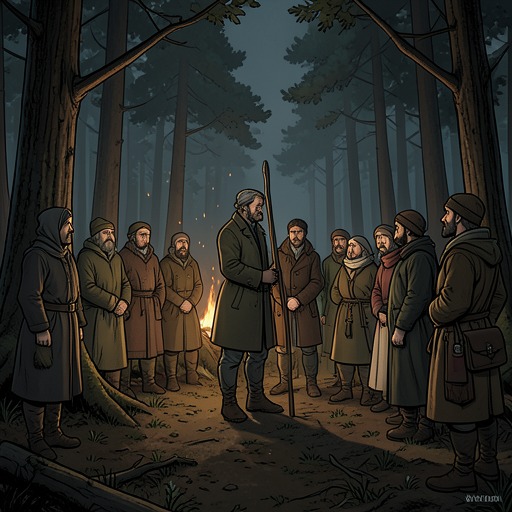
The case is told retrospectively by George and Judge Bluzzard in a conversation in which the family is weighing whether to support England or France. George lays out the sequence from the license and cutting to Frost’s suit, the judgment, and Gulston’s appeal. Judge Bluzzard supplies the court’s reasoning and interprets its refusal as a triumph for an independent American spirit. The framing makes the legal episode part of the characters’ larger argument about allegiance and the authority of the Crown.
Its significance lies in the contrast between imperial authorization and local title, and between the Crown’s demand and the provincial court’s asserted limits. A timber license issued for the Royal Navy could not, in the account given, erase Frost’s ownership; nor could the King’s subsequent order compel the court to enforce a judgment it regarded as outside its provincial jurisdiction. The narrative presents the case as an early instance in which a practical conflict over forest resources became a public test of colonial self-government.