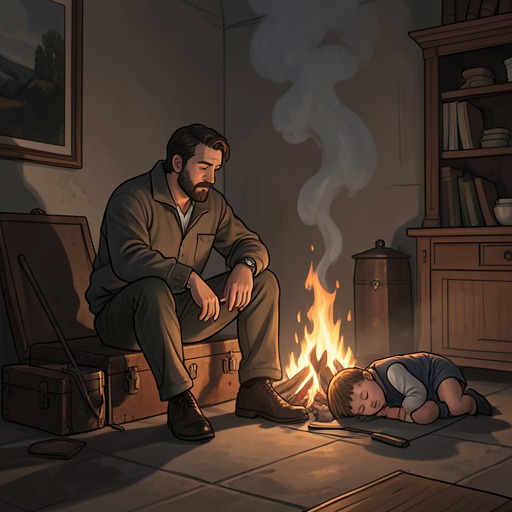
Jinot Sel’s death in New Zealand
BarkskinsJinot Sel’s death in New Zealand begins with an injury while he is cutting a kauri and ends with a storm that destroys his grave and carries his remains into the Pacific. The episode joins the intimate consequences of dangerous labor to the wider extractive system surrounding the timber camps: the tree is treated as a commodity, the worker’s safety as uncertain, and even burial proves vulnerable to the altered landscape.
Background: timber and the forest
The death occurs within a timber economy that reaches beyond New Zealand. Earlier, Charles Duquet had imagined forests as a seemingly inexhaustible source of wealth, an alternative to the unstable fur trade. Centuries later, Duke & Breitsprecher sent its first shipload of pine to Sydney and explored a supply relationship involving New Zealand kauri. The commercial appetite for timber thus connects distant forests to overseas buyers, while the cost of extraction remains at the cutting site.
In the New Zealand shore stations, logging camps were bound up with trading posts dealing in flax, spars, and lumber. Warehouses, sawmills, and small shipyards drew Europeans to the coast; as one area was exhausted, the camps moved on. Kahikatea and then kauri were felled, and fallen timber was burned to clear the ground. This industrial pattern gives Jinot’s work its context: his injury happens not in an isolated encounter with a tree, but within a system organized to take valuable wood quickly and move onward.
The accident at the kauri
Cutting his first large kauri is painful and laborious for Jinot. Before he can begin felling it, he clears a mountain of debris and spends three days making a large enough opening in the trunk to climb inside and swing his axe. His work takes place in a confined space within the tree, with the demands of the task compounded by pain in his leg.
At noon, Jinot moves toward the edge of the opening to climb down for cold tea. He jumps, feels something give way in his knee, and finds that he cannot stand upright. As he falls, his knee strikes the point of a mattock. Arana sees him and helps him down with a forked sapling fashioned into a crutch. Unable to sit, Jinot drinks tea while leaning against the damaged kauri and addresses it as the immediate cause of his defeat: “You got me this time.” The remark makes the tree more than scenery; the encounter between worker, tool, and timber has altered the course of Jinot’s life.
Arana takes Jinot back to the bunkhouse, where the injury is cleaned with water and a strip of cloth. There is no doctor at the camp. Orion Palmer, the trader, undertakes the necessary medical care and examines Jinot the next day. His knee is deformed after a ligament tears and the kneecap shifts upward; the wound from the mattock is swollen and inflamed. Palmer tells him to rest and obtains two patent medicines containing opium, but the camp has no medical resources beyond this improvised response.
Death and burial
Jinot spends a week in and out of drug-induced dreams as the wound becomes infected. Fever leaves him confused: he does not recognize Arana and calls for Franceway. Arana and Palmer see that the injury has become grave, but the treatment available at the camp cannot prevent Jinot’s death. His decline is not presented as an isolated misfortune; it follows a workplace injury in a remote logging camp without a doctor, where the consequences of hazardous labor fall directly on the injured worker.
Arana and Shuttercock bury Jinot near the river at the edge of a hay field, on ground where they had cut rickers two years earlier. Rain begins before the grave is fully covered. It grows into a severe storm, and torrents rush down the bare slopes, carrying rocks, logging debris, logs, gravel, soil, and the old cookhouse. The flood disinters Jinot and sweeps his remains out into the Pacific. The burial, initially an act of care and finality, is undone by the same altered terrain and working landscape that surround the logging operation.
Significance: labor, extraction, and loss
The novel has already shown that river work in logging camps is especially dangerous and that Indigenous workers are assigned to it because employers regard them as expendable. Jinot’s accident occurs during tree-felling rather than a river drive, but his death belongs to that larger portrayal of timber labor: injury is an ordinary hazard, camp medicine is limited, and workers bear risks generated by the pursuit of wood. The account of the camps also emphasizes the physical toll of repetitive work and the lack of secure, comfortable living conditions.
The fate of the grave extends the episode beyond an individual death. Logging clears forests and leaves exposed ground; here, a rainstorm turns that landscape into a force that sweeps away both camp structures and the body entrusted to the earth. Jinot’s remains disappear into the Pacific, while the timber economy that brought him to New Zealand continues to connect distant forests and markets. The ending makes extraction’s consequences tangible without suggesting that the storm alone explains the death: Jinot is first injured at work, left without a doctor, and lost to infection; only afterward does the flood erase the place of burial.