Duquet’s rescue from the wilderness
BarkskinsDuquet’s rescue from the wilderness marks the turn from solitary desperation to survival through other people’s intervention. After becoming gravely ill and losing his way, he is found crawling near a pond by an Odaawa hunting party, which leaves him rather than bring him into its camp. French fur traders later discover him, and an Indigenous woman treats him before the voyageurs carry him by canoe toward an Ojibwa village.
The ordeal before discovery
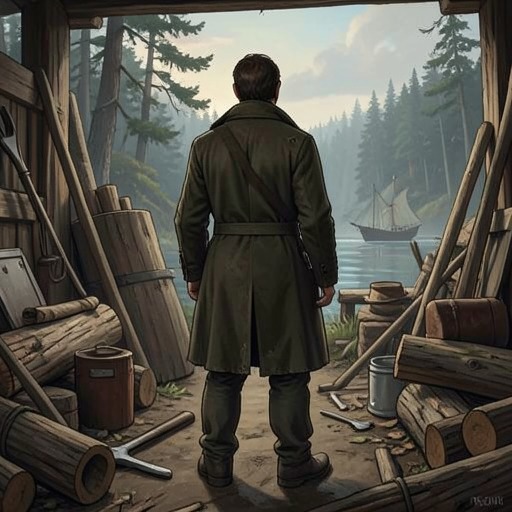
By the third week of his journey, Duquet is profoundly weakened. He has a serious infection in his mouth, wounds on his hands and arms, and cannot reliably stand or walk. He loses the river he has been following, and spends a day searching the ground for it, uncertain where it has gone. His survival narrows to finding food and water: he catches a duckling and follows the possibility of water until he finds the river again. Though he believes he may be dying, he keeps moving north, intent on reaching the fur traders before death overtakes him.
The episode makes rescue contingent on more than his determination. Duquet’s goal of reaching the traders persists, but his body no longer allows him to pursue it on foot. The river, lost and then rediscovered, becomes his fragile route through the wilderness; crawling replaces walking as he tries to follow it.
The Odaawa party withdraws
An Odaawa hunting party has watched Duquet for two days as he inches around the edge of a small pond, sleeping in mud beneath the alders. They recognize that he is sick and wounded. When their voices reach him, he rises onto his knees and gestures as if to attack. The hunters interpret his posture as a threat, laugh, and then withdraw; one identifies him as French. Their decision leaves him where he is rather than bringing him into their group.
The encounter briefly puts Duquet within reach of help without yet delivering it. His condition and the hunters’ interpretation of his gesture shape the meeting: he cannot explain himself, and his apparent hostility contributes to their retreat. The rescue therefore comes later, through another party traveling along the river.
Treatment by the traders
Days afterward, French fur traders stop at a riverside camp to exchange manufactured goods for pelts. The hunters mention the sick Frenchman crawling around the pond, and the traders go to find him. Mud has dried over Duquet, and they break it away before carrying him to the river and washing it off. They doubt he will survive, but the Indigenous woman accompanying them takes charge of his care.
She identifies the infection in his mouth and uses a small wooden instrument with a leather loop to remove his rotting teeth. She gives him a mouthwash intended to fight the infection and an opiate. Her judgment of his prospects is concise: “Not die,” she says. The traders’ initial uncertainty gives way to action shaped by her practical medical knowledge; she is the person who treats him and asserts that he can live.
Removal from the wilderness
Once treated, Duquet is placed in the voyageurs’ worn canoe. They set out for a distant Ojibwa village to the northwest, carrying him away from the pond and the immediate danger of being left alone in the wilderness. The rescue is thus not simply the moment the traders find him: it includes the Indigenous woman’s intervention and the journey that brings him toward a settled community where he can rest.
The episode contrasts isolation with interdependence. Duquet’s own effort keeps him moving toward the river and the trading network, but his survival ultimately depends on the hunters who report his presence, the traders who retrieve him, and the woman who treats him. The scene also places medical knowledge and mobility within the Indigenous communities and fur-trade routes through which he is carried to safety.
The rescue as a turning point
The rescue changes Duquet’s immediate prospects without erasing the vulnerability that brought him to the edge of death. The hunters’ withdrawal leaves him alone, but their later report makes his discovery possible: information passes from the riverside camp to the French traders, who go back for him. His survival depends on this chain of observation, communication, and care, rather than on a single dramatic intervention.
The woman’s treatment is especially important because the traders themselves doubt that Duquet will live. She assesses his condition, removes the decayed teeth with a small wooden instrument fitted with a leather loop, and provides a mouthwash and an opiate. Her brief assurance, “Not die,” counters their uncertainty. The episode presents Indigenous medical expertise as practical and decisive: she takes responsibility for his case, and the traders’ rescue becomes effective through her care.
Significance of the rescue
The episode’s turn is not a return to self-sufficiency but a passage into dependence on other people and on networks of knowledge and travel. Duquet’s determination to reach the fur traders has brought him north, yet when he is found he cannot continue without assistance. The Odaawa hunters’ report carries news of him to French traders; the woman traveling with them supplies the treatment the traders themselves cannot provide; and the voyageurs’ canoe carries him toward an Ojibwa village. Each link changes what rescue means: discovery alone is not enough, and survival follows from communication, care, and transport.
The scene also complicates the fur trade’s usual direction of exchange. Traders arrive at a riverside camp offering axes, hatchets, needles, guns, bullets, and powder for furs. In this instance, however, the decisive value moving through that network is not a commodity but practical medical knowledge. The woman recognizes the infection, treats Duquet, and answers the traders’ doubt about his survival with a brief assurance. The narrative therefore presents Indigenous expertise not as background to European commerce but as the effective intervention that makes this particular rescue possible.
Aftermath and narrative significance
The rescue restores Duquet to a human network but does not turn the episode into a simple tale of individual recovery. The immediate sequence runs from the Odaawa hunters’ observation to their report at the riverside camp, from the traders’ retrieval of Duquet to the woman’s treatment, and finally to transport by canoe toward an Ojibwa village. Each step answers a different need: information makes discovery possible, medical care makes survival plausible, and travel removes him from the place where he had been left alone.
The encounter also places the limits of Duquet’s self-reliance beside the practical knowledge and movement of Indigenous people. He had struggled north toward the fur trade, yet once found he could neither explain his need nor continue under his own power. The traders’ commercial exchange of goods for pelts forms the setting, but the decisive exchange is care: the woman assesses and treats him while the voyageurs carry him onward. Her brief assurance, “Not die,” stands against the traders’ doubt and makes her intervention the hinge between discovery and survival.