Great Fire of 1910
BarkskinsThe Great Fire of 1910 was a vast wildfire that burned more than three million acres of prime timber and settlements in Montana, Idaho, and eastern Washington in two days. Its destruction shocks a country that had located its imagined wilderness in the western forests, and sharpens the novel’s conflict between extractive use and the difficult work of forest restoration.
Scale and Public Shock
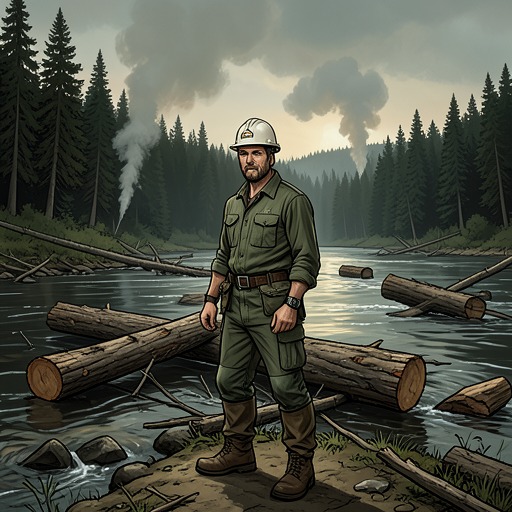
The fire is presented as an unprecedented blowup crown fire, racing across hundreds of miles and consuming remote forest and settlements within forty-eight hours. Newspaper headlines reported the destruction of what many Americans regarded as the country’s wild heart. The scale matters not only as a disaster but as a rupture in the belief that immense forests would remain available beyond the settled frontier.
The catastrophe belongs to a wider history of land clearance and timber exploitation. Earlier, settlers’ chopping and agriculture had driven animals from their habitats, while commercial logging repeatedly treated another stand of trees as an unlimited substitute for the one already cut. Against that accumulated damage, the 1910 fires make forest loss suddenly visible at a continental scale.
Dieter’s Response
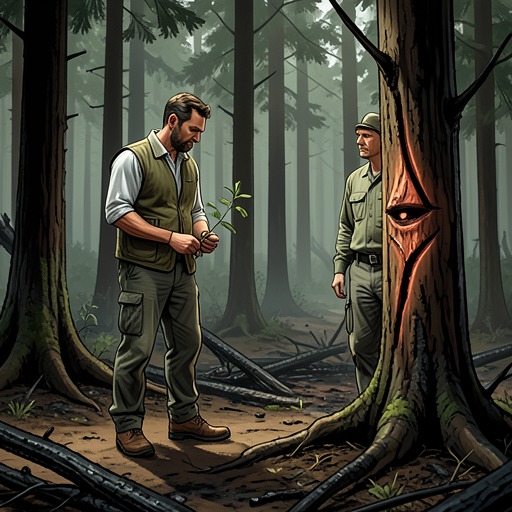
Dieter Breitsprecher answers the disaster with an organized campaign for public action. He presses politicians and members of Congress for more money and authority for the Forest Service, and opposes the claim that fires are beneficial because they open land to settlement. His response links protection of scenery to practical concerns: he volunteers to establish pine and fir seedling nurseries to replant burned mountains and help restrain landslides from exposed soil.
He also tries to enlist his older son, Charley, in the effort. Dieter proposes a meeting with James Bardawulf and Andrew about salvaging burned timber and asks Charley to join the work of restoring damaged land. The appeal reveals Dieter’s hope that commercial forestry and repair might be made compatible, rather than allowing devastation to become merely another opportunity for extraction.
Charley’s Rejection and the Novel’s Conflict
Charley refuses the invitation. He predicts that the destruction will recur until careless settlers have burned the country clear, and regards salvage logging as akin to taking from a corpse. His refusal sets the fire’s aftermath within the family’s larger disagreement over what a forest is and whether it can be renewed through management. Where Dieter sees a reason to organize restoration and sustain future timber supplies, Charley doubts that human institutions can halt repeated destruction.
The fire therefore functions as both catastrophe and test of competing environmental convictions. Its immense burned area makes the consequences of forest exploitation impossible to dismiss as a distant or gradual loss, but it does not produce consensus: Dieter turns shock into advocacy and replanting, while Charley sees the damage as part of a cycle that will continue. The episode leaves restoration as an urgent undertaking whose success is not guaranteed.