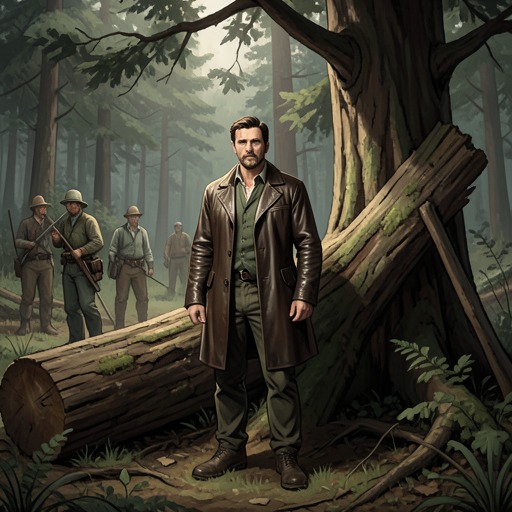
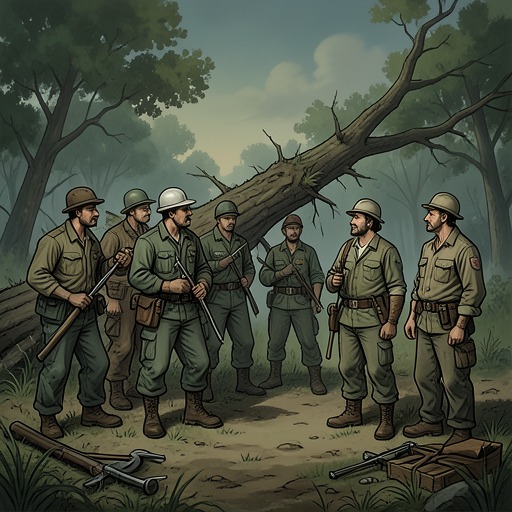
Franz Wei died in a logging river accident
BarkskinsFranceway’s death in a logging river drive turns dangerous work into a lasting personal loss for Jinot: while the two men try to free a jammed river, a released log strikes Franceway, and Jinot watches without being able to call out. The accident marks the end of Jinot’s childhood in the woods; its memory recurs years later beneath a bateau and remains bound to Franceway’s songs.
The Hazardous World of the River Drive
The accident takes place in the seasonal work of moving logs downstream. River work is described as the most dangerous task in the camps, with wooden crosses along the banks marking past deaths. The work was assigned to Indigenous laborers by the boss, who treated drowning as a risk shared by all men. Logs had to be moved by water to reach the sawmill, and a camp boss later explains that the company must accept the expense of the drive because there is no other way to get its logs to the saw house.
The river drive required workers to read how timber moved and where it caught. When a crooked log lodged on a ledge, more logs crowded against it, building into a jam. Marchand ordered the men to roll logs down from the top, not realizing that the crooked timber at the bottom was holding the mass in place. Franceway recognized the problem, set down his pike pole, fetched his ax, and tried to make Marchand understand that the jam had a key log. The scene makes the danger a consequence of the work’s physical arrangement: clearing the blockage means entering the unstable mass that the blockage is holding.
The Jam Breaks
Franceway and James Ketchum chopped their way down through the jam to the bent log and began cutting into it. As the log started to crack, Ketchum called for them to run. Franceway instead delivered one final blow. The key log broke, the jam began to move, and the gathered timber poured over the ledge.
Jinot watched from a bateau above the jam. A log about thirty feet long rose with the releasing pile, then fell and struck Franceway. The blow killed him. Jinot opened his mouth to scream but could not produce a sound. The accident’s decisive reversal is stark: the action intended to release the river’s flow succeeds, but Franceway is caught in the force it unleashes, while Jinot becomes a witness unable to intervene.
Jinot’s Loss and Its Return
The workday continued until after sunset. Bereaved, Jinot crawled beneath the bateau and lay beside the place Franceway had occupied. He did not sleep; he wept and rolled back and forth. The account identifies this as the first of many sleepless nights, making the accident not a grief Jinot quickly leaves behind but the beginning of a recurring response to loss.
Jinot tried to get past his misery by working. He became a quick, sure-handed chopper and volunteered for spring drives, earning recognition along the rivers for his fluid, quick-footed style. He continued working in camps, went home in summers, and later moved between rivers with his brothers. But the work that provided a way forward also kept him within the world in which Franceway died.
Years later, around the turn of the century, Jinot returned by mistake to Marchand’s camp, this time in the Allagash watershed. He slept beneath a bateau, remembering Franceway from their youth and wondering what their lives might have been like had both survived into their thirties. The old image had become attached to a particular place and habit: Jinot would always think of Franceway when he slept under a boat. In the night he dreamed of his friend, but the person who woke him was his half-brother Francis-Outger, not Franceway. The scene separates dream from present reality while showing how persistently the dead friend returns in Jinot’s memory.
A Songbook as Remembrance
Franceway’s memory survives not only in Jinot’s recurring thoughts but in a small songbook. After Beatrix’s death, Jinot gathered his possessions and placed Franceway’s tiny songbook among his precious mementos. It held only two or three reminder words for many songs, yet it could summon the beloved voice Jinot associated with them. The object links the earlier accident to a later departure: in the same moment that Jinot holds onto a remnant of Franceway, he is also preparing to leave the Penobscot house.
The story therefore gives Franceway’s death consequences beyond the immediate loss. It ends Jinot’s childhood, initiates a pattern of sleepless grief, and remains present through the work, places, dreams, and keepsakes that follow. The river drive is one episode in a dangerous labor system, but for Jinot it becomes a dividing line: Franceway’s absence cannot be repaired, only carried forward through memory and song.