Ava and Gideon begin exchanging letters
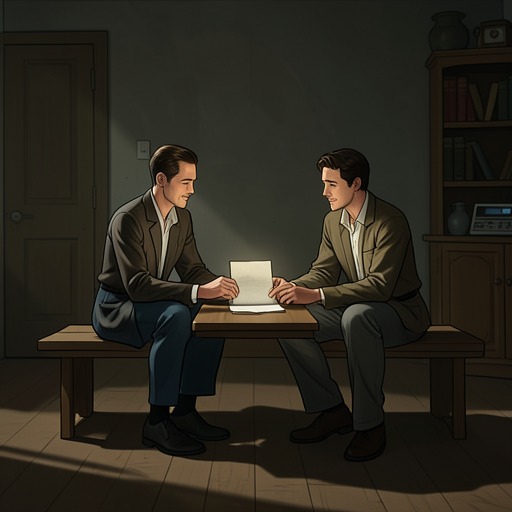
BeautifulAva and Gideon begin exchanging letters after Gideon sends Ava a mint-green envelope containing his first real letter. What starts as an awkward invitation becomes a reciprocal, carefully bounded way for them to be candid with one another: Gideon risks showing the person behind his shyness, while Ava answers with jokes, questions, and a more direct account of how she sees the world. The correspondence gives their developing friendship a form that is both intimate and low-pressure, built from small disclosures rather than demands for immediate explanation.
Background and First Letter
The first letter arrives at a moment when Ava feels that several parts of her life have come undone. She has been expelled, and her father has decided she will meet with TAPs; she has no say in that decision and is already disappointed in herself over what has happened. Against this backdrop, her father hands her a mint-green envelope. Inside are two pages of Gideon’s neat handwriting. The object is modest, but its arrival interrupts a day in which Ava has been bracing for things to get worse.
Gideon begins by admitting that he has never written anyone an actual letter before. He is unsure how long a letter should be or what important thing he might have to say, but settles on telling Ava that he is glad they met. Instead of presenting himself as effortlessly confident, he supplies ordinary details: he is seventeen, in Year 12, has a sister and two mothers, writes poems, likes guacamole, and dislikes bananas. His explanation of the dislike turns into a comic riff on their texture and a possible metaphor for people, then into a numbered list of things he finds weird.
The list extends his self-portrait. Gideon includes snakes, which he finds strange because they can swim without arms, people who put an r sound in ask, and people who can write letters without lists. He briefly admits that his claim about lists is a deliberate attempt to seem cooler, then tells Ava that she is naturally and effortlessly cool. The praise is mixed with self-mockery and uncertainty about letter etiquette, making the letter feel less like a polished performance than an effort to keep talking despite not knowing the rules.
Ava’s Reply and the Exchange of Jokes
Gideon asks Ava to write back if she wants to. Ava rereads his letter, finds it funny, smart, and dorky, and is surprised that he has actually sent it and disclosed real details about himself. She decides to reply partly because she does not want him to think she does not want his friendship. Her first response keeps the playful tone: she calls him an idiot for calling her weird, then wonders whether that makes them even. She also explains that her father has rules about appropriate language and asks Gideon to tell her more about having no phone or internet and not acting normal.
Ava’s reply is itself an act of improvisation. Writing late because she cannot sleep, she worries about her handwriting and whether letters are merely an excuse to rant. She signs off affectionately and asks Gideon to write again. Then she explains that she hand-delivered the letter because she did not know where to buy a stamp. Looking up his address on her phone led her to realize she could have used the phone to find a post office; the small practical problem opens, in her telling, into an existential crisis about technology and her place in the world. Her self-deprecation answers Gideon’s own rather than simply reassuring him.
Gideon’s reaction is immediate and physical in its buoyancy: he describes happiness as a quick, squishy feeling, and is pleased that Ava has mocked him back. He had written four drafts of his first letter and could recite it by the time he sent it; he suspects Ava’s reply is a single, unrevised original. That difference delights him. He had feared that the letter might make things awkward at work, but her answer tells him that it has landed well and that she wants another. His relief carries a further uncertainty: he feels he must learn how to proceed without turning the next letter into another object of obsessive revision.
A Deliberate Practice of Writing
Gideon turns that uncertainty into a practical rule. Remembering Ria’s writing-class insistence that students should not apologize for existing or for what they have to say, he sets a kitchen timer for thirty minutes. Whatever he writes in that interval must go into an envelope. He plans to address and stamp it, give it to his mother to post, and tell her not to return it if he later asks. When the timer rings, he signs the letter, folds and seals it without reading it back, and hands it over with that instruction. He scarcely sleeps, imagining possible disasters, but does not ask for the letter back. The correspondence therefore begins to work not only as communication with Ava but also as a small exercise in acting before anxiety can take over.
The next mint envelope brings five stamps tumbling to the floor as Ava opens it on the porch. Gideon uses his letter to clarify that he dislikes bananas, not all fruit, and describes using the same thirty-minute timer and no-revision limit. He admits that he thinks about nearly everything and says that Robbie has been urging him to be bolder. His postscript asks what a post office is, turning Ava’s delivery mishap into a continuing joke between them. The letter’s honesty is not separate from its humor: Gideon can reveal his self-conscious habits while still making the exchange light enough to continue.
Ava likes receiving his letters and recalls that, at work, Gideon talks to her without flirting or placing expectations on their time together. Their conversations about customers and his references to books and films she has not encountered feel light and fun to her. The contrast matters: she describes being around him as free of the history and anticipation that complicate other interactions. She decides to answer immediately, takes out her notebook, sets the oven timer, and writes a long reply at the kitchen bench, surprised by how much she tells him.
Mutual Disclosure and Narrative Significance
In a subsequent letter, Ava agrees to the thirty-minute limit and to not reading the result back, though she confesses that she looked up the word foible before writing. She challenges Gideon’s interest in being normal: in her view, people have different troubles but often try to convince one another that they are ordinary. She says she would rather people be honest about being unhappy, unwell, or happy than maintain that performance. She also contrasts her former optimism with what has changed after difficult events, describing how learning that the world can be awful makes it hard to return to believing that everything happens for a reason. She closes by telling Gideon to be happy, then admits in a postscript that she wrote well beyond the timer. The rule has become a shared experiment, not a rigid test either has to pass.
After several days without a reply, Gideon worries that Ava may not write again. On returning home following a conversation with Robbie about Robbie’s future move, he finds Ava’s letter on his bed and feels relieved. Her correspondence has become something he actively anticipates, even as each letter exposes how readily he imagines it going wrong. Across the exchange, the envelopes, stamps, timers, and revisions—or the decision not to revise—give shape to a friendship whose participants are still learning how to speak plainly. The letters do not erase the uncertainty or distress in their lives; they make room for candor, humor, and a continuing connection without requiring either person to pretend to be fine.