Ava begins at TAPs
BeautifulAva Spirini’s first days at TAPs, The Alternative Program, mark a change not simply of school but of how her distress is received. Expelled after punching Trevor Lane for insulting Kelly, she arrives expecting the new school to confirm her own contempt for it. Instead, a teacher’s quiet intervention and classmates’ matter-of-fact acceptance unsettle her assumptions: at TAPs, she can say she is unhappy without becoming a spectacle.
Background and Referral
At MacGreggor State College, Ava’s grief has collided with the school’s rules and expectations. In a meeting with Mrs Bryan, Ava and Ava’s father are told that staff and students are concerned for her, but support is tied to behaving according to school rules and not disrupting an assembly. Mrs Bryan recommends counselling; Ava rejects the suggestion, connecting it to Kelly and insisting that she is upset and intended her outburst to show it. The meeting leaves her feeling that the school is passing responsibility elsewhere rather than understanding what has happened.
The practical response is a shortened timetable, but Mrs Bryan also warns that Ava may have missed enough school to repeat. Ava’s father does not know the extent of her absences: she has been skipping school and going to work instead. That history makes the transfer a consequence of more than one incident. After Ava punches Trevor Lane, Mrs Bryan tells the family that the school will expel her, recognizes that Ava has experienced trauma, and says the institution can no longer support her. She recommends TAPs as a better fit for Ava’s immediate needs and Year 11, handing Ava’s father a bright red-and-yellow pamphlet with contact information for Rahila Saeed.
Ava’s first response is shaped by the stigma she already associates with alternative education. She imagines TAPs as a place for teenage mothers, bullying victims, students marked as strange, and young people with anger issues—the last category turning back on her when she recalls why she has been sent there. Her transfer thus begins with a double judgment: the former school classifies her behaviour as grounds for removal, while Ava has absorbed dismissive ideas about the students who attend TAPs.
First Arrival
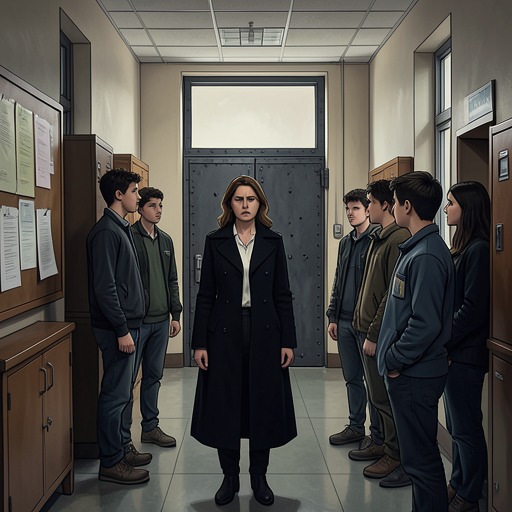
On her first day, three boys watch Ava through the glass of a door leading to a courtyard. One has a mohawk; he nods and smiles, and the others laugh and pat him on the back. Feeling exposed in denim shorts, Ava rolls her eyes and gives them the finger. Their laughter makes the encounter feel, at first, like confirmation that she will be watched and judged in her new school.
Rahila Saeed, TAPs’ head teacher, interrupts that dynamic. She greets Ava, looks through the glass, and quickly signals for the boys to leave. Then she turns her attention back to Ava, touches the corner of the bright blue headscarf resting on her shoulders, and touches Ava’s arm as she reassures her. The gesture and calm manner contrast with Ava’s earlier experience of adults discussing her conduct and needs as a problem to manage. Ava remembers that their meeting the previous week had already made her feel better about the move: Rahila had spoken to her, not about her, and had asked what she wanted and what her goals might be.
The school’s practical differences also matter to Ava. She will not have to wear a uniform; there are only forty students; the days are shortened; extracurricular programs are available; and students call teachers by their first names. When Ava says she has no goals, Rahila suggests that making some is a goal in itself. Ava agrees to try, and she notices her father’s body relax. The transfer therefore offers a modest but concrete beginning: not a completed plan for Ava’s future, but a conversation in which she is asked to help define one.
A Classroom Without a Spectacle
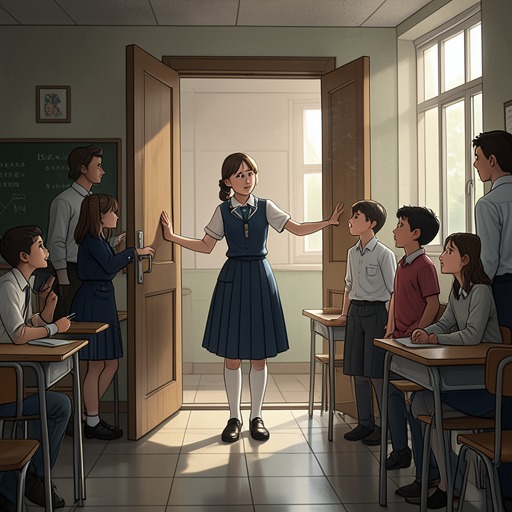
By lunchtime, Ava has begun to understand how TAPs works. In English, Minda argues with Allan, who has apparently provoked her without reading the chapter under discussion. Their exchange is lively rather than hushed: Jason, Ava’s new English teacher, urges the class to explore why Minda thinks Allan is prejudiced, while also reminding her about her language. The lesson turns from their disagreement to the judgments people make about one another.
The group is small—ten students—and Jason asks each person to name a basis on which others judge them. Students mention clothes, piercings, hair colour, and music. Minda describes how people judge her for having a child at fifteen. Rae explains that people assume she is unhealthy because she is fat, then counters that assumption by mentioning how much she can bench-press, to the group’s impressed laughter. The exercise gives Ava a set of specific examples of how people are reduced to visible traits or circumstances before she has to speak for herself.
Ava says that people think she is happy because she is funny. When Minda asks if she is, Ava answers no. The bluntness surprises Ava herself, but it does not stop the lesson or prompt a joke. Minda smiles in recognition, and the others simply nod. Jason continues teaching as though Ava’s answer needs neither interrogation nor a special intervention. For Ava, that ordinary response is the turning point: she realizes that her classmates have their own difficulties and are not making her grief the sole subject of the room. The relief feels almost like sunlight through a window; she even finds herself happy, a feeling she regards with surprise.
Friendship and a Different Kind of Belonging
Two days later, Ava stays after school and spends the afternoon with Minda and Rae. She learns that they are dating, and goes with them to Minda’s home, a small brick duplex shared by Minda, her grandmother, and her one-year-old son, Maddox. As Ava hands the child a plastic train, Minda asks whether it is strange for Ava that she has a child. Ava says it is not, adding that having a child would be strange for her because she can barely look after herself at that point.
Ava’s account of Minda is notably admiring. She sees her as confident and smart, someone who tells people when they are being inappropriate or racist and asks good questions without being rude. Minda has effectively adopted Ava into the student group from the first English lesson, introducing her to others and explaining how things work. The friendship develops through practical welcome rather than a promise to solve Ava’s grief: Minda includes her, makes space for candid talk, and brings her into the ordinary life of her home.
Beginning at TAPs consequently reverses Ava’s expectations without erasing the reasons she arrives. Its students are not the caricatures she had imagined, and Ava herself is not reduced to her expulsion or anger. The school’s small classes, relaxed arrangements, and candid conversations give her a place where unhappiness can be admitted without becoming an exception that interrupts everyone else. Her first steps toward belonging are modest—trying to name a goal, staying after class, visiting a friend—but they offer a contrast to the institutional rejection that preceded them.