Ava and Gideon share secrets with each other
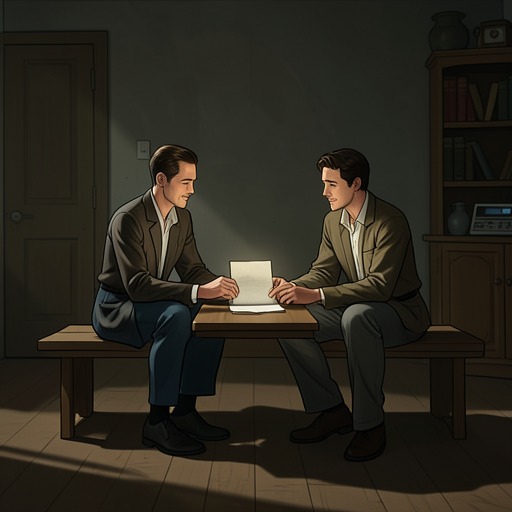
BeautifulAva and Gideon share secrets with each other in a carefully negotiated conversation that changes their closeness from quiet understanding into explicit trust. Ava discloses that Lincoln caused the bruise on her cheek, and Gideon reveals that his family moved because the bullying he endured at school became overwhelming. Their exchange also brings into view Ava’s complicated feelings about her mother and Gideon’s current struggle with anxiety and depression. The scene’s decisive movement is not toward a solution but toward being believed, staying present, and allowing another person to know what has been hidden.
Conditions for Disclosure
The conversation takes place within a relationship already marked by grief and growing intimacy. Both have reasons to approach painful subjects carefully: Ava is carrying the loss of Kelly Waititi, while Gideon has his own history of distress. Their exchange does not begin as an interrogation. They establish that non-verbal communication is acceptable, and they make the disclosure feel reciprocal by agreeing to take turns. That arrangement gives each person room to speak without making silence or hesitation a failure.
Ava’s first admission is that she does not think she loves her mother. Gideon has time to respond, but Ava covers his mouth before he can, turning the moment into a brief, playful interruption. The gesture does not erase the seriousness of what she has said; it shows that the terms of the conversation still belong to her. She decides when to continue and when to move on. The alternation between playfulness and painful material lets the disclosures emerge without making the scene a formal confession in which every statement has to be explained immediately.
Ava Names What Happened
Ava next tells Gideon that he has misunderstood the bruise she once had on her cheek: she was not clumsy, and Lincoln Waititi caused it. The disclosure revises what Gideon thought he knew about both the mark and Ava’s continued connection with Lincoln. Her statement is particularly difficult for Gideon because she still talks to him, while Gideon sees Lincoln as someone who behaves aggressively and is admired by other students. His anger rises quickly, and he has to pull Ava’s hands away from his mouth before he can respond. The scene registers the strain between wanting to protect her and hearing that she has kept this from him.
Ava’s revelation also changes the meaning of her earlier silence. She has carried the knowledge privately rather than using the conversation to ask Gideon to intervene or decide what she should do. Her disclosure gives him access to a fact she has chosen to share; it does not make him the authority over her response to Lincoln. The exchange therefore exposes both the gravity of what she tells him and the limits of what he can do with it. His anger is real, but listening has to come before any attempt to act on her behalf.
Gideon Explains the Move
Gideon answers Ava’s disclosure with one of his own: his family moved because he was not okay. He describes being picked on throughout school for being tall, for having two mothers, and for having a sister who was smart. In Year 7, classmates found a story he had written about a sad moon during an eclipse, copied it, and posted it around the school. He presents each incident as small in isolation, but emphasizes that the small cruelties accumulated through repetition.
He then names the escalation that makes the reason for the move unmistakable: students created a website devoted to hating him, filled it with abuse, and posted secretly taken photographs of him with hostile comments. Ava responds with sympathy and places her hand on his knee, leaving it there. Her reaction is not advice or an effort to argue the experience away. It is a physical sign that she is listening and remains beside him after learning what his family’s move had concealed.
Gideon also tells her that he is in a dark period and taking medication. He describes his anxiety as part of his experience, not as a complete account of who he is; when he falters over whether it is simply his brain, Ava links the feeling to what she understands of Kelly’s mind. The comparison does not claim that their experiences are identical. It gives them a point of recognition while leaving room for the differences between them. Gideon’s disclosure makes clear that the history of bullying is not only a closed chapter: he is still managing distress in the present.
Witnessing Without Repair
After the disclosures, Ava tells Gideon that she thinks he is amazing. He closes his eyes, and a tear gives way to sustained sobbing. He turns away and cries into a pillow; Ava moves close, puts an arm beneath his, and holds him. Gideon eventually takes her hand and draws it toward his chest, intertwining their fingers. Neither tries to convert the moment into an explanation. The physical exchange answers what the disclosures have made vulnerable: he can be seen in distress without being abandoned or pressed to stop.
The conversation’s idea of support becomes explicit when Gideon tells Ava that she can be there with him. His answer sets a limit as well as an invitation: she cannot undo what happened, but her presence matters. This is consistent with the earlier exchange, where the value lies in hearing one another rather than supplying quick advice. The scene moves from withheld information, through anger and painful recognition, into shared vulnerability. Its change is relational: each now knows something consequential about the other, and neither has to carry that knowledge alone.
Place in the Wider Story
The confidences sit within a wider pattern in which grief and recovery do not proceed in a straight line. Ava has described school after Kelly’s death as unbearably slow and has doubted that she will ever feel differently. Elsewhere, she recognizes that being with Lincoln can briefly make the rest of life matter less, while also knowing that the comfort is complicated by Kelly’s absence. These disclosures do not resolve her grief or make the past manageable. Instead, they create a relationship in which difficult truths can be spoken alongside affection and uncertainty.
Gideon’s later reflections on therapy reinforce the importance of this kind of response. When he speaks with Robbie about the aftermath of a frightening episode, Robbie asks him to identify the good as well as the painful. Gideon describes writing letters, while his account of his mental health acknowledges that medication and support have helped without promising that difficult moments have disappeared. Nola likewise tells Ava that grief has no typical path and that its course cannot be scheduled. Read alongside those moments, the mutual disclosures model a modest form of care: another person may listen, believe, and remain present, even when neither can make the grief or the underlying history vanish.