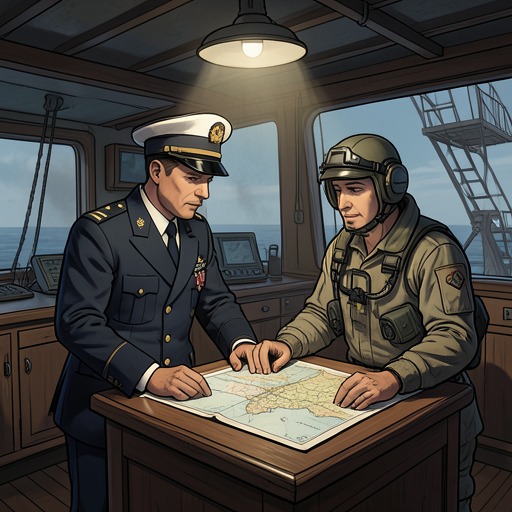
Henri Marcell—Anna Strauss
BlackwaterHenri Marcell and Anna Strauss are commander and executive officer aboard the TNV Blackwater, but their relationship is more than a division of rank: it is a working trust tested by decisions that can endanger their crew and the civilians caught in the war. Strauss questions Marcell directly when his choices carry risk, and he relies on her to carry out urgent orders amid combat. Their partnership joins practical coordination to disagreement over what responsibility demands.
Command Partnership
Strauss serves as Marcell’s executive officer, a position that places her beside him in the ship’s command decisions. When an encrypted burst arrives from a military supply ship, she recognizes that such a transmission is unusual and begins to question what it might mean. Marcell completes her thought: the ship may be carrying top-secret cargo, possibly ammunition, spare parts, or even components for a vessel. He then turns the discovery into an operational opportunity, ordering that Roland Horn and Duncan Glenn be brought to the bridge. The exchange shows how their shared command work moves from observation to inference and action without either officer having to explain the whole situation to the other.
Their coordination also rests on a larger tactical picture. In a briefing aboard the PFSS Grain & Steel, Rocco Swift hears that the Union intends to move on Phobos and that the taskforce will try to disrupt its plans by disguising its approach. Reconnaissance and electronic-warfare cruisers will make the force appear to be a civilian flotilla fleeing the Amazon Sea, while heavier ships hide in the radar shadow of smaller vessels. This wider reliance on deception forms the military context for the Blackwater’s later efforts to mislead the Union: Marcell and Strauss operate in a campaign where reading signals, concealing intent, and acting on incomplete information are indispensable.
Disagreement and Civilian Protection
The clearest test of their trust comes after Marcell and Gunnery Sergeant Hoffmann consider the possibility that a supply drone is a trap. Strauss asks Marcell whether he and Hoffmann had considered the danger. He answers that they had, and calls the decision a calculated risk. His explanation shifts the focus from tactical opportunity to the people the decision is meant to help: he saw a chance to keep them fed, and the civilians had not chosen to be pulled into the war. Marcell compares their predicament to Vespa, adding that the difference now is that he is the one in charge.
Strauss does not treat that humanitarian purpose as a reason to disregard the military situation. She warns that they are on borrowed time because Union forces are moving through the area; they are fortunate the enemy has not committed its entire taskforce to finding them. Marcell replies that she is not telling him anything he does not already know. The exchange is direct rather than conciliatory: Strauss states the danger, while Marcell acknowledges it without withdrawing the decision or denying its cost. Their disagreement makes visible a shared pressure, not a breakdown in confidence. He accepts her warning; she challenges him because the crew and civilians remain exposed to the consequences of his choice.
Trust Under Combat Pressure
That trust becomes operationally concrete during Roland Horn’s dangerous maneuver. Marcell watches Roland’s identification marker move away from an explosion and realizes that, although Roland appears to have survived, the maneuver has left him unable to reach the transport and return safely. With the Blackwater reduced to two Panzerters—and potentially only one—Marcell orders Strauss to hail Roland and tell him to turn around if she can raise him. The order gives her a clear, immediate role at a moment when the consequences are personal as well as tactical: the commander sees the danger, and depends on his executive officer to try to reach the pilot.
The situation does not offer a simple rescue or an easy alternative. Marcell still has destroyers, frigates, and orbit-patrol cutters, but the cutters would be of little use in a direct fight against Union warships. Their value lies in relaying data from astrogation buoys and guiding civilian ships through the hazardous zone. The Union’s attention may now turn toward the lower shoal zone after the reconnaissance cruiser is crippled, leaving Marcell to weigh the threat against the limited force he has. In this setting, Strauss’s role is not merely to transmit orders: she is part of a command partnership operating under severe constraints, where every decision has consequences for both combatants and civilians.
Shared Work and the Cost of Command
Marcell’s response to the enemy’s uncertainty shows the kind of command Strauss supports. He orders the Blackwater to follow the Union formation, takes several cutters for navigation, and directs an open-channel broadcast claiming that a large taskforce from the belt will arrive in five hours after refueling at Deimos. When asked how he knows such a force is present, he admits that he does not. Jamming and interference prevent certainty, but he hopes the broadcast will make the Union react to them rather than dictate the terms of the encounter. The stratagem is a deliberate bluff, not confirmed intelligence: its purpose is to alter the enemy’s choices by making a possible threat seem real.
The same preference for shaping the odds informs the use of deployable magnetic mines. They attach to a vessel, avoid friendly craft by checking identification signals, and turn into shaped charges against a target’s hull. Clearing them forces enemy ships to move slowly and use point defenses manually, exposing them to fast missiles. When a Union destroyer misreads a missile carrying megathermal warheads as another minelayer, the error proves fatal: the warheads strike amidships, the drive fails, and the ship splits in two. This sequence does not establish that Strauss planned each element of the deception or weapons attack; it places her partnership with Marcell within a broader campaign that rewards careful coordination and the exploitation of enemy assumptions.
A Mismatched Crew, a Shared Purpose
Later, when Charlotte Huber and Roland discuss the crew’s unconventional composition, Strauss explains that the Blackwater exists to attack the Union in a way it is unprepared for. A mismatched crew is therefore consistent with the ship’s purpose, rather than a defect that must be concealed. Her explanation connects the ship’s unusual personnel to Marcell’s broader operational approach: adaptation matters because the enemy cannot be met on familiar terms alone.
Across their scenes together, Strauss is neither a silent subordinate nor a rival commander. She spots implications, presses Marcell on risk, and carries out his orders; he listens to her assessment and trusts her with urgent communications while retaining responsibility for decisions. Their relationship is defined by that balance. In a war shaped by shortages, hidden intentions, and civilians who did not choose to become part of the fighting, their command partnership makes room for disagreement without surrendering their shared duty to keep the Blackwater and those around it alive.