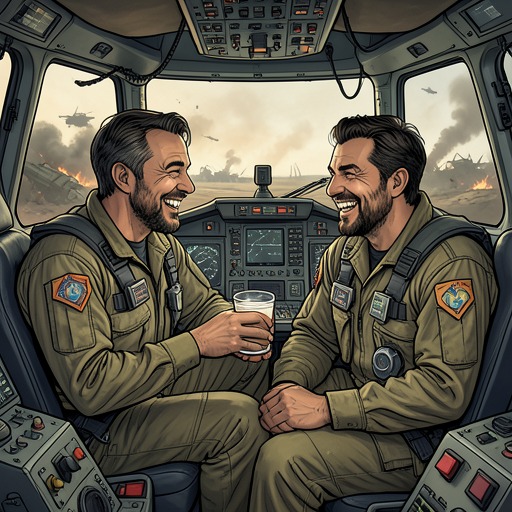
Roland Horn–Duncan Glenn relationship
BlackwaterRoland Horn–Duncan Glenn relationship is a battlefield partnership formed in the middle of combat rather than through a formal introduction. Roland first treats Duncan as an unidentified friendly pilot, offering him a way to survive and disable a recon cruiser; after the rescue, the two establish their names and fall into the work of flying together. Their bond is defined less by ceremony than by rapid coordination, mutual trust, and the shared risks of protecting a civilian flotilla from Union forces.
Formation Through Rescue
The relationship begins when Roland, facing a damaged recon cruiser and several pressing threats, spots a falling Panzerter whose path intersects the cruiser. He calls to its pilot, asking him to straighten his flight path and prepare his sword, then assigns him a precise task: strike the engineering section and kill the ship’s drive. Roland promises to return for him, turning a desperate tactical proposal into an offer of rescue as well as a combat plan.
The unidentified pilot carries out the attack. His Panzerter reaches the cruiser’s engineering section and disables its drive, while Roland survives the surrounding engagement and closes on the target. The exchange makes their first connection one of reciprocal, practical reliance: Roland gives the stranger a specific chance to act and promises not to leave him behind; the stranger responds under fire rather than withdrawing from the fight.
Once the immediate danger has passed, Commander Anna orders Roland to return to base with the rescued pilot. Roland retrieves the damaged Panzerter IV by its backpack handles and carries the additional machine despite the strain on his own thrusters. When he tells the pilot that he is part of the crew and asks his name, the answer is Duncan Glenn. Roland gives his own name, Roland Horn, and promptly nicknames Duncan Wolverine. Their introduction therefore follows the rescue itself: the two become identifiable to one another as the consequences of their battlefield cooperation are still unfolding.
A Partnership Put to Work
The next major test comes during the Union attack, as a civilian flotilla travels through the Lusatia cluster. Commander Anna Strauss assigns Roland to intercept enemy torpedo Panzerters and Duncan to deal with the torpedo boats and destroyers. The division of labor gives the newly formed pair distinct responsibilities within a common defensive mission, with civilians moving through the same contested space and neither pilot able to treat the engagement as an isolated duel.
They launch together from the Blackwater, then push toward the vulnerable passenger ships. Roland realizes that he has outpaced Duncan and tells him to use the debris to gain speed, making their first visible adjustment in the field a practical effort to keep the pair together. When Roland spots the enemy, he sets the terms of their attack: they will strike and withdraw, aiming to keep the Union forces uncertain rather than destroy every opponent. Duncan accepts Roland’s direction without turning their uncertainty over seniority into a contest. Roland has not established which of them outranks the other and considers that Duncan might be close to junior-grade status, but his private uncertainty does not interrupt the mission.
During the attack on the Union torpedo force, both pilots demonstrate the complementary value of the arrangement. Roland destroys a torpedo boat by damaging its forward hull and detonating its magazine, then disables another by attacking its engineering section. Duncan evades a corvette, removes the point-defense turret threatening him, and fires torpedoes that destroy two more corvettes in succession. The result is immediate and substantial: within seconds, two-thirds of the Union torpedo force has been eliminated. Their effectiveness comes from separate actions conducted within the same coordinated assault, not from either pilot simply duplicating the other.
Trust Under Fire
The engagement turns more dangerous when Union Panzerters attack. Roland is forced into close combat and loses part of an arm on his machine while defending himself. Duncan, meanwhile, has just used his torpedoes when an opposing Panzerter drives him into another attacker. The second enemy machine strikes Duncan’s Panzerter and knocks its head off, leaving his craft crippled and colliding with Roland’s. The pair’s independent attack roles have now brought them into a shared crisis: Duncan is no longer merely covering Roland’s assault, but is himself in need of protection.
The Union machines prepare to fire on them, but both are destroyed by the Venomous, whose crew had been waiting for the Panzerters to hold the attackers in place. With Duncan unable to pursue the Union machine that escapes and neither pilot fit to continue the chase, Roland pulls his wingman along as they turn back toward the shoal zone. The gesture echoes the first rescue, but reverses its immediate direction: Roland had earlier carried Duncan’s disabled Panzerter back after their first encounter, and now, after they have fought together as a pair, he again helps bring his damaged wingman away from the engagement.
Character and Significance
Their exchanges give the partnership an informal register without weakening its military purpose. Duncan calls Roland boss during their first shared attack, while Roland’s response to the unresolved question of seniority is relief that Duncan does not seem determined to assert command for its own sake. The evidence does not establish a formal rank relationship; instead, it shows that they can act on tactical instructions while leaving the question open for later. Their teasing designation of Wolverine and the light banter on the channel sit beside serious decisions about when to attack, when to withdraw, and how to get one another home.
The partnership also emerges against a wider system of cooperation that the combat narrative makes concrete. The Blackwater’s launch, the assignment of targets, and the Venomous’s intervention all contribute to the pilots’ survival, while the civilian flotilla supplies the mission’s immediate stakes. Roland and Duncan are capable fighters, but their work is neither solitary nor sufficient by itself: they coordinate their actions, depend on shipboard support, and rely on the wider force when their machines are too damaged to continue. Their relationship is thus presented as both a personal wingman bond and a working unit within a larger defense.
The clearest endpoint in the available account is not a permanent resolution but a repeated act of recovery. Roland first retrieves Duncan after their encounter with the recon cruiser, then later draws him back toward the shoal zone after the Union attack. In between, the two move from stranger and rescuer to named comrades with complementary roles and demonstrated trust. Their partnership remains grounded in what they do for one another under pressure: accept a risky plan, maintain coordination in combat, and refuse to leave a damaged wingman behind.