Rocco Swift–Eric Irons relationship
BlackwaterRocco Swift–Eric Irons relationship is a friendship shaped by the ordinary routines and shared pressures of combat aviation. Irons is Rocco’s wingman, but their bond is not merely a matter of formation flying: they tease one another over food, skill, and recognition, then depend on one another in the work of preparing and leading pilots into battle.
Friendship in the Hangar
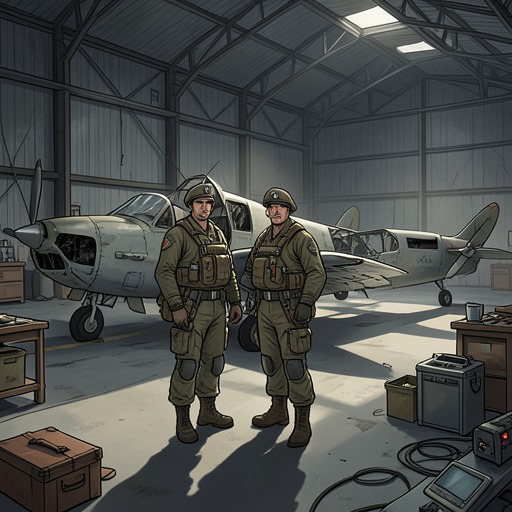
The relationship is introduced in the Grain & Steel’s hangar, where Rocco is watching technicians paint his Martian. Irons approaches with two aluminum meal trays and offers one to Rocco, who has considered skipping lunch to make his unit lighter. Their exchange turns immediately playful: Irons doubts that hunger is worth a microscopic gain in engine output, while Rocco snaps his fingers and points an imaginary gun at him, joking that this is why Irons is not yet an ace. The gesture makes their rivalry feel familiar rather than hostile; Irons can challenge Rocco’s judgment, and Rocco answers with a comic boast.
The conversation also establishes that their competitiveness has a professional basis. Irons says he leads the Graveyard Squadron in assists and believes he would be an ace if Rocco did not take his kills. The claim is teasing, but it identifies a real difference in their standings: Rocco is already an ace, while Irons is not officially recognized as one. Their banter lets that imbalance surface without turning it into an open dispute.
Their shared meal grounds the exchange in the less glamorous side of military life. Irons identifies his stew as vat meat, remarks that the cheese seems real, and continues eating despite his distaste. Rocco, who had been intent on keeping technicians attentive to maintenance, is drawn into the conversation instead. The scene makes companionship part of their routine: Irons brings the food, sits beside Rocco on an ammunition crate, and gives him news as they eat.
Recognition and News
Rocco reassures Irons that he expects him to become an official ace once they reach Mar de Paulo. The promise links recognition to the campaign ahead, though it remains an expectation rather than a confirmed outcome. Irons responds by asking whether Rocco has heard the scuttlebutt. Rocco has not: he has been occupied overseeing maintenance in the hangar. The contrast shows how their duties give them different access to information, even while they remain close enough to trade news directly.
The exchange does not resolve the question of Irons’s ace status. Instead, it presents the two pilots as friends who can speak frankly about achievement and opportunity. Rocco’s reassurance is encouraging, but the passage supplies no later confirmation that Irons receives the title at Mar de Paulo.
Planning and Squadron Cooperation
Their partnership extends from casual conversation to operational coordination. Before a mission involving the Impervious, two A-Class ships, and a Pulaski-class vessel, Rocco discusses splitting the pilots into flights and then reforming them into their squadrons. The two pilots take an express elevator to the mess to brief their squadrons together; Rocco messages Irons to bring his squadron up while Wayne Wendel Wheeler contacts his own team. The shared briefing gives their friendship a practical dimension: the pilots’ rapport supports the organization of a larger force.
The combat narrative likewise places them in connected roles. During the launch sequence, Rocco checks in as Green Leader for 2nd Squadron, while Irons is identified as the leader of the next flight. As they emerge from the carrier, Rocco surveys the fighting and the scattered settlements around Mars Lagrange 9 (Promise). The details establish a coordinated deployment, though they do not specify every tactical exchange between the two men.
Rocco later directs the Panzerters into escort formation, with the immediate task of ensuring that 4th Squadron reaches the battle. Irons’s voice is among those checking in as the formation assembles. Rocco answers the ready call with a joke about dancing, then turns to the escort order. Their familiar humor persists even as the conversation changes register from camaraderie to command; the lightness does not erase the serious coordination required by the operation.
Combat and Continuity
After the fighting, Rocco has re-formed with roughly twelve units of his squadron. Irons reports more stragglers approaching from two-thirty high, and Rocco responds with another joke about their arrival. Meanwhile, Wheeler’s surviving pilots are landing aboard the Grain & Steel for debriefing and possible rearming and refueling. The report places Irons back in the flow of information Rocco relies on, while the reference to Wheeler’s survivors gives their exchange a sober operational context.
Across these scenes, the relationship holds together through repeated acts of contact: Irons brings Rocco food, shares squadron news, reports approaching contacts, and checks in during combat; Rocco teases him, encourages his prospects, and leads formations in which Irons serves. The evidence portrays affection through ease and usefulness rather than through declarations. Their friendship is both a source of levity and part of the working structure that carries them from hangar routine into battle.