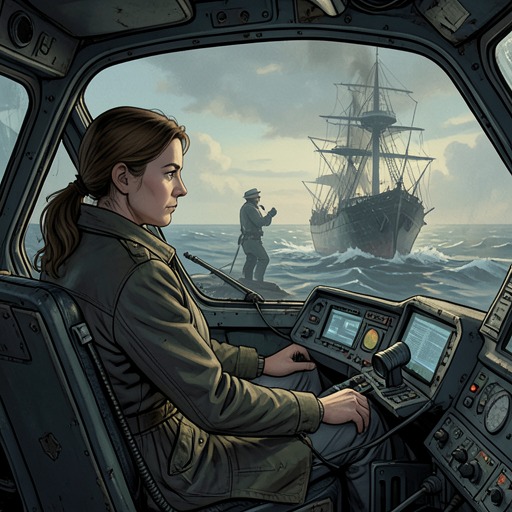
Roland Horn—Charlotte Huber
BlackwaterRoland Horn and Charlotte Huber’s relationship is forged in the wreck of a military transport and deepened by the work of keeping one another alive. Their connection moves from cautious rescue to professional trust and shared danger: Charlotte’s expertise enables Roland to use a high-performance Panzerter, while his concern for her persists beyond the immediate crisis, becoming one of the human memories that informs his resolve in battle.
Rescue and First Trust
At 0500 Colony Time on 2 November 2135, aboard the wrecked military transport in the shoal zone below Island Fredrick, Roland forces his way through a vortex with the help of his magboots and assists a smaller figure in sealing an inner hatch. When the other spacer gives him a thumbs-up, he reaches for his helmet; she catches his hand. The light in her faceplate reveals that she is a woman wearing a standard navy pressure suit, a visual sign that she is a crew member rather than a gunner, maintainer, or pilot.
The two meet under the pressure of isolation and a possible enemy threat. Roland asks whether she is the only survivor. She confirms that she is, and he apologizes: after ditching the tanks, he had decided to switch off the beacon so the enemy would not find it. He also admits that he does not know her name. Her answer supplies both a personal introduction and a professional identity: she is Charlotte Huber, a warrant officer. Roland introduces himself as Ensign Roland Horn and immediately asks where the beacon is and how to shut it down. Their trust begins not with a leisurely acquaintance but with practical questions and cooperation in a dangerous, enclosed space.
Expertise and Shared Escape
Charlotte’s role in their partnership becomes clearer as she leads Roland through the ship’s damaged corridors, stairs, and ladders. After he rapidly empties a pouch of hot soup, she takes his helmet and guides him toward the bow. There she reveals that she is the ship’s tech chief and, specifically, the only person in the navy certified to work on the Mark VIII. The disclosure changes the terms of their alliance: Charlotte is not merely another survivor to be escorted, but the specialist whose knowledge can make a way out possible.
That expertise is decisive when she brings Roland to a container holding a high-performance machine. He asks how she can know he will be able to fly it. Charlotte turns back, beaming, and explains that the machine was built to let pilots transition to a high-performance machine with minimal retraining. Its controls are identical to those of the Mark III, though the new machine offers wider tolerances and higher performance; its familiar readouts, icons, and displays should make the cockpit intuitive to Roland. It is fueled and ready because trials against Panthers had been planned. Charlotte’s technical confidence and Roland’s existing familiarity with the control system meet at a precise point: her work gives him access to a machine he can operate without a lengthy conversion period.
Danger Beyond the Wreck
Their rescue alliance continues into the violence outside the transport. On a floating rock near the wreck, Charlotte rides as Roland’s passenger after the confrontation with enemy forces. He checks on her, asking whether she is all right; his own chest, head, and legs throb, and he cannot imagine what the smaller spacer is experiencing. Charlotte replies that she is going to be sick. The exchange is brief, but it makes their shared danger bodily and immediate: survival has carried them out of the ship, not out of distress.
The relationship also persists in Roland’s memory during his later fight with Valentin Fulbright. As Fulbright taunts Roland about his new Panzerter and argues that they could have built a better Mars together, Roland’s mind returns to the children aboard refugee ships, coughing amid overtaxed air filters yet smiling when he brought them food and sweets. Among those memories is Charlotte’s tear-streaked face, relieved simply to know she was not alone. Roland also recalls Captain Henri Marcell, Commander Anna, Gunnery Sergeant Hoffman, and Duncan Glenn doing what they could to protect others. Charlotte’s image belongs within that larger moral picture: the rescue has become evidence, for Roland, of the people and lives behind his decision to fight.
Trust After the Battle
After a victory, Roland reflects that the broader situation remains difficult: the colonies in the Jupiter and Saturn systems are still cut off, resources are hard to move to or from the surface, and the Union has a direct line to the planet. He nevertheless allows himself a smile when Charlotte spins toward him. The smile fades when he sees her struggling with the gas jets and realizes that this may be her first untethered spacewalk. He tells her to slow down, warns her not to overuse the jets, and begins explaining how to somersault. Charlotte’s empty gas pack then hits him in the ribs, knocking the wind out of him and forcing him back into his seat; she blusters on top of him and sits up after discarding it.
The incident ends their sequence not with a polished display of competence but with an unguarded collision. Roland’s instinct is to watch out for Charlotte and guide her through an unfamiliar task; Charlotte’s inexperience with the jets produces an awkward mishap rather than another crisis to be solved by technical mastery. That comic reversal gives their trust a different register from the rescue aboard the transport. They remain companions in danger, but their bond also allows room for concern, embarrassment, and physical comedy. Across these scenes, mutual aid is not an abstract virtue: it is a sealed hatch, a shared escape plan, a check on an ailing passenger, a remembered face, and advice that arrives just before a gas pack lands in Roland’s ribs.