Rocco Swift—Roland Horn
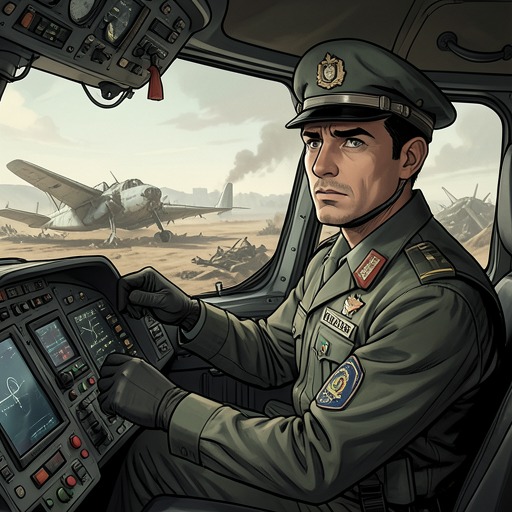
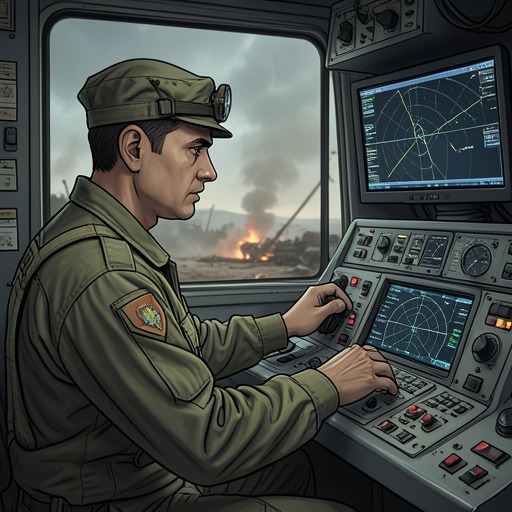
BlackwaterRocco Swift—Roland Horn is a relationship forged in combat: the two pilots meet as enemies, recognize one another’s ability under fire, and part with a promise of unfinished business. Their connection matters because respect does not dissolve the war between them. Instead, it changes the terms of their rivalry, allowing a moment of assistance and personal acknowledgment to emerge in the middle of a lethal engagement.
A Rivalry Tested in Combat
Their relationship first takes shape amid the confusion of the battle in the shoal zone. Rocco is flying in the same combat space as Roland, whose Panzerter has been effectively ditched. Rocco nevertheless credits the Tharcian pilot with doing well in an obsolete machine, and specifically recognizes the cleverness of his drop-tank maneuver. The judgment is significant: Rocco may be an enemy, but he does not mistake an old machine for proof of an inferior pilot.
That recognition does not make Rocco protective of Roland. When Valentin Fulbright orders fire on a transport to stop its occupants escaping, Rocco keeps station near Roland’s abandoned Panzerter and fires into the vessel. He sees small explosions tear through a transport his squadron had already shot down, and concludes that Roland should have listened to him. Rocco’s thought that he had known the Tharcian was not dead shows that Roland remains present in his attention even while their sides are still fighting and Rocco is acting against the transport.
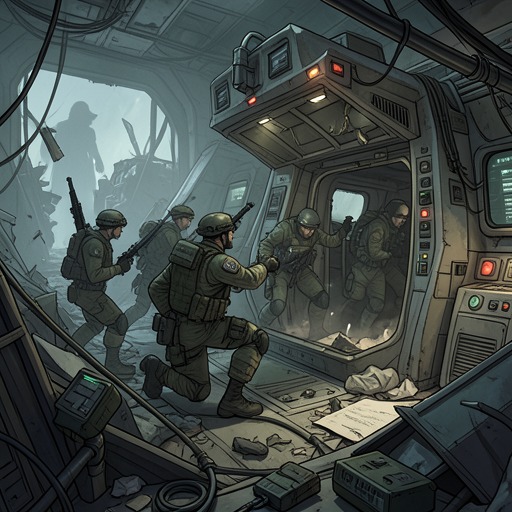
The encounter also places Rocco’s practical judgment beside his combative instinct. When another pilot reports what may be a launch bay, Rocco initially thinks the opening is probably only a cargo door, but goes to investigate anyway. The doors open, and an unknown machine emerges from the darkness into the shoal-zone dust and vacuum. Rocco fires at the silhouette, expecting his 50-mm rounds to penetrate its armor. The episode establishes the uncertainty and danger surrounding the fight: neither pilot’s skill cancels the threat posed by unfamiliar equipment and rapidly changing circumstances.
Recognition Amid the Gray Ghost Fight
As the engagement intensifies, a fast Tharcian machine cuts through Martian pilots with accurately placed laser fire, then vanishes among the debris. Rocco’s subordinate Rowan calls it a gray ghost and says it is too fast. Rocco answers by ordering Second Squadron to keep its cool, reminding them that the opponent remains outnumbered and that they are still the Union’s best. His leadership in this moment is collective and tactical: he acknowledges the danger without allowing the squadron’s alarm to dictate its response.
Rocco then sees Fulbright’s Panzerter and asks whether the IRS agent has any information about the machine. Before an answer can resolve the uncertainty, Rocco rolls left on instinct as a blue beam lights the space where he had been. This near miss keeps the relationship’s central tension in view. Rocco is capable and composed, but the battle does not grant him control; his eventual decision to help Roland occurs in a struggle where survival depends on immediate judgment rather than a settled plan.
Their respect becomes especially clear in Rocco’s assessment of Roland as a possible exception among Tharcian pilots. After knocking a weapon from one opponent’s grasp and firing five rounds into another Panzerter’s cockpit hatch, Rocco taunts the enemy pilots and wonders whether Horn is an outlier. The remark is not a declaration of friendship. It is a combatant’s reluctant distinction: Roland’s performance has made him a standard against which Rocco measures the others.
Assistance Without Reconciliation
The decisive turn comes when Roland finds the green Union machine waiting for him and prepares to throw himself back into the fight. A private hail interrupts the confrontation. Rocco explains that he is low on fuel and can either recover Fulbright or continue fighting Roland for another five minutes. Since intelligence assets appear to be the priority, he says, the Gray Ghost may escape while he assists Fulbright.
Rocco’s choice is limited and openly pragmatic. He does not claim that the two pilots have become allies, and his stated reason for breaking away is the priority of recovering an intelligence asset. Yet the choice gives Roland an opening to leave, and Roland immediately understands what Rocco is doing; relief escapes him before he thanks the Union pilot. The scene turns assistance into an action with consequences: Rocco withdraws from a fight he could continue briefly, and Roland is able to accelerate toward the colony opening rather than remain trapped in the confrontation.
Rocco makes clear that this kindness should not be mistaken for weakness. He points with his axe toward Fulbright’s drifting machine, then salutes Roland, while Roland passes with a sword salute of his own. The gestures preserve the encounter’s military character even as they lend it a personal courtesy. Rocco is not offering peace; he is postponing the contest until it can be fought on terms he finds more satisfying.
Names and Unfinished Business
Before Roland departs, Rocco asks for the young pilot’s name. Roland identifies himself as Ensign Roland Horn, assigned to the TNV Blackwater, and asks who Rocco is. Rocco answers that he is Senior Lieutenant Rocco Swift, commander of the Grain & Steel’s Gravedigger Squadron. The exchange converts the opponent from an impressive but distant presence into a named rival with a rank, assignment, and squadron command.
Rocco’s final warning combines concern with challenge: Roland should not die out there, because they still have a battle to finish. Roland grins—not only because the exchange gives him a chance to get away, but also because an enemy ace has acknowledged him. He promises that he will not die, then shoots toward the opening of the colony. Their parting therefore holds two truths at once: Roland has been spared the immediate contest, but neither pilot treats that reprieve as its conclusion.
The Shape of Their Mutual Respect
The relationship is defined by a distinction between respect and reconciliation. Rocco appreciates Roland’s flying in an obsolete Panzerter and later singles him out as a possible outlier; Roland, in turn, takes genuine satisfaction in being recognized by an enemy ace. These judgments arise through combat rather than private familiarity, and the evidence for them is concrete: Rocco observes Roland’s maneuver, chooses to assist him, asks his name, and explicitly reserves their battle for another time.
Their brief exchange also complicates the idea of rivalry as mere hatred. Rocco’s assistance remains bounded by fuel, tactical priorities, and his desire for a better rematch; Roland accepts the opening without pretending the two sides have ceased to be enemies. The salutes, the warning, and the unfinished battle keep that limit visible. What changes is not the war but the pilots’ regard for one another: each recognizes an opponent worth meeting again, and the prospect of that future fight becomes the relationship’s defining promise.