Promise Squadron's isolation
BlackwaterPromise Squadron’s isolation is not simply a matter of being outnumbered. It is a tightening bind of exhausted supplies, disrupted communications, vulnerable civilians, and incomplete knowledge of where the enemy will strike next. With Union forces able to overwhelm the squadron in a direct contest, Marcell turns the shoal zone into both refuge and instrument: a place where limited local knowledge, concealment, and carefully staged signals can make a weaker force harder to find and harder to predict.
Causes and Conditions
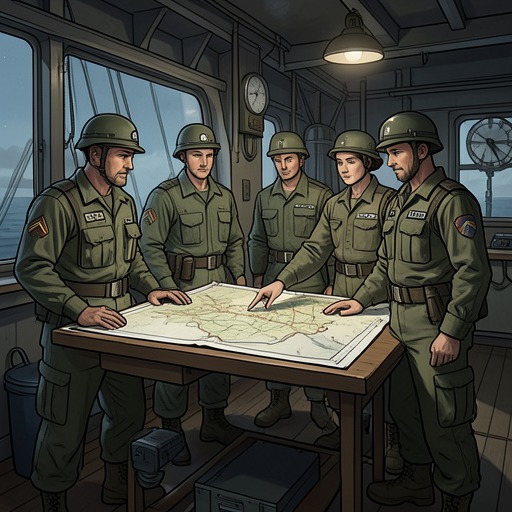
The squadron’s strategic predicament becomes explicit when Marcell assesses the response from Deimos. The Union has hit several sectors at once, and although the 3rd Fleet forced the enemy to withdraw from Mar de Paulo, the fighting left much of that area wrecked. That fleet must return to Deimos and refuel before it can help; only the unlikely launch of ships still under construction could bring earlier relief. Marcell therefore cannot plan around a prompt reinforcement.
The immediate alternatives are both dangerous. Without ammunition, fuel, or spare parts, his flotilla will eventually lose an attrition contest. Retreat is no clean escape: it would leave civilians to their fate, while the Union could pursue and destroy the withdrawing ships. The choice is not between safety and danger, but between risks with different costs, one of which includes abandoning the people the squadron is trying to protect.
That pressure sharpens when Marcell confronts the Union force searching for Roland Horn. It includes a battlecarrier, a reconnaissance cruiser, three destroyers, and about a dozen corvettes. The Union’s Panzerters give it a nine-to-one advantage over the available Tharcian machines, rising to eighteen to one in the diversion meant to let Roland escape the debris cloud and reach an encrypted signal. Marcell has four frigates of two types, three destroyers, and Duncan Glenn in an increasingly hybridized Panzerter; the enemy’s numbers make ordinary tactics untenable.
The squadron’s isolation is also informational. Union jamming and interference from another shoal zone prevent Marcell from communicating above the centerline. Two additional reconnaissance cruisers are at the Lagrange point, and he cannot know whether a comparable Union force is concealed in the upper shoal zone. Nor can he know with certainty how the Union will interpret the picture in front of it. His plans must work against the enemy’s ships while also exploiting the gaps in what either side can see.
The Shoal Zone as Refuge and Advantage
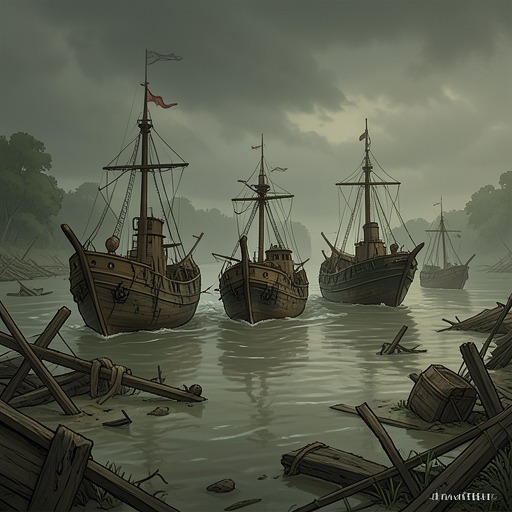
Marcell’s most dependable advantage is the shoal zone’s navigational infrastructure. Cutters and navigation buoys let his forces observe movement into and out of the zone, while Union ships entering it would have to fly comparatively blind. The local advantage does not erase the imbalance, but it changes what the smaller force can know and how quickly it can react.
The civilian ships’ concealment depends on that environment. With their main thrusters inactive, they blend among debris in the shoal zone. Their reactors could still betray them: if the Union reconnaissance cruiser had enough time, their signatures might stand out against residual heat in wrecks and gas pockets. Marcell therefore treats that cruiser not merely as another enemy vessel but as the enemy’s eyes and ears. Crippling it would make the civilians harder to detect and leave the Union with less ability to interpret the debris field.
That aim shapes his estimate of what victory could mean. He does not need to annihilate the Union force. If his ships can remove the reconnaissance cruiser and damage the battlecarrier’s launch or hangar decks, the Union would lose its best local surveillance and leave many Panzerters without a home. The objective is to disrupt the enemy’s capacity and delay its choices long enough for help to matter, rather than to win a symmetrical fleet engagement.
Deception, Delay, and Improvised Force
The wider campaign shows how signal manipulation can compensate for numerical weakness. In the plan briefed by Altman, five reconnaissance and electronic-warfare cruisers are to make a taskforce appear to be civilian ships fleeing the Amazon Sea. Reports relayed to Deimos from the Lagrange point are timed to make the Tharcian forces believe an attack began hours earlier than it did, potentially drawing them away to protect Deimos before they are ready. The deception extends to the taskforce’s physical appearance: battlecruisers and heavy cruisers hide in the radar shadow of lighter ships, while electronic-warfare suites make the formation appear to contain many more small vessels. The trick is not simply concealment, but control over the enemy’s interpretation of scale and timing.
Marcell adapts that logic to his own desperate situation. After the reconnaissance cruiser is crippled, he still faces a force capable of shifting more attention to the lower shoal zone. With five hours to hold out, he orders Schuster to follow the Union formation and Opera to tell the squadron they are moving, taking cutters for navigation. Then he orders a full-power broadcast over an open channel claiming that a large taskforce from the belt will arrive in five hours after refueling at Deimos.
The broadcast is deliberately uncertain rather than a report of known fact. When Opera asks how he knows there is a squadron in the upper shoal zone, Marcell says he does not. Jamming and interference mean he cannot verify it, but he expects the Union to hear the claim. Its value lies in forcing the enemy to consider a new possibility and, ideally, react to the squadron instead of dictating the pace of events. The bluff makes uncertainty itself part of the force Marcell can deploy.
He adds a physical threat to the false signal by ordering mine-scattering missiles along the Union’s likeliest approach. The mines use magnets to attach to ships, while their sensors avoid friendly identification signals. Once attached, adjustable explosives form shaped charges that breach a vessel’s hull. Searching for them requires enemy ships to move slowly and use manually aimed point defenses, a method that makes them vulnerable to fast missiles. The squadron’s forward momentum helps conceal the launch, while the minefield complicates the Union’s approach even before it causes damage.
That complication produces a sharp battlefield reversal. Union point defenses fire at incoming missiles, then slacken when one appears to be dispersing mines. The commander seems to mistake the third missile for another minelayer and saves defensive fire for a more obvious threat. Instead, it releases multiple megathermal warheads into a destroyer. Most strike amidships; the ship’s drive fails, explosions travel through its connected systems, and the vessel splits in two. The result is not a sudden end to the larger imbalance, but a concrete demonstration of how misreading a signal can turn a guarded approach into a catastrophic loss.
A Temporary Relief, Not an End to Isolation
The Union taskforce eventually breaks contact. Danubia alone had been troubling; backed by the fleet carriers Reverence and Perseverance, the heavy cruisers Reichsburg, Pulaski, and Unbowed, and dozens of smaller ships, the arriving force is too powerful for the attackers to ignore. Marcell has reason to think those ships are meant to protect Deimos, so their presence cannot be treated as a permanent rescue for his own command. Their arrival changes the enemy’s calculation and helps end the immediate attack, but it does not dissolve the squadron’s underlying vulnerability.
Reports from other pilots add a larger strategic shift: the battle for Mar de Paulo has ended in a stalemate, and, for the first time since the war began, the Union is hurrying back toward its own space. That retreat feels like an improvement, not a resolution. Marcell recognizes that the squadron remains cut off from its colonies in the Jupiter and Saturn systems; moving resources to or from the planetary surface is difficult, while the Union retains a direct line to the planet.
The Meaning of Isolation
Promise Squadron’s predicament is defined by the contrast between physical weakness and tactical inventiveness. The unit cannot count on timely reinforcement, cannot freely resupply, and cannot rely on unobstructed communications. Yet the same constraints make information and interpretation decisive: radar shadows can misstate a fleet’s size, a broadcast can make an unverified force seem imminent, and a mine-laying missile can cause an enemy to lower its guard for the wrong reason.
Marcell’s methods do not erase the human stakes of the delay. Retreat would abandon civilians; staying risks the attrition of ships, ammunition, fuel, and spare parts. Even a successful deception can only buy time, and the taskforce’s departure leaves the greater isolation intact. The state therefore persists as more than a temporary pause in combat: it is the condition under which every tactical success must be measured, useful insofar as it preserves the squadron and those depending on it without promising a secure way out.