Holburne Museum
BloodhoundsThe Holburne Museum is a prominent Bath museum whose valuable collections and vulnerable architecture draw it into the police response to the Penny Black riddles. After a previous theft established a pattern linking the riddles to museum crime, officers guard the building through the night, but the anticipated attack never comes. The museum’s role is therefore twofold: it is a real repository of cultural objects and a possible next scene in a criminal challenge whose clues have made security itself part of the plot.
Setting and collections
The museum stands in Sydney Gardens, in a converted hotel at the end of Great Pulteney Street. Peter Diamond initially needs a reminder of which museum is meant when Sydney Gardens is raised in connection with the riddle. John Wigfull identifies the institution, prompting an immediate change in the room: he grips the arms of his chair and wonders whether another theft is being planned. The collection makes that concern concrete. The museum holds silver and ceramics described as among the best in Europe, alongside paintings by Guardi, Zoffany, Turner, and Gainsborough. Its cultural importance is thus not merely atmospheric background; the possibility of a second theft gives the riddle’s apparent wordplay a practical consequence for the police.
The setting also places the museum within a wider landscape of public and historical associations. Sydney Gardens had once drawn Bath residents with brass bands, a bowling green, a maze, grottoes, and firework displays. Napoleon III, Haile Selassie, Jane Austen, Emma Hamilton, and Lord Macaulay had walked its paths. Those associations frame Wigfull’s later passage through the gardens as an unusual modern vigil in a place with a long public history. The grandeur of the surroundings, however, offers no assurance of protection: the museum’s security depends on police deployment, alarms, lighting, and vigilance.
Architecture and security
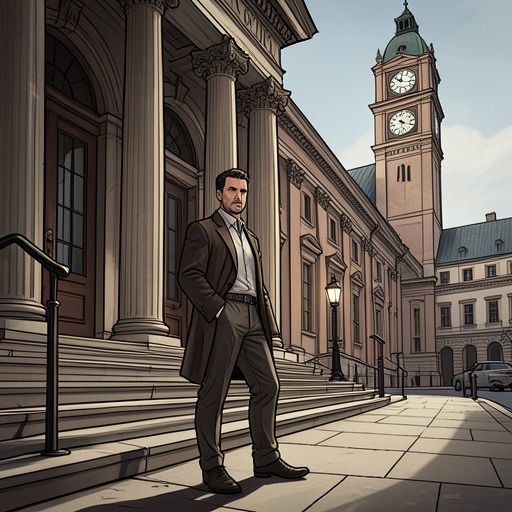
The Holburne is described as difficult to secure, despite its impressive appearance. Built toward the end of the eighteenth century as a hotel, it resembles a cross between an English country house and a Greek temple. Its classical facade has a pediment and four columns above three arches. Over roughly two centuries, the building was altered, most notably by the addition of an extra storey and balustraded walls at the sides. The contrast between its formal design and its practical vulnerabilities matters to the investigation: an imposing public facade does not make the building impenetrable.
At the front, the museum is open to the road. Railings have disappeared, leaving a low wall facing Great Pulteney Street, while two watchmen’s boxes remain only as decoration. The rear presents another weakness: drainpipes and footholds between the stone blocks could serve an intruder as a ladder. Against these physical openings stand more modern protections. An efficient alarm system and floodlights at the front are supplemented by security lights around the building. The description makes security a matter of overlapping measures rather than a simple barrier; the building’s age and successive alterations leave routes that technology and human attention must compensate for.
The museum as a threatened target
The concern about the Holburne follows a specific sequence in the riddle campaign. Wigfull recalls that the Penny Black was taken on the night after a riddle was sent and appeared on the day the second riddle arrived. That interval gives the police a reason to expect further action soon after another message. When Arnold Musgrave hears that the Holburne is in Sydney Gardens, he tells Wigfull to alert its security staff. The riddle is temporarily set aside so that the officers can attend to the murder inquiry, but the museum remains an unresolved security concern rather than a confirmed crime scene.
Wigfull later explains that the previous timing is why he expects action without much delay. In response, six men are stationed at the museum. He considers the building difficult but believes six should be enough, provided they are strategically placed. The arrangement reflects the uncertainty of the threat: the police know that a theft followed an earlier riddle, but they do not know whether, where, or exactly when another attempt will occur. The museum becomes a focus of preventive policing, with the cost of a false alarm weighed against the risk of leaving valuable collections exposed.
The overnight vigil
Around midnight, Wigfull parks opposite the entrance to the Bath Spa Hotel and walks through Sydney Gardens to the museum. He chooses not to park closer, in Sydney Road, because he does not want to reveal his presence, even to his own men. When a sergeant opens the side door and looks out, Wigfull signals for silence before entering. His arrival is deliberately concealed, adding an extra layer of surveillance to the six-man deployment already in place.
The officers are posted inside and on the roof and keep in radio contact. Wigfull calls them on their personal radios and also visits them every half-hour, insisting on alertness through the night. The account makes the burden of the watch visible in its repetition: radio checks, physical rounds, and the need to keep every officer awake. By 6:30 the next morning, nothing suspicious has happened. Wigfull is disappointed that the villain has not been caught, but relieved that the museum remains intact. From the roof he eats chocolate while watching dawn over Bathampton Down, then leaves instructions for the senior officer to maintain the vigil until the relief team arrives at 8 A.M. A light frost has blanched the lawns as he takes the short cut back through Sydney Gardens to his car.
Narrative significance
The museum’s episode turns architectural description into a practical component of the mystery. The columns, low wall, decorative watchmen’s boxes, and climbable rear wall are not simply features of a handsome old building; they define the routes and weaknesses that the police must consider while responding to a possible theft. In contrast, the modern alarm and lighting systems, together with the six officers’ radios and repeated checks, represent an organized attempt to make an exposed historic structure defensible.
The vigil also extends the consequences of the riddles beyond their intellectual audience. A sequence that might appear to invite interpretation becomes a matter of protecting a collection and assigning officers through the night. Yet the anticipated crime does not occur during this watch. The museum is left intact, while the police gain no arrest from their precautions. That outcome preserves the riddles’ uncertainty and gives Wigfull’s conscientious effort an ironic edge: he has secured the building against a threat whose timing seems patterned, but the pattern has not produced an attack on this occasion.