Postal Museum
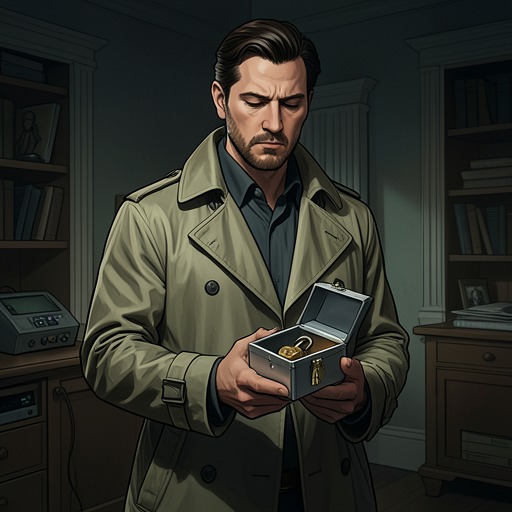
BloodhoundsThe Postal Museum is the scene of the Penny Black theft, a crime that becomes both the starting point of a staged detective puzzle and a test of how far fictional methods can illuminate real events. The museum matters less as a described building than as the point in a larger scheme where security, advance knowledge, and public performance converge: the missing stamp is later planted in Milo Motion’s copy of The Hollow Man, where its discovery turns the theft into a locked-room challenge for police and the Bloodhounds.
The Theft and Its Place in the Scheme
John Wigfull distinguishes the theft from an ordinary act of stealing. In his account, the stamp was taken as part of a stunt, planned by someone with inside information about the Bloodhounds’ next meeting. The perpetrator needed to know that Milo Motion would bring The Hollow Man and read from it during a discussion of locked-room mysteries. The stolen Penny Black cover was then discovered at the chapter devoted to that subject, at the moment Milo was about to read aloud. The timing makes the museum theft the first stage of a performance whose later reveal is designed to echo the club’s chosen genre.
Wigfull also places the theft within a tightly coordinated sequence. A mistaken tip-off from Bristol came on Thursday; the first rhyming riddle and the theft followed on Friday. He argues that the tip-off to Sergeant Plant, the riddles, the theft at the Postal Museum, and the planting of the stamp in Milo’s book were all parts of a plan made in advance. In this reconstruction, the museum is not an incidental source of a valuable object: the theft supplies the indispensable opening move in a chain intended to make both the police and the Bloodhounds look unable to solve the mystery. Wigfull further suggests that the thief meant to return the stamp after the performance had achieved its effect.
Security and the Locked-Room Puzzle
The museum’s security becomes important through competing accounts of how the theft could have been carried out. Shirley-Ann Miller’s later theory assigns Sid Towers the practical role: as a security man, he could have known how to defeat the museum’s video cameras and special locks. She imagines Jessica Shaw as the planner, combining her intelligence with Sid’s technical expertise. This is presented as Shirley-Ann’s deduction, not as an established account in the conversation itself; she is reconstructing a possible partnership and motive from the clues available to her.
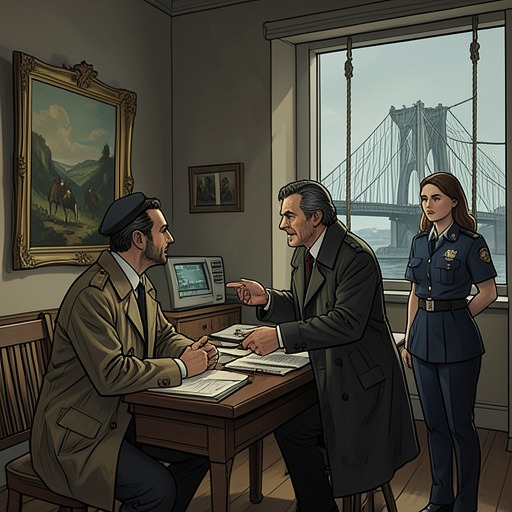
The police discussion gives the museum theft a second apparent locked-room dimension. Once the missing cover turns up in Milo’s book aboard his locked boat, the question is no longer only how someone entered the museum and removed the stamp. It is also how the object travelled from the theft to a book kept on a boat that was secured during the week. Wigfull points out that the book’s presence on the boat and the boat’s locked condition create a puzzle of their own. The museum therefore anchors one end of a mystery that appears to cross a boundary of security twice: first at the place from which the cover disappears, then aboard the boat where it reappears.
A Real Crime Becomes Club Business
The Postal Museum theft is also the subject that draws the Bloodhounds’ reading habits into direct contact with an unsolved crime. At a meeting, Hilda Chilmark proposes applying the club’s experience with detective stories to the theft in their own city. She recalls that a report in the Chronicle made the case seem particularly suited to the group’s interests and gave them a chance to test their wits on a real investigation. The transition from fiction to inquiry is deliberate: the club does not merely discuss a locked-room story, but tries to use its methods on an actual theft.
The members initially disagree about why the stamp was taken. Jessica Shaw suggests that a fanatical collector may have commissioned the theft. Shirley-Ann Miller, who had joined the previous week, instead considers a ransom demand and even proposes that payment might be routed through a secret Swiss bank account. Hilda then moves the discussion from motive to the riddles sent by the thief, producing copies so the members can consider the latest one. Their sequence of debate—from the identity of a possible buyer, to ransom, to the riddles—shows how the museum crime generates not one settled explanation but several competing interpretive routes.
Narrative Significance
The museum’s importance lies in the way the theft changes meaning as it passes between investigators and amateur detectives. For Wigfull, it is evidence of a carefully plotted stunt whose pieces dovetail. For the Bloodhounds, it is an unsolved local crime that invites the application of detective-fiction expertise. For Shirley-Ann, it becomes the starting point for a theory about collaboration between Jessica and Sid. These perspectives share the same originating fact—the Penny Black was stolen from the Postal Museum—but give it different motives and structures.
That movement between the physical theft and its later interpretation makes the Postal Museum a foundation for the novel’s contrast between detective stories and real crime. The museum supplies the missing object and the breach of security; the staged discovery in The Hollow Man turns those facts into an apparent literary puzzle. Yet the club’s theories and Wigfull’s reconstruction remain acts of reasoning rather than interchangeable certainties. The location’s decisive narrative function is to initiate a crime whose meaning is repeatedly revised as new connections are proposed.