Walsingham Gallery
BloodhoundsWalsingham Gallery is both Jessica Shaw’s art business and a conspicuous public stage for the investigation into Sid Towers’s murder. Its window, first used to arrange a painting for display and later marked with an accusation, makes the gallery’s boundary between private business and street spectacle central to the case: events inside draw a crowd, while what appears on the glass turns the gallery itself into a source of evidence and suspicion.
Setting and public-facing work
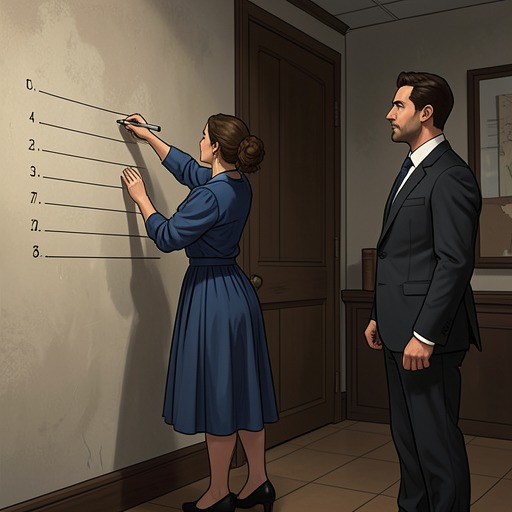
When Peter Diamond and Julie Hargreaves first visit, the gallery window is being dressed. Jessica is directing a man on the other side of the glass, gesturing to show where a painting on an easel should stand. The work has gathered a small audience in the narrow, flagstoned passage of Northumberland Place, where the bystanders make it difficult to get to the far end. Jessica appears fully aware that the arrangement has become street entertainment. Her cherry-red woollen dress and thick white cardigan make her conspicuous among the onlookers in subdued outdoor clothes.
The scene establishes the gallery as a working art space whose display is visible from the street, but also as a place where attention can accumulate beyond the business of looking at art. Jessica continues giving directions when Diamond first addresses her, and confirms her identity while still concentrating on the window. Her focus gives the encounter a practical rhythm: the officers arrive in the middle of work already in progress, rather than summoning her to a separate, private setting.
The exchange also hints at an upstairs area associated with A.J. When Diamond asks whether the objects in the window belong to him, Jessica says that she keeps him upstairs. The remark does not explain his precise role or living arrangements, but it places the gallery in relation to more than its public display space. The place is at once shopfront, workplace, and a setting shared with people connected to Jessica.
Police inquiries at the gallery
Diamond introduces himself and Julie in a deliberately formal manner and asks to speak with Jessica inside. She points out that she has already spoken with a sergeant, who recorded what she said the previous day; Diamond explains that this is a follow-up. The gallery therefore becomes one stage in a continuing police inquiry, where Jessica’s earlier account is revisited rather than treated as a completed matter.
The questioning touches on Jessica’s place in the Bloodhounds. She says she joined the previous winter and was among the last members to do so, apart from Shirley-Ann Miller, who had attended only a couple of times. Diamond also asks about Sid Towers’s membership. This line of questioning connects the gallery’s proprietor to the social circle under scrutiny, while the later evidence makes clear that her membership and presence among the group do not by themselves resolve the questions surrounding Sid’s death.
A detail about a paper bag sharpens the investigative character of the conversation. Jessica recalls using the old remedy of holding a bag to the mouth when a woman was hyperventilating and says that the woman soon responded. Diamond immediately asks what happened to the bag afterward. The gallery interview thus reaches beyond Jessica’s general associations and into the handling of a particular object. In the investigation, even an apparently practical act of care invites questions about what remained afterward.
The private view and the writing on the window
That evening, the gallery’s private view attracts an unusually large crowd. The newspapers are full of the Narrowboat Murder, and guests know that Sid attended a Bloodhounds meeting on the evening he was killed and that Jessica belongs to the group. Some hope to obtain inside information; others are drawn by the possibility that someone at the party might be connected to the crime. The guests’ attention shifts from the art to one another, turning the opening into a social event shaped by public fascination with the investigation.
The contrast is pointed: the gallery’s red stickers mark paintings that have sold, while guests joke that they would be more useful attached to Jessica’s Bloodhound friends. The joke captures how the murder case has rearranged the meaning of the gathering. A private view ordinarily organized around art becomes, for its visitors, an occasion to watch the people associated with the victim.
The event is interrupted when someone draws attention to the exterior window. Jessica pushes through the guests, with Shirley-Ann following, and finds Barnaby Shaw and A.J. examining the glass. Large, crude white letters have been sprayed across it: SHE DID FOR SID. Shirley-Ann is appalled; Jessica calls the writer a rat and is upset that her guests must have seen the accusation while she was greeting them inside. The message turns the gallery’s most public surface into an attack on its proprietor, and makes the party itself part of the message’s audience.
Removal, investigation, and significance
Jessica initially wants to call the police, but Barnaby advises that the words may be taken seriously if they do. The decision to ignore and erase the writing involves A.J. and Shirley-Ann as well as Barnaby; Shirley-Ann later recounts that the words were sprayed on the window and cleaned off by Jessica’s husband. She insists on the distinction between what she knows and what she merely suspects, presenting the graffiti and its removal as facts. Her account gives Diamond a concrete lead that had not been preserved on the glass.
Barnaby later confirms that he, A.J., and Shirley-Ann took part in the decision to treat the message as unserious. He says Jessica brought Shirley-Ann out to look at it, apparently because she was the first Bloodhound Jessica could find. Asked whether the accusation might be true, Barnaby acknowledges that he considered the possibility but could think of no reason Jessica would have done such an immature thing; he describes his wife as unusually clever. His response places the window incident within the relationships among the people present, without establishing that any of them authored the message.
Diamond returns to the graffiti in a later conversation with Barnaby, who is rattled when asked who told the detective about it. The question shows that removing the writing did not remove its investigative importance: the decision to suppress a public accusation has itself become something police examine. On a subsequent visit, Diamond finds that Jessica is taking the day off and is told that A.J. is not expected either. That detail does not establish why either is absent, but it extends the gallery’s role as a point of contact in the inquiry.
The gallery’s significance in the story rests on the way its ordinary functions keep being redirected. A display window attracts passers-by, then carries an accusation; a private view convenes art patrons, then turns them into observers of a murder investigation; and a place where Jessica works becomes a setting where her associations, decisions, and the handling of evidence are examined. The glass is not merely a backdrop: what is put on it, who sees it, and who chooses to erase it all shape what the police can learn.