“We must uncenter our minds from ourselves”
Blueback“We must uncenter our minds from ourselves” is the central injunction of an epigraph that frames the novel’s relationship between people, place, and the sea. Attributed to Robinson Jeffers’s Carmel Point, it asks for a shift in perspective: away from treating human needs as the sole measure of the world, and toward acknowledging that people are made from, and belong within, the natural world. The plot gives this idea practical weight through the dangers of diving, Dora Jackson’s rootedness in Longboat Bay, and her eventual work to secure the bay’s protection.
The Epigraph and Its Claim
The epigraph begins, “As for us:” and proceeds from the demand to “uncenter our minds from ourselves” to the call to “unhumanise our views a little.” Its wording makes the change of perspective an obligation, not merely an invitation to admire scenery. The next lines ask people to become confident “As the rock and ocean that we were made from.” Human beings are not set outside nature, looking at it from a position of mastery; the poem instead presents them as formed from the same material world they might otherwise treat as separate or subordinate.
The phrase also appears alongside an earlier epigraph attributed to Randolph Stow, which directs the reader to “look down” at “the coral bones of all our ancestors.” Together, these opening fragments connect human history to the sea’s physical depths. Jeffers’s expression extends that connection into a challenge to perspective: if the human and the ocean share a material origin, the sea cannot be understood only as a resource or a backdrop to human concerns. The novel tests this claim through particular choices and consequences rather than leaving it at the level of a motto.
Risk and Attention at Sea
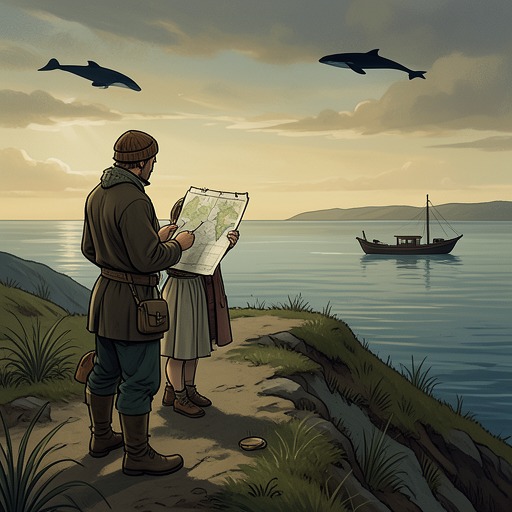
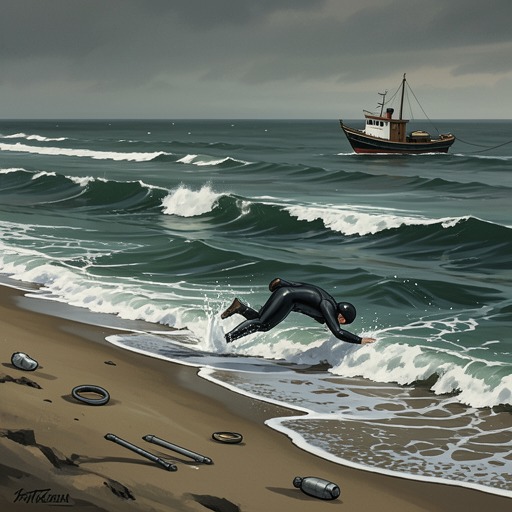
Mad Macka’s solitary abalone diving makes the conflict between human confidence and the sea’s power concrete. From the jetty, Abel watches the diver’s yellow boat throb with the compressor while its orange hose carries air to Macka, who works unseen below. His mother recognizes the danger in this arrangement: using a hookah alone amid abalone meat in the water leaves him without an offsider, though divers usually work in pairs. She remembers that an abalone diver had been bitten in half by a great white shark further along the coast, and she shudders at the sight of Macka’s boat moving across the bay with no one else aboard.
The scene refuses to make the water a passive setting for human adventure. Macka’s work depends on equipment and skill, but the sea remains a place of risks that cannot simply be controlled. The boat’s apparent solitude, with the diver invisible beneath it and the blue-and-white flag flapping on deck, makes the limits of what observers can see part of the scene. The epigraph’s call to uncenter human assumptions resonates here as a demand for attention: the sea is not merely the space in which a person chooses to work, but an active environment with dangers beyond that person’s command.
Longboat Bay as a Relationship
Dora’s understanding of the bay gives the epigraph a domestic and emotional dimension. When Abel asks whether she wants to stay, she says she is close to everything in Longboat Bay: its memories, his father, and the place itself. She calls the bay her place. Although she misses Abel, she says she is not lonely, because the place is “a kind of friend” to her. Abel sees how distinctly she belongs there: unlike his schoolmates’ mothers, she is quiet and tough, with lined, calloused hands, and he thinks she looks as if the land and sea had made her.
That description closely echoes the epigraph’s image of people made from rock and ocean. It does not reduce Dora to a symbol of nature; the novel gives her a particular history, daily labor, and attachment to a specific coast. But her life at Longboat Bay makes belonging something more than possession. The developers who approach her see a potential resort site: hotels, a golf course, a marina, tourist balconies, and commercial trips on the water. Dora’s refusal to sell rests on a different understanding of value. The bay is not an interchangeable asset to her, but a life and a sustaining relationship.
From Inheritance to Protection
The distinction becomes sharper as the developers’ pressure escalates. Their initial friendliness brings flowers, chocolates, champagne, an outboard motor, and a wind generator; when Dora continues to refuse, the gifts stop and small hardships begin. The road deteriorates, the mail arrives late or not at all, fuel deliveries contain water, and mysterious winter bushfires break out. Abel, away from the bay, reads his mother’s letters and understands that the pressure is wearing down her time and nerves. He also recognizes what the businessmen fail to see: Longboat Bay is not just property to Dora.
A storm eventually exposes thousands of whale bones on the shore, where they had lain beneath the sand for a century or more. Dora walks among them and understands them as traces of her family’s history in whaling and sealing. The Jacksons had come there for blubber oil, baleen, seal fur, and fish; now only Dora and Abel remain. The inheritance is not presented as uncomplicated innocence: their forebears also lived by extracting value from the sea. Faced with that history, Dora decides that it is time to help the sea live and to protect the bay for all time.
She turns that decision into sustained action, writing hundreds of letters to politicians, business leaders, and scientists. Photos of Blueback reach newspaper editors, while the letters continue despite being ignored. Eventually, while Abel and Stella are diving, a fax reports that Longboat Bay has been declared a sanctuary and marine park, with everything growing and swimming there protected by law. The ending makes the epigraph’s shift of perspective consequential: the bay is no longer treated solely as a place for human profit, and its living inhabitants receive protection under law.
Significance
The expression is both a statement of outlook and a measure of the choices the narrative places before its characters. It connects human ancestry to the natural world, then asks what follows from that connection: whether people will treat the sea as a source of private gain, or acknowledge their dependence on a world that exceeds their control. Macka’s exposed solitude, Dora’s relationship with Longboat Bay, and the resort proposal reveal different stakes in that question. The whale bones, in turn, bring the history of extraction into view and help Dora choose a different inheritance.
The novel does not make the epigraph an abstract rejection of human life. Its concern is how people live within the world that formed them, and whether they can act with attention to lives and processes beyond their own immediate interests. Dora’s protection campaign gives the phrase its clearest practical expression: a change in perspective becomes letters, persistence, and finally a legal sanctuary for the bay’s marine life.