“the coral bones of all our ancestors”
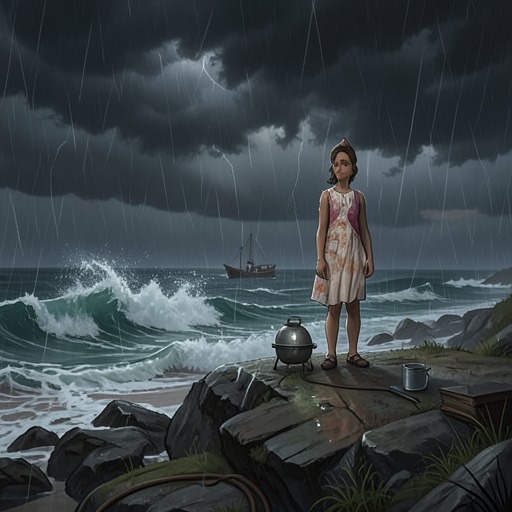
Blueback“the coral bones of all our ancestors” is the culminating image of an epigraph from Randolph Stow’s ‘Portrait of Luke’. Its instruction to look down establishes a vertical perspective that the novel repeatedly returns to: beneath the sea’s changing surface lie traces of the dead, family history and earlier ways of living. The phrase gains particular force when a storm uncovers the whale bones buried along Longboat Bay, making the past visible and helping Dora Jackson recognize that her family’s inheritance must become a duty of care for the sea.
The epigraph and its image
The epigraph presents eyes as “open harbours” and thoughts as dolphins that cannot obscure what lies below. The movement is from openness and motion to looking down: beneath the lively image of the sea is a record that cannot simply be hidden by what passes over it. The phrase’s “coral bones” joins two kinds of imagery, the living and the skeletal, while “our ancestors” makes that submerged history collective rather than private. In the novel, the sea is not only a setting in which the living work and swim; it also holds the material traces of people and actions that came before them.
The image is not a literal description of the remains later found on the beach. Those are whale bones, not coral or human bones. Its resonance comes instead from the way the novel places natural life, human history and death in the same coastal world. Looking down can mean seeing the underwater landscape that Abel Jackson knows from childhood, but it can also mean confronting what a family’s past has left behind. The epigraph offers a compact frame for both kinds of attention: wonder at the sea’s life and recognition of what it preserves.
Longboat Bay as family inheritance
Abel and Dora Jackson live from the sea and land at Longboat Bay, where their family has lived for more than a hundred years. Their land dates to whaling times; surrounding it is national park. Behind the orchard stands a small family cemetery, marked by white crosses and headstones. One cross marks Abel’s father, though no body is buried beneath it. The absent body makes the cemetery an incomplete record, while the bay holds another, less visible record beneath its sand.
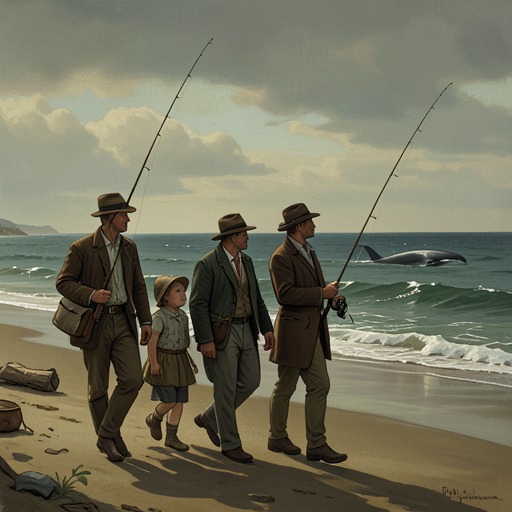
The family’s connection to the coast includes both daily subsistence and a history of extraction. Abel and his mother gather abalone, taking only a couple from each clump and leaving the rest to breed and grow. Their present practice depends on close knowledge of the reef, but Dora also tells Abel that his father’s family came as whalers: lookouts watched for pods from the ridge, and crews rowed out in longboats to harpoon them. When Right whales later surround their fishing boat, mother and son stop work to watch. Dora recalls feeling bad about the old hunting, though it happened before their time, and says the sea has taken its fair share of the family. The encounter places living whales beside remembered whaling and the family crosses above the orchard; the coast connects histories that might otherwise seem separate.
The bones emerge
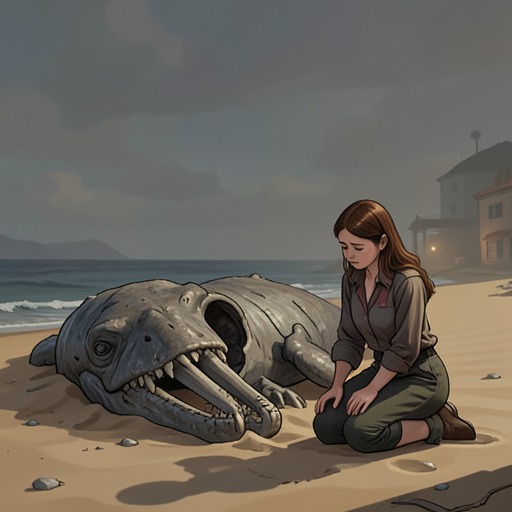
After a fierce storm, Dora walks down to the shore and finds thousands of white whale bones exposed along the bay. They stand out of the sand like posts, broken teeth and tombstones. She has walked over them for forty years without knowing they were there. The revelation makes the phrase’s downward gesture concrete: what had been concealed under an ordinary, familiar landscape appears all at once as a graveyard. Dora experiences the discovery as history suddenly unearthing itself.
The bones belonged to whales killed during the Jacksons’ earlier whaling and sealing years. Dora sits among them and recognizes that the family’s livelihood was part of the history written into the coast: blubber oil, baleen, seal fur and fish helped pay for the land. Generations of Jacksons are dead, leaving only Dora and Abel. The inherited place is therefore more than property or a familiar home. It contains the consequences of how the family once lived from the sea, and the material evidence changes what Dora believes inheritance now requires. She decides that it is time to help the sea live and to protect the bay for all time.
From inherited history to protection
Dora turns that recognition into action. From the wreckage of her house she writes hundreds of letters to politicians, business leaders and scientists, continuing month after month despite being ignored. She also sends newspaper editors photographs of Blueback. Eventually Longboat Bay is declared a sanctuary, a marine park where everything that grows and swims is protected by law. Abel and Stella leave their expedition to return home when they receive the news. The history the bones disclose thus leads not simply to regret about the past but to a change in how the bay will be treated.
The later life of the sanctuary gives the epigraph’s buried history a changed direction. Fish enter the protected bay to breed, and their numbers contribute to stocks beyond it; seagrass, coral and sponges thrive, abalone grow, and sea lions return to Robbers Head after a hundred years away. The sea’s recovery does not erase the bones or the whaling history. Instead, protection becomes a new inheritance alongside them: a way for the living to alter their relation to the place their ancestors used.
Memory beneath the surface
The novel’s recurring descents connect the phrase’s image to Abel’s experience of memory. As a boy, he learns to dive with Dora, working underwater in limited breaths among rock, weed and reef fish. Later, while away from home, he dreams of Blueback guiding him past drowned sailors and other dead people to Mad Macka and Abel’s father. His father remains young in the dream, forever thirty-two, and Abel cannot bring him back to the surface. The sea holds a vision of the dead that the ordinary family graveyard cannot provide, while the dream leaves the loss unresolved rather than turning it into a recoverable past.
That tension remains in the ending. Abel and Stella return to Longboat Bay and continue their scientific work, watching, listening and reading, but they never discover the sea’s secrets. Abel supposes that Dora, his father and Mad Macka may have understood more; for himself, he lets the sea be itself. The phrase’s importance lies partly in this limit: looking down can disclose buried evidence and deepen a sense of kinship, but it does not make the sea fully knowable. Its bones call the living to remember and take responsibility, even as the depths remain beyond complete human possession.