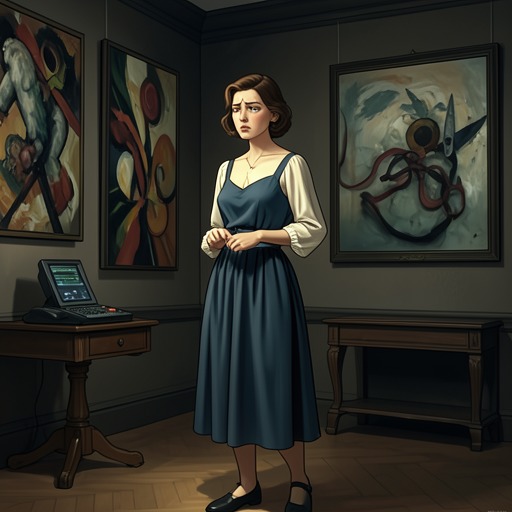
“We are much too horrible for this nice place. We give up. We quit. The end!”
Bluebeard“We are much too horrible for this nice place. We give up. We quit. The end!” is Marilee Kemp’s proposed inscription for the walls of her rotunda, and a radical interpretation of Rabo Karabekian’s return to painting. It converts the formal finality of his abstract work into a renunciation of humanity’s violence: art should not make destruction look powerful, but declare that its makers have no right to keep doing it.
Origin in a Reunion
Rabo explains to Marilee that he has returned to the arts after a long hiatus and, to his own astonishment, has become a creator of serious paintings. He imagines that the work would make Dan Gregory turn over in his hero’s grave in Egypt, and says that the paintings are unlike anything the world has seen. Marilee responds with mock horror at the prospect of hearing about art again, calling it a swamp she will never escape. But when Rabo describes his New York City circle of painters, whose works differ in every respect except that they are about nothing but themselves, she listens thoughtfully.
Her answer begins as an interpretation of what Rabo has done to the canvas. Once he has talked himself out, she sighs and says that he has performed the last conceivable act a painter could perform: he has written “The End.” Her remark recognizes a terminal quality in his work, but it also exposes a difference between his account and her own. Rabo hopes the paintings do not mean that art, or human endeavor, is finished; Marilee hopes that they do.
From Artistic Finality to Moral Refusal
Marilee enlarges the phrase from a judgment on painting into a demand on culture. After what men have done to women, children, and every other defenseless thing, she says, every work a man creates—painting, music, sculpture, drama, poetry, or prose—should carry the same declaration: “We are much too horrible for this nice place. We give up. We quit. The end!” The phrase’s repeated stopping points make surrender sound less like an artist’s private failure than a public acknowledgment of responsibility.
The argument follows a conversation that has moved from war toward peace. Rabo has spoken of returning to art and of paintings that reject external subjects in favor of being about themselves; Marilee reframes that apparent self-containment as an ethical verdict on the world beyond the canvas. Her formulation does not praise the human capacity to depict catastrophe. It asks art to stop turning human destructiveness into a source of masculine grandeur or encouragement.
The Rotunda and the Rejected Alternatives
The phrase acquires a physical destination when Marilee tells Rabo that their unexpected reunion may have solved an interior-design problem that has troubled her for years: what, if anything, should go on the blank spaces between the columns of her rotunda? She wants to leave a mark on the place while it is hers, and sees the rotunda as the site for doing so. Her question makes the idea architectural as well as verbal: the message is meant to meet visitors wherever they look at eye level.
Marilee had considered commissioning women and children to paint murals of death camps, the bombing of Hiroshima, land mines, witch burnings, and Christians being fed to wild animals. She rejects that approach because, in her view, images of atrocity can perversely egg men on. They may invite the response that human beings are godlike in their power and that nothing can prevent them from committing even the most frightful acts. Against such images, her proposed phrase offers no spectacle of violence and no heroic account of its perpetrators. It asks the walls themselves to withhold encouragement.
Commission and Significance
Marilee tells Rabo that his idea is better: men entering the rotunda should receive no encouragement wherever they look, and the walls should cry out, “The end! The end!” The shorter refrain condenses the longer declaration into an environmental message, turning the architecture into a repeated refusal rather than a gallery of violent scenes. Its intended audience is not limited to Rabo or Marilee; the statement confronts male visitors with a judgment on the destructive conduct she has described.
The proposal leads directly to a practical commission. The narrative identifies the resulting undertaking as a second great collection of American Abstract Expressionist art, after Rabo’s own collection, whose storage bills are making paupers of him and his wife and children and for which nobody else wants to pay anything. Marilee orders ten paintings sight unseen, leaving their selection to Rabo, at one thousand dollars apiece. The phrase thus becomes more than a provocative reading of his work: it gives his paintings a new home and a public purpose, while setting Marilee’s collection against the financial burden and rejection surrounding his own.