1936 St. Patrick's Day Modern Art Museum Conflict
BluebeardThe Museum of Modern Art confrontation on Saint Patrick’s Day, 1936, transforms a forbidden visit into the break that ends Rabo Karabekian’s apprenticeship with Dan Gregory and separates him from Marilee Kemp. Gregory treats their outing not merely as disobedience but as a betrayal of his authority over art and loyalty; Rabo leaves his home that evening, while Marilee stays behind. The scene turns a private affair into an expulsion, and a young employee’s first step toward independence into a painful separation.
Causes and Setting
Rabo and Marilee went to the museum together while he was still employed by Gregory. He had worked for the painter for almost three years and was just under twenty. The visit was not new to him: he recalls that they had gone perhaps fifty times. In the hard circumstances of the Great Depression, he was no longer a would-be artist but an artist’s employee, fortunate to have any job at all. He also looks back from a later knowledge that the Depression would not be followed by an uncomplicated return to ordinary life: another world war still lay ahead.
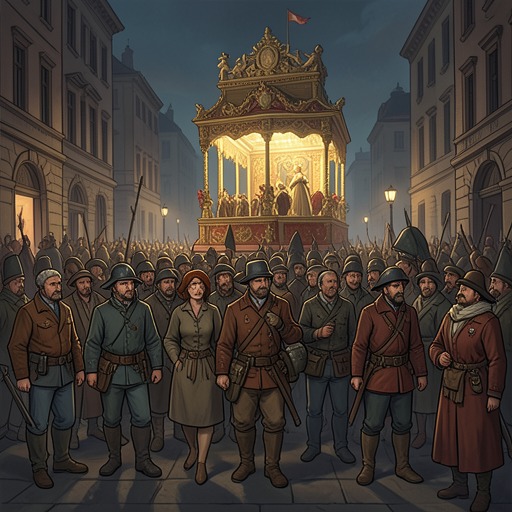
The discovery happened amid the commotion of the Saint Patrick’s Day parade, which was moving north on Fifth Avenue. Its traffic left Gregory’s convertible Cord stopped half a block from the museum. Fred Jones, Gregory’s old World War I aviator, was at the wheel. The parade’s green-clad crowds and the stalled car placed the confrontation in full public view: Gregory could not quietly summon the couple home, but had to cross the crowd and face them there.
The Confrontation
Gregory pointed at the pair, trembling with rage, and called out, “Caught you!” He pushed through the crowd, stood in front of them with his feet apart and fists clenched, and accused them of being parasites and ingrates. Although he had often hit Marilee, Rabo remembers that Gregory had never struck him. The threat of physical violence is present in the scene’s history, but the confrontation is carried out through accusation and expulsion rather than a blow.
The lovers’ excitement had its own causes: youth against age, physical attractiveness against wealth and power, and the thrill of forbidden time together. Gregory recast the encounter in the language of gratitude, loyalty, and modern art. He insisted that his request that they stay out of the museum had been a test of allegiance, a simple way to prove they were on his side rather than the side of the people who championed modern painting. In his account, their happiness as they came out was the deeper insult: it seemed to mock him and everyone who had tried to control a paintbrush.
The museum’s apparent novelty was itself complicated. Many of its paintings had been made before the First World War, before Rabo and Marilee were born; the art world had once been slow to accept changes in painting. Gregory nonetheless made the visit symbolic. His ban was not, he said, meant to shield them from looking at the pictures, but to make them demonstrate loyalty by staying away. The couple’s ordinary excursion thus exposed the imbalance in their relationships with him: what they experienced as pleasure and discovery, Gregory interpreted as public repudiation.
Expulsion and Separation
Gregory told them that he would have Fred drive him to City Island, where his eighty-foot sailing yacht, the Ararat, was in dry dock. He intended to live aboard until Fred could assure him that Rabo and Marilee had left the house on Forty-eighth Street and that every trace of their having lived there had been removed. The decision turned Gregory’s anger into a concrete act of household expulsion. His proposed retreat to a yacht in dry dock was as theatrical as it was impractical: he would have to use a ladder to get aboard and rely on the boatyard’s toilet and telephone.
Gregory’s words framed the relationship in familial terms even as he ended it. He said he had treated Rabo as a son and Marilee as a daughter, making their relationship to each other a double betrayal in his eyes. Rabo and Marilee, however, had not experienced their visit as an attack on their protector. The clash lays bare Gregory’s attempt to make loyalty to himself inseparable from loyalty to his artistic judgment.
Marilee told Rabo that he had to go while she had to stay. She had saved enough money to take care of him for a week or two, but said he had become too comfortable and needed to leave. When he asked how they could part after what had happened between them, she answered that the clocks had stopped while they were together and had started again; she said the encounter did not count and should be forgotten. She had already decided, she said, that she needed a man to take care of her, and that Dan was a man. Her choice left Rabo without the lover or the security of Gregory’s household.
Departure and Aftermath
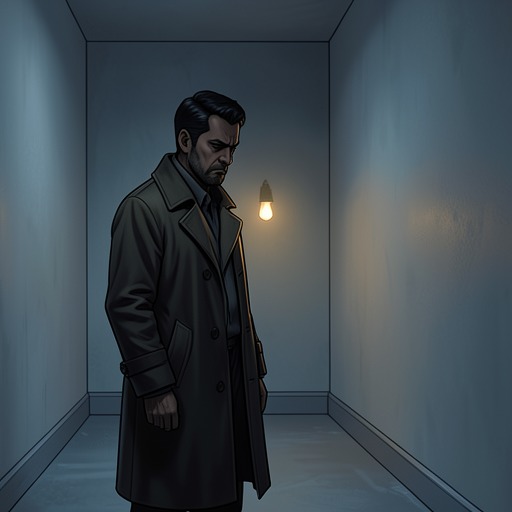
Rabo went to his room confused and humiliated, packed his belongings, and left without Marilee seeing him off. He did not know which room she had gone to or what she was doing there; nobody saw him out. At sunset on Saint Patrick’s Day, 1936, he left the house forever without looking back at the Gorgon on Gregory’s front door. He spent his first night on his own at the Vanderbilt YMCA, only a block away.
For perhaps a month or two, Rabo imagined that the separation was a challenge: he would become a great financial success, return, and take Marilee away from Gregory. He understood that fantasy through the stories Gregory used to illustrate his lessons. At the time of the expulsion, Gregory was working on a new edition of Tales of King Arthur and His Knights, with Marilee posing as Guinevere. Rabo imagined himself returning with the Holy Grail, recasting the end of his apprenticeship as a quest and his lost lover as its prize. That imagined ending did not happen soon: he would neither see nor hear from Marilee for fourteen years.
Significance and Later Reframing
The confrontation changes the terms of Rabo’s life. Before it, he is an employee within Gregory’s household, bound to a powerful mentor whose authority reaches into his work, domestic security, and romantic life. After it, he has to stand on his own, though the immediate result is not triumph but humiliation, uncertainty, and a night in a YMCA. The event’s force lies in that reversal: Gregory’s assertion of control expels Rabo, while also ending the arrangement that had kept him dependent on Gregory.
The novel’s later museum scenes give the incident an ironic afterlife. Years afterward, Rabo lives amid a major private collection of Abstract Expressionist paintings, answering visitors who ask what the pictures mean. His own house becomes a public-facing museum: an architectural article describes its entrance hall as containing the core of a small museum’s modern-art collection, and the visitor route eventually leads to the enormous work in his potato barn. There, Rabo tells visitors that the work is not a painting but a tourist attraction, a World’s Fair, and Disneyland. Against that later role as collector, guide, and self-appointed interpreter, the 1936 visit marks the moment when modern art was still the forbidden territory through which Gregory demanded allegiance—and when Rabo’s passage into that territory cost him both his place in Gregory’s home and his hoped-for future with Marilee.