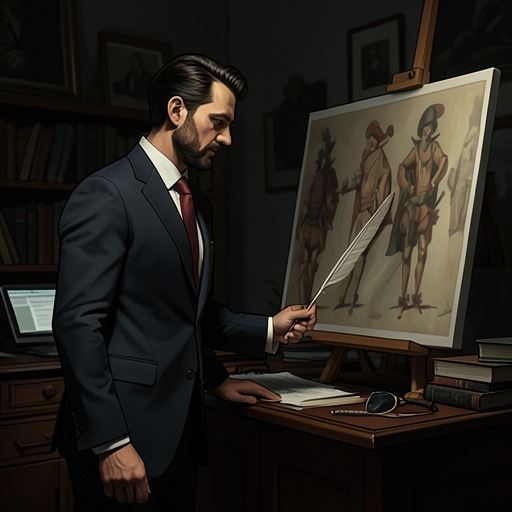
Battle of Sidi Barrani
BluebeardThe Battle of Sidi Barrani is the 1940 battle in Egypt where Dan Gregory and Fred Jones were killed after going to Italy to paint the Italian Army in action. In Rabo Karabekian’s retrospective account, the battle is at once a military defeat and the end of an artistic household: Gregory and Jones had left America with Marilee Kemp, whose love for Gregory explains her decision to go with them, and none of the three returned together. The event’s significance lies in how Rabo folds a public campaign into the private histories of art, intimacy, and loss.
Causes and Background
Gregory and Jones left for Italy with Marilee to take part in Benito Mussolini’s social experiment. Though both men were already in their fifties, they obtained Mussolini’s permission to wear Italian infantry officers’ uniforms without insignia of rank or unit and to make paintings of the army in action. Their departure also transformed Gregory’s New York mansion: after the three left, its three brownstones were made separate again, a physical sign of the household’s dispersal.
The war pulled the painters into a setting where their artistic work and military surroundings were difficult to separate. Gregory and Jones were interested in weapons, and their plan to paint the army placed them near the conflict rather than outside it as detached observers. Rabo presents their artistic mission plainly, then marks the irony of its outcome: the two men who went to depict military action were killed in battle.
Course and Deaths
Rabo dates their deaths to around December 7, 1940, almost exactly a year before the United States entered the war. At Sidi Barrani, he recounts, 30,000 British troops overwhelmed 80,000 Italians, capturing 40,000 men and 400 guns. He pauses to clarify that the captured guns were large weapons, not rifles or pistols, before naming the equipment he says killed Gregory and Jones: Matilda tanks, Sten guns, Bren guns, and Enfield rifles with fixed bayonets.
The detail gives the deaths a material scale without turning them into a battle narrative from the soldiers’ point of view. Rabo supplies the disparity in forces and captures, then narrows the view to the weapons associated with his two acquaintances. He does not describe their final moments; the account establishes the place, approximate date, military defeat, and outcome, leaving the men’s deaths as the hard boundary of their story.
Marilee and the Aftermath
Marilee went to Italy because she and Gregory were in love. Rabo contrasts this straightforward attachment with the complicated histories that followed: in a later imagined message to her, he foretells that she and the two men will move to Italy, that Gregory and Jones will die at Sidi Barrani, and that she will later win the heart of Bruno, Count Portomaggiore. The forward-looking recollection makes the battle a turning point in Marilee’s life as well as the end of Gregory and Jones’s.
After the war, Rabo visited Marilee in her palace in Florence. She showed him a painting given to her by the mayor of Florence, depicting her late husband’s death before a Fascist firing squad near the end of the war. Rabo judged it commercial kitsch of the kind Gregory had once made and of which Rabo himself remained capable. The picture does not depict the Battle of Sidi Barrani; instead, it connects the battle’s aftermath to Marilee’s later marriage and widowed life, and to Rabo’s continuing reckoning with Gregory’s artistic legacy.
Narrative Significance
The battle enters the book through Rabo’s recollection, not as an independent, continuous account of the campaign. He moves between the approximate date, the reported scale of the British victory, the weapons involved, and what became of the people whose departure he remembers. This shift between public history and personal memory makes the battle legible through its consequences: a mansion divided back into separate homes, an artistic trio broken apart, and Marilee’s future redirected by the deaths of the men who accompanied her to Italy.
Rabo’s account also places the deaths within his own wartime experience. He later served in the United States Army as a camouflage specialist, and at the end of the European war he was captured and lost his left eye. He describes the artists in his camouflage unit as a family, and elsewhere recalls enduring years of loneliness after his family life collapsed. That context does not make the Battle of Sidi Barrani part of his own service; it explains why the fate of Gregory and Jones belongs to his broader meditation on war, artistic fellowship, and the losses that shape a life.