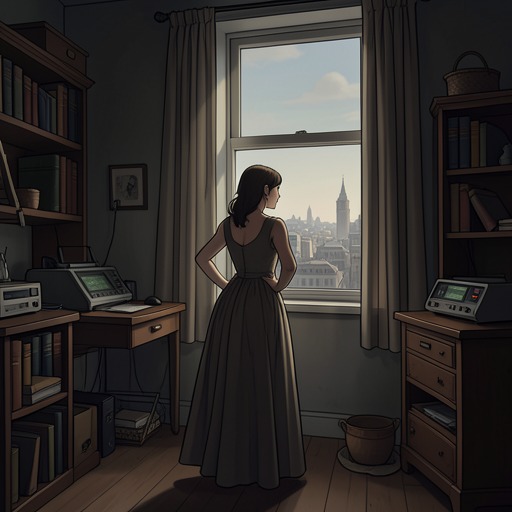
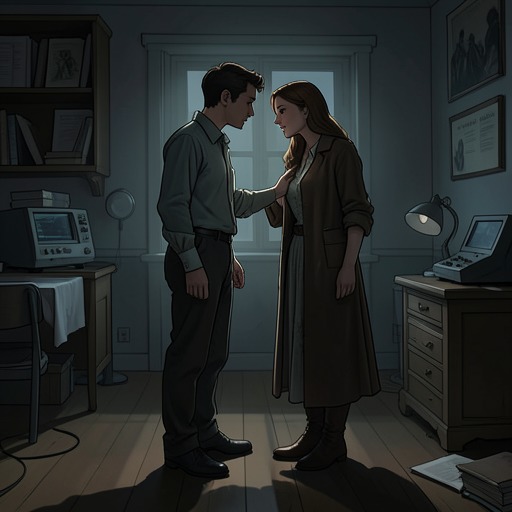
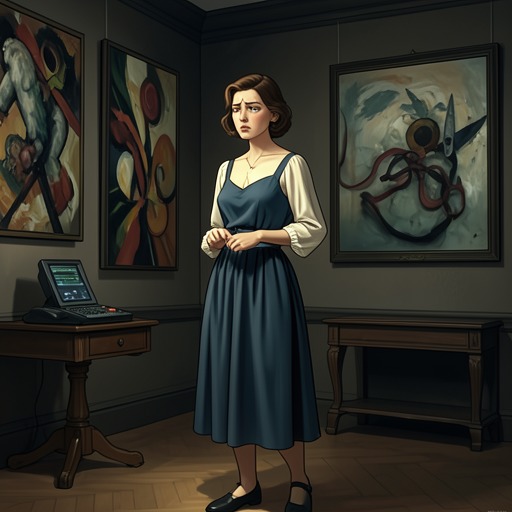
In 1950, Labo and Marilie reunited in Florence
BluebeardThe 1950 reunion of Rabo Karabekian and Marilee Kemp in Florence transforms an apparently romantic summons into a meeting of old intimates, wary humor, and artistic recognition. Their past returns first as flirtatious expectation and a sharp rebuke; the conversation then moves from Rabo’s wartime experience to his renewed painting, culminating in Marilee’s order for ten works that helps establish a second major collection of American Abstract Expressionist art.
The Invitation and the Return
On his last day in Florence, Rabo found a note in his hotel pigeonhole, although he believed he had no friends anywhere in Italy. The message, written on expensive paper bearing a noble crest, addressed the possibility that he might be the wrong Rabo Karabekian with playful indifference: he was invited to come anyway, encouraged to rub his feet on the writer’s carpets and make sparks, and told to wear something green. It was signed by Marilee, Countess Portomaggiore, who identified herself as the coal miner’s daughter. The teasing invitation joined her aristocratic title to the identity she had before marriage, and ended with a deliberately provocative dismissal of modern art.
Rabo telephoned immediately from the hotel. Marilee asked him to come for tea in an hour, and his heart was beating hard as he agreed. Her palazzo was only four blocks away. The narration pauses to dwell on the building’s elaborate architecture: a fifteenth-century design for Innocenzo “the Invisible” de Medici, organized around a domed rotunda, with Corinthian columns, a clerestory of thirty-six windows, and a painted dome. The pause gives the reunion an imposing setting, but the narrator makes clear that these architectural details come from a newly published book about private art treasures in Tuscany, rather than from Rabo’s own prodigious recall. The building’s splendor is thus presented through a mixture of remembered encounter and borrowed research.
Old Intimacy, New Discomfort
Before going to the palazzo, Rabo read Marilee’s message and her invitation as signs of sexual possibility. Her tone and her admission that no men were in her life suggested to him that they might soon resume the passionate relationship they had shared years earlier. In his imagination, the reunion would be different from the earlier affair: he would return not as a callow youth but as a war hero, roué, and seasoned cosmopolitan.
Rabo disclosed two facts that complicated that fantasy. He had lost an eye in battle and would be wearing an eye patch; he was also married, though he described the marriage as nearly over. He then tried to make light of his time as a soldier with a crude sexual joke, adapting the language of wartime shelling to boast about women’s availability. His bravado exposes the gap between the heroic identity he projects and the vulnerability he has just acknowledged.
Marilee’s appearance and manner puncture his expectation. She was not wearing the death’s-head mask associated with the palazzo’s eccentric former owner, but her pale face and flaxen hair seemed almost carved from one piece of ivory in the dim light. Rabo was aghast. In an imperious, scornful voice, she greeted him as her faithless little Armenian protégé and reminded him that they had met before. She then said that he had evidently expected to get laid again. The words echoed beneath the dome, turning his private anticipation into an accusation publicly amplified by the architecture. Their renewed intimacy begins not with a kiss but with Marilee’s refusal to let him control the story of their past.
From War to Painting
The conversation eventually moves away from war and toward peace. Rabo tells Marilee that, after a long hiatus, he has returned to the arts and become the creator of serious paintings—work he believes would make Dan Gregory turn over in his grave in Egypt. He claims that the paintings are unlike anything the world has seen. Marilee protests in mock horror that she does not want to hear about art, which she calls a swamp from which she will never escape, but she listens thoughtfully as he describes the New York group around him.
Rabo explains that the group’s paintings look nothing alike except in one respect: they are about nothing but themselves. Marilee responds not by accepting his account of their work as a movement, but by imagining what such work might do in her own rotunda. She proposes that men entering the space should encounter no encouragement at eye level, and that the walls should seem to cry out that everything is over. The proposal converts her earlier anti-modern-art teasing into a specific, audacious vision for displaying the paintings. What began as a conversation Rabo might have expected to avoid becomes a serious exchange about how the work could inhabit a particular place.
The Commission and Its Aftermath
Marilee orders ten paintings without seeing them, leaving their selection to Rabo and offering one thousand dollars for each. His astonishment is immediate: he asks whether she is joking. She insists that the Countess Portomaggiore never jokes and invokes both her wealth and her authority in the palazzo. The order matters beyond its financial terms. Rabo’s own collection of Abstract Expressionist paintings is burdening him, his wife, and his children with storage bills, and nobody else wants the works at any price. Marilee’s purchase makes her the founder of what the narrator calls the second great collection of American Abstract Expressionist art, after Rabo’s own.
Their talk also touches on the group’s still-unsettled identity. When Marilee asks what they call themselves, Rabo says that they have no name and that critics will eventually name them. She suggests the Genesis Gang, reasoning that they are returning to a beginning before subject matter existed. Rabo likes the idea and plans to propose it when he gets home, but the name never catches on. The failed suggestion distinguishes Marilee’s imaginative role from the movement’s eventual public identity: she can recognize and shape the work’s possibilities without determining what it will be called.
They talk for hours, until darkness falls outside. At last Marilee tells Rabo he had better go. He recognizes the echo of her dismissal fourteen years earlier, on Saint Patrick’s Day, and says so. This time Marilee asks him not to forget her so quickly. The exchange closes the reunion without resolving it into a simple restoration of their former romance. The old separation remains present in their jokes and in the remembered dismissal, while the commission gives their renewed connection a durable artistic consequence.
Significance of the Reunion
The scene changes direction through a series of reversals. Rabo arrives expecting sexual reconciliation, but Marilee meets him with scornful recognition; he approaches her as a celebrated survivor, yet must disclose both his missing eye and the failure of his marriage; and the woman who initially mocks modern art becomes the first major buyer to give his new paintings a home in a collection. The sequence makes the reunion consequential without pretending that its personal history has been repaired.
Its architectural framing reinforces that distinction. The rotunda’s imposing dome and its painted religious vision lend the meeting a ceremonial scale, but the exchange beneath it is teasing, embarrassed, and rooted in the unresolved past between two people. Marilee’s commission does not merely validate Rabo’s account of his artistic return: it places the paintings in a setting she has actively imagined for them. Her role is both intimate and practical—she remembers the young protégé, challenges the man he has become, and acts as a patron of the work he now claims as his own.