First World War
BluebeardWorld War I enters the account through Fred Jones, whose wartime experience first gave him a place in the Air Corps and later serves as a mirror for Rabo Karabekian’s own life. The war’s legacy is not only the spectacle of aerial combat: it is also the fragile belonging each man found in military service, and the rupture that followed when an eye injury made that life impossible.
Jones’s wartime vocation
Jones discovered during World War I that he could fly rattletrap kites used as machine-gun platforms. Once he took the controls of an airplane, he experienced a similar exhilaration in firing its machine guns and watching the aircraft ahead leave a trail of smoke and flame. He later told Rabo that the trails of falling airplanes and observation balloons were the most beautiful things he expected to see. Rabo connects Jones’s response to the pleasure Jackson Pollock took in watching paint spread across a canvas: both men found beauty in patterns produced by motion, though aerial combat made Jones’s patterns inseparable from human loss.
A home lost
Rabo sees Jones as someone whose life had been downhill since the war. The Air Corps had given him a home, just as the Corps of Engineers would later give Rabo one. But Jones was eventually dismissed after losing an eye. The loss turns the war’s promise of vocation into a lasting contrast: a man whose abilities had found expression in military service was left without the place that had made those abilities matter.
Rabo’s recognition of the parallel
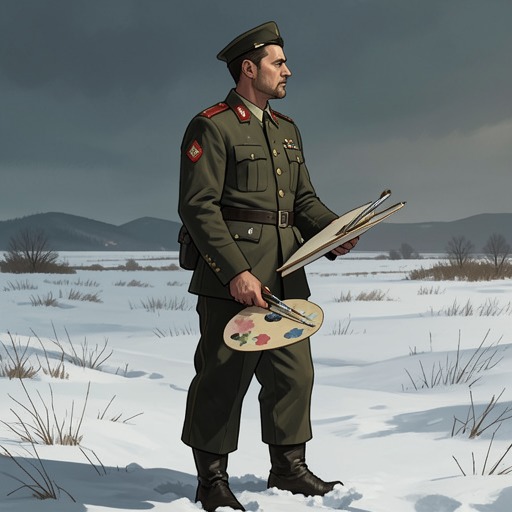
Looking back from the Great Depression, Rabo had once thought of Jones as both funny and sad. In retrospect, he imagines warning his younger self that he would become much like Jones: a one-eyed old soldier, afraid of women and unsuited to civilian life. Rabo’s own eye was lost when his camouflage platoon was fighting as infantry in Luxembourg near the end of World War II, and he was taken prisoner. The parallel is not exact—his injury came in a later war—but it makes Jones’s history an early, unsettling image of the life Rabo would come to lead.
Aftermath and narrative significance
In the book’s retrospective account, the consequences of World War I reach beyond Jones’s flying career. Rabo recalls reading at Fort Belvoir that Jones and Dan Gregory had died in Egypt; their obituaries described Jones as a World War I ace and aviation pioneer, though Rabo says the claim that he was an ace was untrue. Rabo also frames his own postwar life through the absence of anything to return to: after the war, the Army paid for cosmetic surgery at the place where his eye had been, but he describes himself as blank rather than bitter. His reflections connect the two soldiers’ lost eyes with a broader break between military belonging and civilian life, while making Jones’s story a point of recognition in Rabo’s later autobiography.