World War II
BluebeardWorld War II remakes Rabo Karabekian from an aspiring painter into a wounded officer and prisoner, then leaves him to negotiate a difficult return to civilian life. His military service brings together artists whose camouflage work turns visual invention into a practical means of survival; the war’s end, by contrast, confronts him with a vast, unsettled population of survivors. Years later, he makes that collective upheaval the subject of a monumental painting, joining private recollection to a crowded record of wartime displacement and survival.
Service and the camouflage platoon
Rabo had joined the regular Army and become a lieutenant two years before the United States entered the war. When the country did enter, he served in North Africa, Sicily, England, and France before being forced into combat near the German border. He commanded a platoon of thirty-six men, each an artist or someone who worked as an artist in civilian life. The Army had assigned them to camouflage on the theory that artists would be especially suited to it.
The platoon’s work was effective: its illusions misled German forces about what lay behind Allied lines and what posed a threat. Its unusual place in the military reflected the value of that skill. Rather than being permanently attached to a division or corps, the unit received orders directly from the Supreme Headquarters of the Allied Expeditionary Force and was lent temporarily to generals who had heard of its deceptions. Rabo remembers those generals as permissive patrons, fascinated by the unit’s work and grateful for it before the platoon moved on again.
The artists’ military life was correspondingly irregular. They were allowed to be careless about dress and military courtesy, living by a looser code than ordinary units. Rabo could have sought promotion beyond captain, perhaps as high as lieutenant colonel, but refused advancement because he wanted to remain with his “happy family” of thirty-six men. The decision makes the platoon more than a posting: it is his first large family, and a form of belonging he would later miss.
Capture, injury, and the end of the war
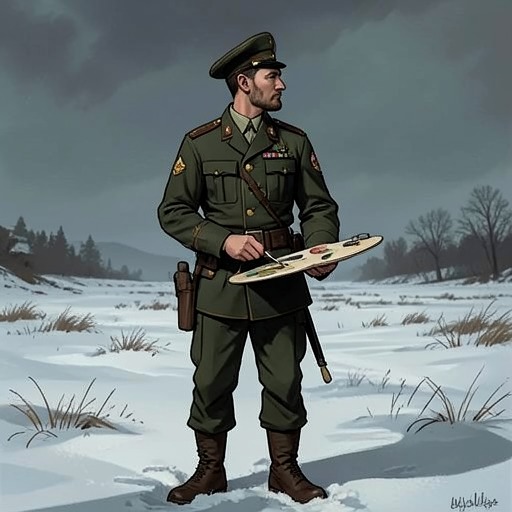
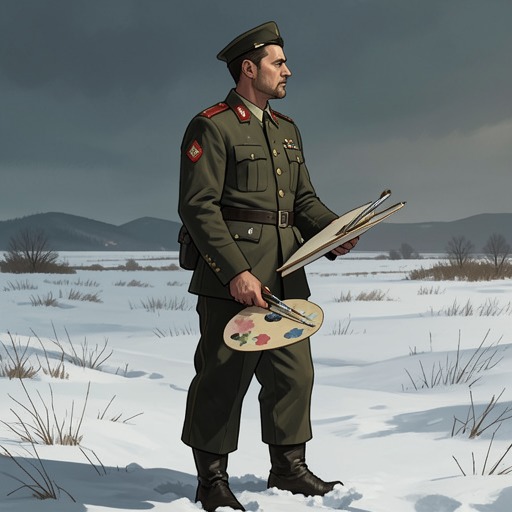
Near the end of the war, Rabo and his platoon were ordered into combat to help contain the last major German breakthrough. He says he was wounded and captured without firing a shot. In his recollection, the scene resolves into a white German tank and soldiers dressed in white crossing a snow-covered meadow in Luxembourg. He does not remember being hit. Unconscious when captured, he was kept under morphine until he woke in a German military hospital in a church across the border, in Germany. The injury cost him his left eye, but he describes its immediate physical course as comparatively painless and says it healed quickly. He was then sent to a prisoner-of-war camp as an unremarkable prisoner.
Rabo’s account resists making the injury a simple measure of suffering. When Circe Berman points out that he had told her there was little pain and that the wound healed quickly, he nevertheless insists that he is entitled to Survivor’s Syndrome, as his father was. The exchange distinguishes the visible fact of his lost eye from the private aftermath he claims for himself. The injury also marks a decisive change in his identity: he begins the autobiography as an “erstwhile American painter” and a one-eyed man, with the military past embedded in how he presents himself.
The war ended in Europe on May 8, 1945, but Rabo’s camp had not yet been captured by the Russians. He and hundreds of captured officers from many Allied and former Allied countries were marched out into the countryside. Their guards disappeared during the night. The next morning, they found themselves above a green valley near the border between what is now East Germany and Czechoslovakia. Rabo estimates that as many as ten thousand people were gathered below: concentration-camp survivors, forced laborers, people released from asylums and prisons, and captured soldiers from armies that had fought Germany. The last remnants of Hitler’s armies were there too, their uniforms in tatters but their weapons still working.
The scene becomes one of the war’s lasting images for him. In a later telling, he adds the ruins of an ancient stone watchtower near the place where the prisoners had been halted, and recalls that civilians who had fled the Russian, American, and British fronts were also among the people gathered in the valley. He describes the purpose of the dispersal as keeping this volatile population away from cities, where it might cause disorder. The episode is not a clean transition from captivity to freedom: it is a moment of release into a landscape crowded with people whose wartime experiences and immediate prospects differ, but whose movement has been shaped by collapsing military and civilian systems.
Return and the difficulty of civilian life
At the end of the war, the United States paid for cosmetic surgery where Rabo’s eye had been. He recalls that public support as coming from “Uncle Sam,” and says he felt blank rather than bitter. He connects that blankness to Fred Jones, whom he had understood to be similarly emptied by wartime experience; neither man, he says, had anything to come home to. The operation addressed the physical aftermath, but it did not restore a civilian home or the wartime community that had given his life structure.
After the war, Rabo married the nurse who cared for him. They had two sons, Henri and Terry, who later stopped speaking to him and legally took the surname of their stepfather, Roy Steel. Rabo regards his failure as Dorothy’s husband and the estrangement of his sons as among the matters for which he is most ashamed. The account places his damaged family life alongside the wartime loss of his close-knit platoon without claiming that the war alone caused the later rupture.
His artistic life also changes course. After returning, he sold the belongings that had not gone into his barn, giving him a bankroll to invest; he studied accounting, economics, business law, and marketing at New York University and imagined becoming a businessman. He had concluded that cameras could reproduce the likenesses he had been trained to paint. Later, he became a friend and seeming peer of the American painters associated with the Abstract Expressionist school. The wartime platoon had been one large family; the postwar circle of painters became another, though the two forms of belonging belonged to different lives.
That contrast remains active in the present of the narrative. Rabo says that he endured loneliness as a boy, during several years in New York City in the Great Depression, and after Dorothy and their sons left in 1956. He then spent eight years as a hermit. His closest friend, Paul Slazinger, is also a wounded veteran of World War II. Rabo’s memory of the military family thus sits beside the difficulty of sustaining relationships after service: comradeship is vivid in recollection, while postwar companionship is narrow and marked by wounds.
War remembered and painted
Rabo’s locked potato barn eventually proves to contain a giant painting made from the war’s human aftermath. Before seeing it, Circe Berman finds a large, paint-marked book of wartime uniforms in the library and asks whether it relates to what is inside the barn. Rabo gives no definite answer at first, then acknowledges that it does. The book’s wear and the barn’s secrecy connect his private work to a long accumulation of looking, research, and withheld disclosure.
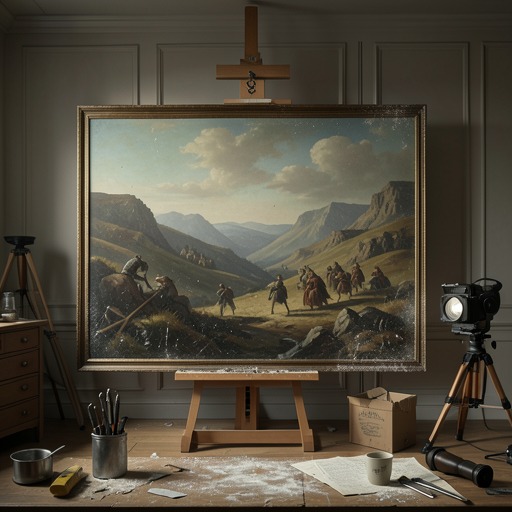
The painting, titled “Now It’s the Women’s Turn,” depicts a valley filled with wartime survivors and displaced people. On average, Rabo says, ten clearly drawn World War II survivors occupy each square foot. Even the distant figures, small as flyspecks, represent particular kinds of people: concentration-camp victims, forced laborers, prisoners of war, soldiers from German units, local farmers and their families, and people released from asylums. He says that every figure has a war story. He invented a story and then painted the person to whom it had happened, turning the work into a multitude of individual imagined histories rather than a single soldier’s account.
Rabo initially stayed in the barn to tell visitors those stories, but gave up because explaining them became exhausting. He now directs visitors to the painting and invites them to make up their own war stories as they look. With Circe, however, he is willing to recount the histories she asks to hear. The difference matters: the mural is at once a carefully constructed image and an open field of interpretation, in which looking may lead to stories the painter cannot or will not supply for every figure.
One small detail anchors the image to the historical date of the war’s end. Rabo tells Circe that, with a stepladder and magnifying glass, she could read “May 8, 1945” in tiny characters on an ammunition box. The date places the painting’s crowded valley at the moment when the European war ended, but its countless figures keep the scene from becoming a simple emblem of victory. It records people still gathered amid the consequences of war: prisoners, survivors, civilians, and soldiers whose next destination is not resolved by the date itself.
Narrative and historical significance
World War II appears in Rabo’s story both as remembered experience and as the historical frame for a larger act of witness. His account moves between a specific capture in Luxembourg, the multinational crowd at the war’s end, and the later painting that makes each small figure the bearer of a story. The mural enlarges his recollection beyond what any one soldier could have seen or known, while its invented individual histories acknowledge that the painting is an artistic construction rather than a literal record of every life.
The war also clarifies the distance between military and civilian forms of belonging. Rabo’s refusal of promotion preserves his place among the thirty-six artists in his platoon; after capture, he emerges into a valley of thousands whose shared displacement does not amount to a settled community. In civilian life, he remembers loneliness and estrangement even as he finds fellow veterans and later artistic companions. The novel therefore treats the end of fighting not as an uncomplicated end to war’s effects, but as a boundary after which injury, memory, family relations, and artistic work continue to bear its imprint.
Rabo’s own account is shaped by a tension between modesty and insistence. He emphasizes that his wound healed quickly and that he did not fire a shot, yet claims the right to the psychological standing of a survivor. He also remembers the platoon’s camouflage as a rare, definite success, noting that it received a Presidential Unit Citation and that some of the things hidden from the enemy were never found again. War has made his artistic skill useful in deception, then left him to transform the work of seeing into a painting crowded with figures who cannot be reduced to one soldier’s memory.