Hanno Buddenbrook’s frailty and school anxiety
BuddenbrooksHanno Buddenbrook’s frailty and school anxiety arise from the sharp divide between the life his body and imagination can sustain and the life demanded of him as a student and heir. The sea, music, and the care of adults who understand his sensitivity offer him moments of refuge, but they do not make the ordinary pressures disappear: schoolwork accumulates, fear turns routine lessons into ordeals, and even a passing reprieve leaves him anticipating the next demand.
Vulnerability and the demands of school
The four-week holiday at the seaside is meant to make Hanno stronger, fresher, and more energetic. It has the opposite effect. Though his face and hands are browned by the sea air, he returns softer, more dreamy, and more sensitive, and he knows he has become less able to summon courage in the face of Herr Tietge’s ratios. He imagines himself losing heart over historical dates and grammatical rules, throwing his books aside, and falling asleep to escape the coming classes, disasters, bullies, and his father’s expectations. The holiday’s failure is not a matter of physical appearance alone: the child can see the mismatch between what the adults hoped the shore would do and what his experience has actually been.
A small consolation on the journey home is the thought of seeing Kai again, of music lessons with Herr Pfühl, and of returning to his grand piano and harmonium. Hanno even wants a little beach sand left in his high-buttoned shoes, so that he can keep something of the shore with him. He expects to face the men in their worsted suits and the Hagenström boys again, but the remembered sound of waves reaching the rampart at evening promises a private refuge from life’s hardships. The sea does not cure his fear of school; its remembered sound gives him something to hold against it.
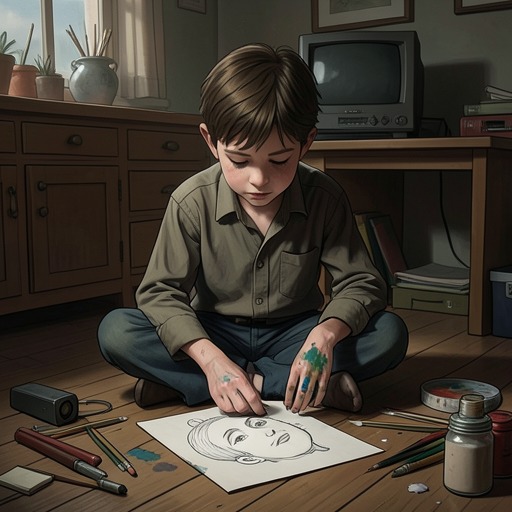
The return to everyday routine exposes how little that refuge can alter the school’s demands. After an evening at the opera, Hanno has allowed himself to dream at the piano and postpone his homework until Monday morning. The performance gives him intense joy, but when it ends he is back in his room, feverish and conscious that only a few hours of sleep separate him from the ordinary world. Beauty leaves him not simply comforted but painfully exposed to the distance between rapture and daily life. He feels a burden that seems older and larger than one night’s private sadness, then sleeps as though he does not want to wake. By six o’clock, he has done none of the work he meant to do.
Anxiety as a physical ordeal
On Monday morning, Hanno tries to evade the accumulated work by persuading himself that he may not be called on in Latin or chemistry. He considers the recent order of names in Ovid and imagines that exceptions might save him. These possibilities are fragile, but entertaining them lets him postpone confronting what he fears. He falls asleep again instead of getting up to study.
The delay becomes bodily distress. At breakfast, he stands to drink cocoa with his hat still on and his satchel under one arm, leaves half the cup, refuses the egg, and rushes out with a painful molar. Ten minutes before eight, he hurries through the wintry fog, counting down the minutes to school. He is at once sweating and frozen, sick to his stomach, breathless, and troubled by a stitch in his side. The race toward the Burg Gate makes school lateness a physical emergency rather than a minor breach of punctuality. When the church bells sound, Hanno hears St. Mary’s playing a hymn badly out of tune; even the music that might ordinarily draw his attention is registered through the pressure of his immediate fear.
At school, the fear is not merely of receiving a poor mark. Beside a courtyard wall, shivering and yawning, Hanno tells Kai that the prospect of Ovid is making his whole body hurt. He says he is not afraid of failing itself, but of the fuss surrounding failure. That distinction clarifies the particular force of his anxiety: the ordeal includes being called on, judged, and made an object of attention, not only the academic result.
When the lesson turns against another boy, Hanno’s sensitivity makes the classroom’s punitive atmosphere difficult to bear. Dr. Mantelsack humiliates the myopic Mumme after he falters in recitation, and the professor’s mark beside the boy’s name makes the judgment visible in his notebook. Hanno feels rebellion and nausea, while also realizing with dreadful clarity that the teacher is returning to the regular order and may call on him next. His own name is called, and he remains seated, caught in a moment that feels unreal.
Music, instruction, and a different kind of discipline
Music offers Hanno a demanding practice that meets his attention differently from school. Gerda Buddenbrook asks Edmund Pfühl, organist of St. Mary’s, to teach her son, explaining that she wants more than conventional piano lessons: she wants someone to help him understand music. Pfühl agrees, and his Monday-afternoon lessons begin after the elementary exercises. Instead of treating scales and technical dexterity as the main purpose, he introduces music theory and demonstrates harmony in a way Hanno can follow. The boy understands the lessons as confirmation of something he has long felt he knew.
Pfühl takes care not to make instruction an obstacle to Hanno’s eager imagination. He aims to give his pupil an intuitive grasp of keys and their relationships, so that combinations can suggest themselves quickly and the keyboard can encourage fantasy and improvisation. He avoids burdening the boy with banal songs and instead gives him chorales, drawing attention to how one chord leads logically to the next. The care in this teaching matters: it does not deny the need for learning but shapes learning around the child’s musical seriousness rather than forcing that seriousness into a routine he cannot inhabit.
The lesson also belongs to a larger musical exchange in the household. Pfühl, at first outraged by Wagner’s music, gradually becomes more receptive after Gerda argues that unfamiliar harmony can unsettle trained ears just as Bach once unsettled his contemporaries. He never fully reconciles himself to Tristan, though he eventually adapts the Liebestod for violin and piano; his resistance also gives way, more readily, to an attachment to Meistersinger. Hanno watches the adults negotiating between old musical authority and new forms, while Pfühl’s changing response demonstrates that difficulty need not mean incomprehensibility. This is a music culture in which Hanno’s own unusual sensitivity can be taken seriously.
Improvisation and the shape of feeling
Hanno’s musical understanding is most visible when it becomes his own composition. At his birthday gathering, he plays a brief melodic fantasia before the assembled family and guests. Pale with excitement, he has barely eaten; seated at the piano in his sailor suit, he appears to withdraw from the room into the piece. Its means are rudimentary, but its emotional handling is remarkably assured. The music is more harmonic than rhythmic, and Hanno gives each modulation weight with a tilt of his head and a shift toward the edge of his chair, using the pedal to intensify each new chord.
He makes simple harmonic turns seem mysterious by delaying or heavily accenting them, and by giving a new chord or attack a faintly echoing tone colour. The ending is especially important to him. With Gerda’s violin moving around him, he holds an E-minor tremolo pianissimo, gradually enlarges it, and drives a C-sharp dissonance toward fortissimo without resolving it at once. He prolongs the tension, withholding the return to B major because he wants the eventual release to remain precious. The passage makes his sensitivity tangible as a way of shaping musical time: desire is stretched out, fulfilment deferred, and the brief happiness of resolution felt all the more strongly when it arrives.
In a later improvisation, a bare theme of a bar and a half grows into a much wider emotional movement. First sounded in the bass with unexpected force, it reappears in the treble with a fragile, frosted-silver colour, revealing a painful descent from one key to another. Restless runs, syncopations, and cries of fear gradually gather into a woodwind-like melody and then a chorale that ends in a churchly cadence. After a pause, the first theme returns; the music moves from that recurring fragment into rebellion and a stormy, defiant hunting-song character. Hanno does not seem to master the succession of episodes so much as allow it to take shape under his hands. The performance gives musical form to a feeling that ordinary schoolroom language cannot accommodate, without suggesting that music has removed his vulnerability.
The classroom’s judgment and Hanno’s place
Hanno’s distress is sharpened by a school culture that makes performance public and judgment punitive. After Mumme’s humiliation, Mantelsack calls Hanno to recite. Hanno struggles through the verses, and the teacher rebukes him in extravagant terms, contrasting his recitation unfavourably with another pupil’s and questioning how someone said to be musical could handle verse so badly. Yet Mantelsack acknowledges that Hanno has studied and gives him a satisfactory mark rather than failing him.
The mark does not simply resolve the ordeal. Hanno is moved by the praise implied in the teacher’s words and briefly sees himself as an untalented but hardworking pupil who has survived with some honour. He senses that his classmates share that view. Nausea stirs again, but exhaustion leaves him unable to think it through; he closes his eyes and sinks into lethargy. The episode exposes the instability of his position: the teacher’s recognition can provide momentary relief, but it also misreads the difference between Hanno’s musical gifts and his difficulty performing under schoolroom pressure.
Together, the return from the shore, the dread of recitation, and the music-making show that Hanno’s frailty is not reducible to a single physical weakness or a simple refusal to work. It shapes the way he experiences time, scrutiny, learning, and expectation. His distress is heightened by demands that treat every child as capable of the same pace and manner of performance; in music, by contrast, patient instruction allows his attention to become knowledge and form. The same sensitivity that makes school feel overwhelming enables him to hear relationships among chords and to make a delayed resolution carry profound emotional force. Neither refuge abolishes the pressures around him, but each reveals what those pressures leave no room to recognize.