Hugo Weinschenk’s prosecution and imprisonment
BuddenbrooksHugo Weinschenk’s prosecution and imprisonment place a legal case at the center of the Buddenbrook family’s private life, making the prospect of conviction a question of reputation, loyalty, and commercial respectability as well as criminal judgment. During the Christmas gathering, his trial is in recess, but its presence governs the room: Weinschenk recounts the proceedings, the family listens uneasily, and Tony later asks Thomas to advance 25,000 marks courant for bail. A week after that appeal, Weinschenk is sentenced to three and a half years and arrested on the spot. The legal outcome closes the immediate suspense, but the costs continue through his disappearance, the sale of possessions, and the town’s changing account of him.
Background and Stakes
Weinschenk is Erika Weinschenk’s husband and an insurance director. At the family’s Christmas gathering, his greying temples and small moustache stand out beside Erika’s youth; she is visibly preoccupied with the legal process, including the conventions, accounting, witnesses, prosecutors, defense lawyers, and judges. The indictment has made him a man accused of an offense against law, civil order, and commercial rectitude, with shame and imprisonment possible outcomes. His presence changes the character of the family celebration: a case normally conducted in court has entered the household, while the family’s concern for its standing is inseparable from its concern for Erika.
The case also unfolds against a longer history in which the Buddenbrooks’ fortunes and respectability depend on business credit. When Bendix Grünlich’s finances collapse, Herr Kesselmeyer presses him to recognize that the standing of a well-known firm affects his own credit, and that the firm’s troubles can alter how others treat him. That earlier episode establishes the wider social logic surrounding Weinschenk’s case: commercial reputation is not confined to a balance sheet but can become a public judgment on the people associated with a business. The evidence does not identify the details of Weinschenk’s alleged offense, but it makes clear that his indictment threatens both his own standing and the family’s sense of security.
The Trial Enters the Household
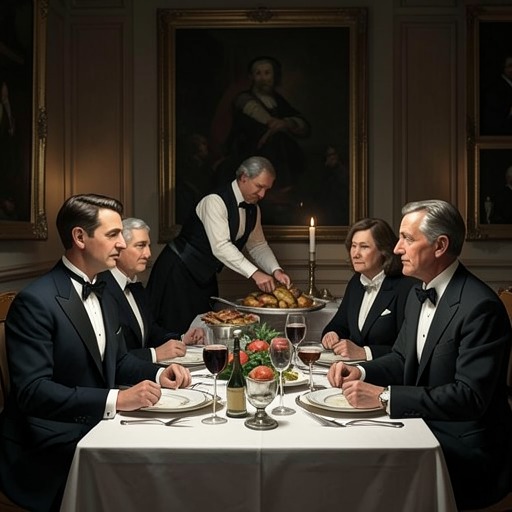
On Christmas Eve, the family’s conversation eventually turns to the one subject everyone has avoided out of respect for the holiday: Weinschenk’s trial. He gives an account of the proceedings with an air of almost wild cheerfulness. The trial is in recess for the holidays, and he describes witness testimony, attacks what he regards as the presiding judge Dr. Philander’s bias, and criticizes the prosecutor Dr. Hagenström’s mocking manner toward him and his defense witnesses. He says that the Berlin lawyer Breslauer has weakened incriminating evidence and assured him that conviction is not yet a reason for despair.
The account does not reassure the room. Thomas asks polite questions; Tony, sitting tensely, curses Moritz Hagenström under her breath; the others remain silent. Weinschenk gradually falls quiet as the lack of response settles around him. In the adjoining room, Hanno finds the Christmas decorations and crèche figures absorbing, while the adults’ room is held in anxious stillness. The contrast separates a child’s private absorption from the family’s collective apprehension, without removing the trial from the holiday scene.
Tony’s Appeal and the Verdict
When the proceedings reach a decisive point, Tony takes Thomas into his private office and asks him for a temporary advance to secure Weinschenk’s bail. The prosecutor, she explains, has demanded either arrest or bail of 25,000 marks courant; Weinschenk gives his word of honor that he will not leave town. Tony says that the family cannot raise the money and promises that Thomas will be repaid, though she fears the payment will soon prove necessary for other reasons. Thomas’s response—recognizing that the case has reached this stage—confirms that the danger is no longer speculative.
Tony’s appeal joins family loyalty to the practical limits of money. She is asking her brother to risk a substantial sum for a man whose case threatens to bring disgrace and imprisonment. Her distress also reaches beyond Weinschenk: she fears that her daughter Erika will be forced through another failed marriage, recalling Tony’s own unhappy marriages to Bendix Grünlich and Alois Permaneder. She describes her lifelong efforts to bring honor to the family as having ended in misfortune. The request for bail thus carries both an immediate purpose and a wider fear that the family’s repeated attempts to secure respectability through marriage have again produced crisis.
One week later, Weinschenk is sentenced to three and a half years in prison and arrested immediately. The decision is definite, regardless of the confidence his account of the proceedings had tried to project. The courtroom has been packed for the lawyers’ final statements. Breslauer’s defense speech impresses listeners with its irony, pathos, and emotion; Christian later reproduces it verbatim at the Club, arranging newspapers in front of himself as though they were legal documents. Even Dr. Hagenström privately acknowledges the pleasure of listening to Breslauer, but the local lawyers make clear that eloquence has not persuaded them to accept the defense. The episode distinguishes the force of courtroom performance from its power to change the verdict.
Aftermath and Social Memory
After Weinschenk disappears, everything that must be sold is sold, and the town gradually forgets him. The sequence makes the aftermath more than a matter of imprisonment: absence and the disposal of property close off the visible traces of his place in the family’s life. Yet his case remains part of the family’s recurring Thursday conversations. The Ladies Buddenbrook from Breite Strasse then claim that they recognized from the beginning that something was wrong with him and that he would come to a bad end. They explain that consideration for others had kept them from saying so at the time.
Their retrospective certainty sits uneasily beside the earlier uncertainty of the trial and the family’s silence at Christmas. What had been an unsettled legal proceeding becomes, in later conversation, a story of supposedly obvious character flaws. The transformation exposes how social judgment can rewrite uncertainty after an outcome is known: the verdict settles the case, while the family’s acquaintances turn that settlement into confirmation of what they say they always knew.
Significance
The prosecution’s narrative weight comes from the way legal and social judgment overlap. The trial is formally about an accused insurance director, but its effects spread through Erika’s anxious attention to legal procedure, Tony’s plea for money, Thomas’s role as a potential source of bail, Christian’s fascination with the defense speech, and the family’s exposure to public shame. The case also contrasts two kinds of authority: the defense lawyer’s rhetorical command of a packed courtroom and the court’s power to impose a sentence that rhetoric cannot avert.
Imprisonment gives the crisis a concrete conclusion, but not a restorative one. Weinschenk is arrested, disappears from the town’s ordinary life, and leaves possessions to be sold; the Buddenbrooks are left to manage both material consequences and the social story told about him. The repeated movement from accusation, to family anxiety, to verdict, to gossip shows how commercial respectability is sustained not only by business and legal institutions but by collective acts of observation and judgment.