Hanno Buddenbrook’s night terrors
BuddenbrooksHanno Buddenbrook’s night terrors are recurring attacks of fear that make his vulnerability visible and turn sleep into a realm of distress beyond his conscious recollection. Called pavor nocturnus by his caregivers, the condition persists across the narrative: Hanno wakes in apparent terror, yet in the morning remembers nothing, while attempts to relieve his physical suffering fail to end the episodes.
The Episode in Bed
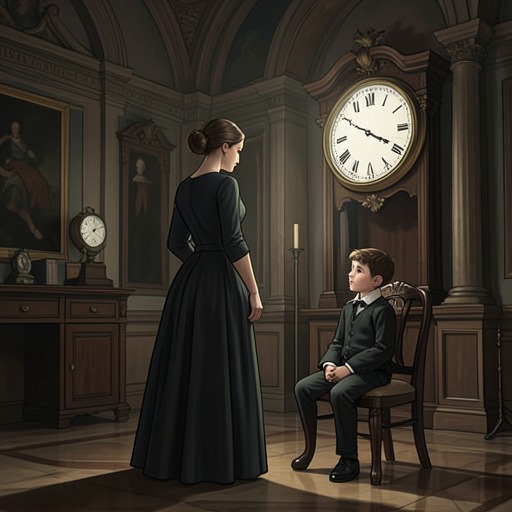
One attack begins while Hanno is in bed and Ida Jungmann is talking with his aunt, Tony Buddenbrook. Ida breaks off mid-gesture when a cry comes from the bed. The cry is repeated, each time more anguished, until it becomes a desperate protest against something horrifying that Hanno seems either to be witnessing or enduring. He rises in bed, stammering unintelligibly, his golden-brown eyes wide open but fixed not on the real room around him; the narration describes him as staring into a different world within himself.
Ida names the episode pavor nocturnus and responds with practiced calm. She sets down her darning, crosses to Hanno, lays him back beneath his blanket, and speaks to him in a deep, soothing voice. Tony recognizes the name and asks whether he will wake. He shows no sign of waking, although his eyes remain open and his lips continue to move. The adults lean closer to make sense of his troubled muttering. Hanno speaks of going to his garden to sow onions and sweet peas, an ordinary fragment of language that sits uneasily beside the fear in his cries. The episode is therefore presented through a stark contrast: his body appears awake to the people around him, but his words and gaze belong to an experience they cannot enter.
Recurrence and Failed Treatment
The night terrors are not an isolated incident. Dr. Grabow had already diagnosed the disorder, and later it continues and grows worse amid Hanno’s other bodily troubles. There is hardly a night when he does not start up once or twice, wringing his hands, calling for help, or pleading for mercy. His panic is described in extreme terms: he behaves as if he were being burned alive or strangled, as if something ghastly beyond description were happening to him. Yet this apparent intensity leaves no accessible account the next day. In the morning, he remembers none of it.
Dr. Grabow tries a glass of blueberry juice before bed, but it does not help. The detail gives the condition a domestic, practical setting: the household has a name for the disorder and attempts a remedy, but neither naming nor treatment brings relief. The episodes continue as part of a wider pattern of illness rather than being resolved by a single intervention.
Bodily Suffering and Childhood
Hanno’s night terrors occur alongside the pain and exhaustion of a frail body. After four healthy molars are removed over several weeks to make room for the wisdom teeth, the visits become a prolonged ordeal; after the last extraction, he is ill in bed for a week from exhaustion. Difficulty chewing brings constant digestive problems, including attacks of gastric fever. Stomach pain contributes to dizzy spells, and his heart sometimes beats too hard or too weakly while his pulse becomes irregular. As these problems accumulate, the older disorder worsens rather than receding.
The narrative connects this persistent physical distress with Hanno’s precocious seriousness. His suffering makes him seem wise beyond his years, though the text also describes an occasional melancholy condescension that surfaces beneath his good taste and talent. When a relative asks how he feels, Hanno answers with a resigned smile and a shrug, dressed in a blue sailor suit. That outwardly composed gesture contrasts with the helpless panic of the night episodes: by day, pain is met with quiet resignation; at night, it returns as cries for help and mercy.
Significance
The episodes are defined by a split between visible response and inaccessible experience. Hanno’s open eyes and moving lips might suggest awareness, but he neither wakes in any ordinary sense nor retains the episode in memory. Ida can steady his body, and Tony can witness the scene, but neither can explain what he is seeing or make the fear communicable. The brief phrase about the garden does not resolve the mystery; its commonplace image only sharpens the gap between the muttering child and the terror expressed by his cries.
The night terrors also recur within the larger account of Hanno’s bodily vulnerability. Dental pain, digestive illness, fever, dizziness, irregular pulse, and nocturnal panic converge without yielding a cure. Rather than treating the attacks as a single dramatic shock, the narrative makes repetition itself significant: night after night, fear returns, while morning erases Hanno’s knowledge of it. This pattern gives his childhood a bleak double rhythm—suffering that is vivid to those who witness it and inaccessible to the child who undergoes it, then repeated without a remembered explanation.